
A Rocky Timeline
Police had good reason to find Terri Morris after she reported an assault by an officer. Detective Rocky Gregory documented the search. But does the paperwork reflect diligence… or deception? His report, dated June 6, 2014, refers to a visit he actually made on July 10. And that’s just one of many chronological incongruities.
Gregory’s log of his search.
Morris told patrol officers on May 24, 2014, that a police officer had assaulted her. Detective Rocky Gregory was assigned the case on May 27. His supplemental report 004, “Attempt to Locate Terri Lynn Morris,” chronicles his search. He logged calls that morning to her listed number, a friend, her grandmother, two shelters, the Salvation Army, the Jesus House and the Day Shelter; a call to a housing complex and a check with the housing authority the next day; and, on May 30 and June 3, two trips with Lt. Timothy Muzny, the head of the Sex Crimes unit, to look for her in person. He put a date and a time on most entries. OCPD Supp. Rpt. 14-041539 (004), Scott Adams 01126–30.
The context matters. On the night Morris made her report, Lt. Michelle Holland called the on-call Sex Crimes supervisor, Lt. Ramos, who said investigators would not be responding. Scott Adams 01125. Three days later Major Denise Wenzel wrote to the deputy chief that Morris “is a crackhead who was trading sex for a rock when they encountered her over the weekend,” adding, “We’re trying to find her to do an interview.” Wenzel to Kuhlman, May 27, 2014, OKC 36361 (Wenzel dep. Ex. 8). The word was not hers alone. Wenzel later testified that Ramos had told her Morris was a “crack head,” and that this was why he had not sent anyone. She passed that along to the deputy chief. Then she and Bacy sat Ramos down and counseled him for it. Wenzel Dep. 137:3–139:22 (Apr. 29, 2019). The captain over Sex Crimes, Ron Bacy, learned of the call the next morning and, by his account, told Ramos that for anything officer-involved “not only do we send detectives but we notify the chain of command.” Bacy Dep. 48:5–49:25 (Mar. 27, 2019). The department did not believe her. But according to Det. Gregory, within the week he, his lieutenant, the vice unit, the gang unit and criminal intelligence were all out looking for her.
At trial, Gregory told the jury he “tried every which way” to contact her, that he “checked missions, family members, phone numbers, everything the police had involved,” and that he brought in the gang, vice and criminal intelligence units. He called it “the persistence of me trying to find her.” Trial Tr. 3204:23–3205:14. The jury did not see the report, or the times he wrote in it.
Gregory logs five stops in twenty-eight minutes.
| Time | Stop | What the report says happened there |
|---|---|---|
| 1345 | Liberty Square, 709 NE 24th | A “walkthrough” of the complex. Spoke with Greg in maintenance, who did not know her. A resident said he hadn’t seen her but knew her nickname. Went to a Mrs. Shirley in Apt. B, who said she didn’t know her. |
| 1352 | The Han-D-Sak, NE 27th and Kelley | They did not know her. The last DOC photo was shown. |
| 1356 | Heritage Point, 2501 N. Kelley | No one knew her. Wanda Jones at the front office did not know her. |
| 1400 | The Valero, NE 23rd and Kelley | Where the original report was taken. They did not know her. |
| 1413 | Sooner Haven | Showed the front office the picture. They were not aware of her at all. |
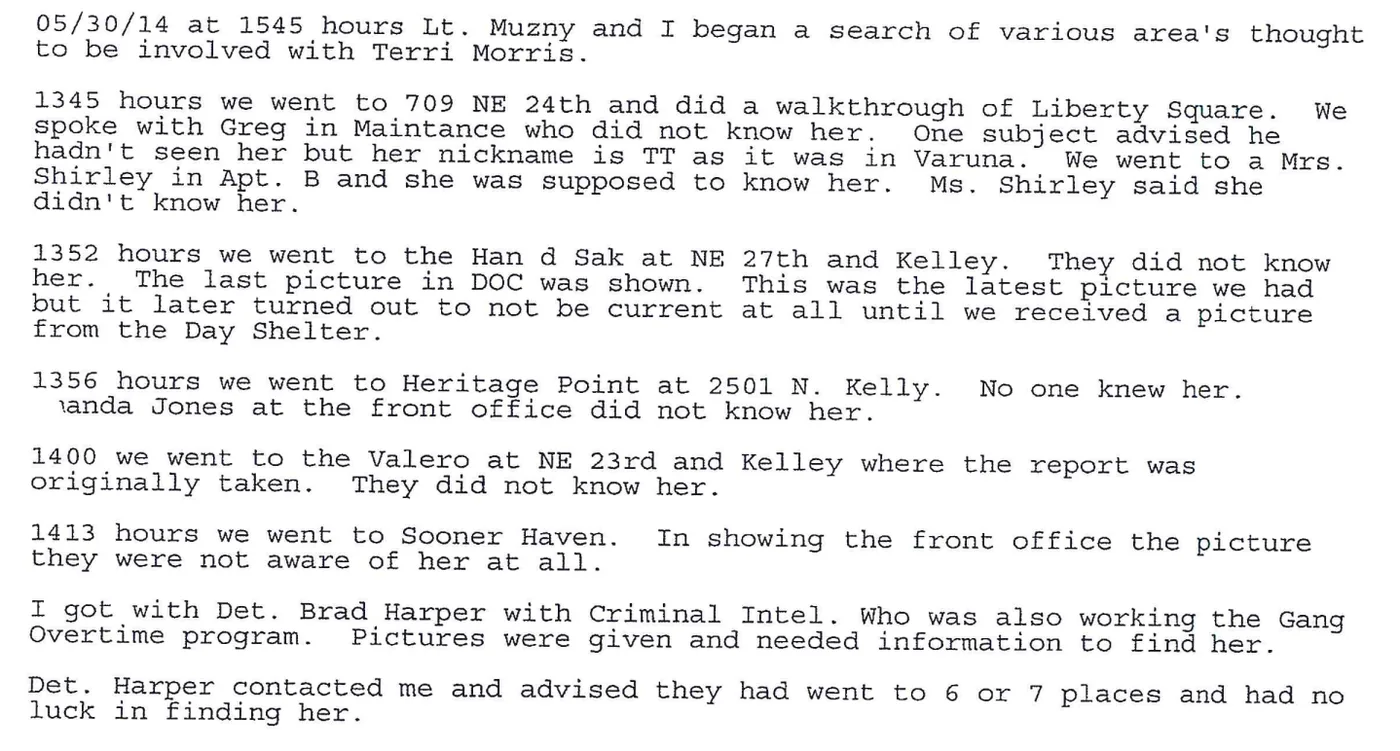
Gregory’s entry has a plain error. He wrote that he and Muzny “began a search of various area’s” at 1545 hours, then timed the five stops beneath it from 1345 to 1413. He never says which time is wrong.
His other times are compressed. At 1345 he has himself and Muzny walking through an apartment complex, talking with a maintenance worker and a resident, and knocking at a second resident’s door. Seven minutes later he has them at the next stop. Four of his five stops fall within fifteen minutes. The intervals are short for what he says they did at each one.
In the same entry Gregory writes that Det. Brad Harper of Criminal Intelligence had people on gang overtime looking too, and that they “had went to 6 or 7 places and had no luck.” He names none of the places and gives no times. Scott Adams 01128.
Four days later, six stops in fifty minutes.
| Time | Stop | What the report says happened there |
|---|---|---|
| 0945 | Love Link Ministries, 1122 Linwood | Spoke with David Clergen, who helps run the thrift store and homeless ministry. He knew of her but had not seen her recently. |
| not timed | OKC Restoration Ministry, 1501 Linwood | Shown a picture; did not know her. |
| not timed | Detox | Showed the picture to Shailmila White and other employees. Records checked back to May 6: she had not been there. |
| 1000 | The Jesus House | Spoke with head manager Melissa Johnson. She looked through program and attendance records, then through every application since January 2014. Nothing. |
| not timed | Meeting with Det. Harper’s informant, Cal | Shown a picture. Said he had a good idea where to find her. |
| 1035 | The Day Shelter | Front-office staff knew her. They said the photo was out of date, pulled up their own, checked their records, and gave directions to a pastor’s house where she had been seen. |
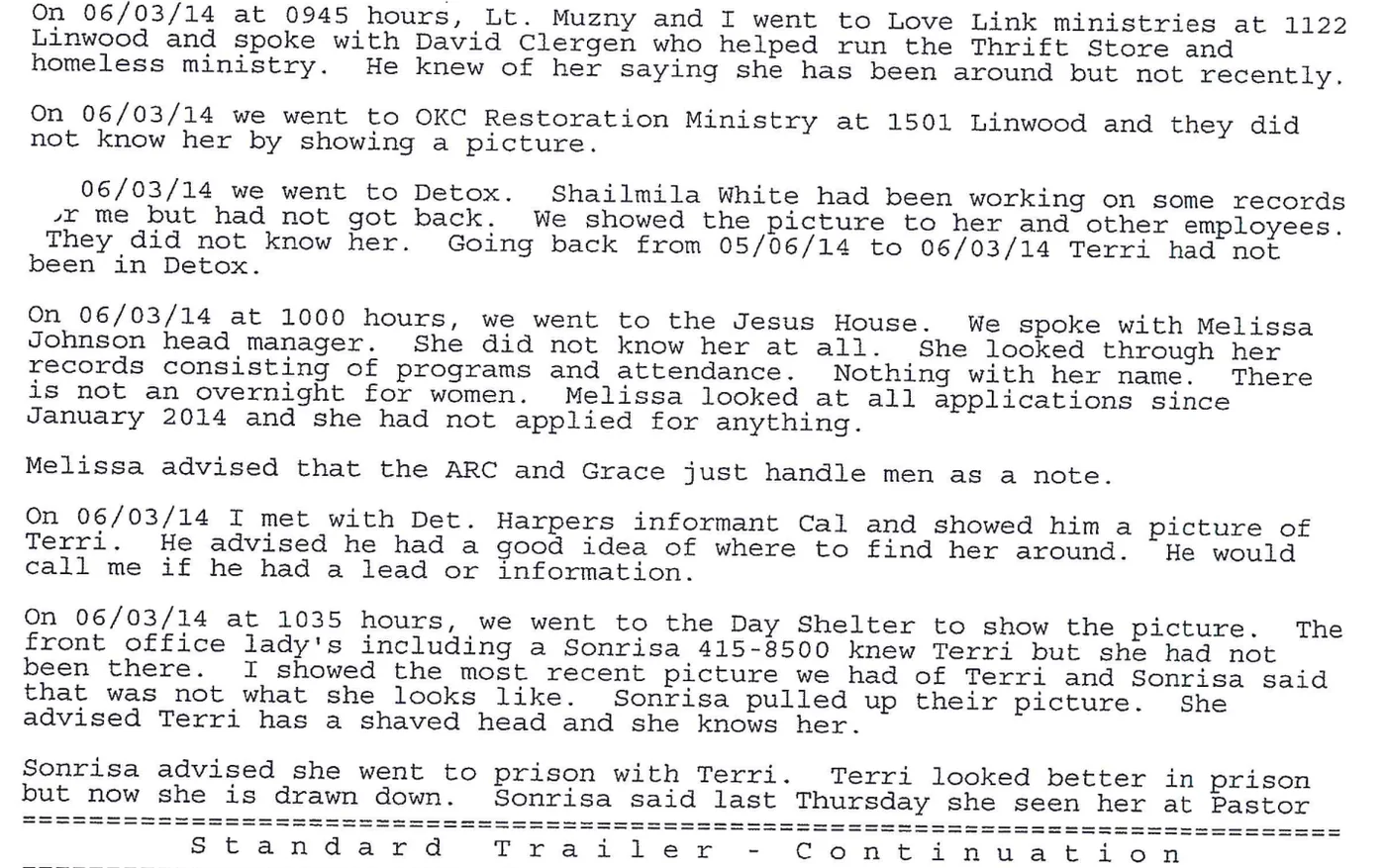
Gregory times the first stop at 0945, Love Link, and the next at 1000, the Jesus House. Between them he places two visits, one of them with a records check back to May 6. His next time is 1035, the Day Shelter. In those thirty-five minutes, by his account, the Jesus House manager went through her program and attendance records and every application since January, and he met with the informant. The stops he left untimed are untimed everywhere.
Later that day the informant saw Morris near NE 26th and Kelley, made an anonymous call to police, and patrol officers took her into custody. Gregory got the call at the county jail, where he was on an unrelated arrest, and went to see her. Scott Adams 01130. What she told him is discussed here.
Gregory’s last line refers to a visit he made five weeks after the date he put on the report.
Gregory dated the search report June 6, 2014; Muzny approved it on July 24. Gregory’s last line reads: “See first, second, and third Detective Contacts with Terri under supplementals.” Scott Adams 01130. The third detective contact is report 018, the visit he and Muzny made to Morris in the county jail on July 10. OCPD Supp. Rpt. 14-041539 (018), Scott Adams 01163. He could not have written that line on June 6.


Muzny later explained how. The typed date is when a report is created in the department’s system, he said, not when its words are final; a report can be changed afterward, and the system “doesn’t show you every time that report was open and somebody made an entry.” Muzny Dep. 117:8–17 (Mar. 26, 2019). Gregory said the same from his side: he starts a report on one date, sets it aside, changes it later. “We’ll leave reports open until we’re able to go back, review them, finish them out.” Gregory Dep. 256:2–19 (Jan. 17, 2019).
Gregory’s report 002 shows how far that can go. He titled it “Charges Presented to the Oklahoma County District Attorney’s Office,” dated it June 5, 2014, and had it approved on August 26. What he wrote in it is from August: the District Attorney’s acceptance of a count against Daniel, five related complaints with August case numbers, and an evidence inventory that includes the June 18 Miranda waiver, Daniel’s pants, the car swabs, Morris’s July 10 buccal swabs and the audio of the “third contact.” OCPD Supp. Rpt. 14-041539 (002), Scott Adams 01118–19.
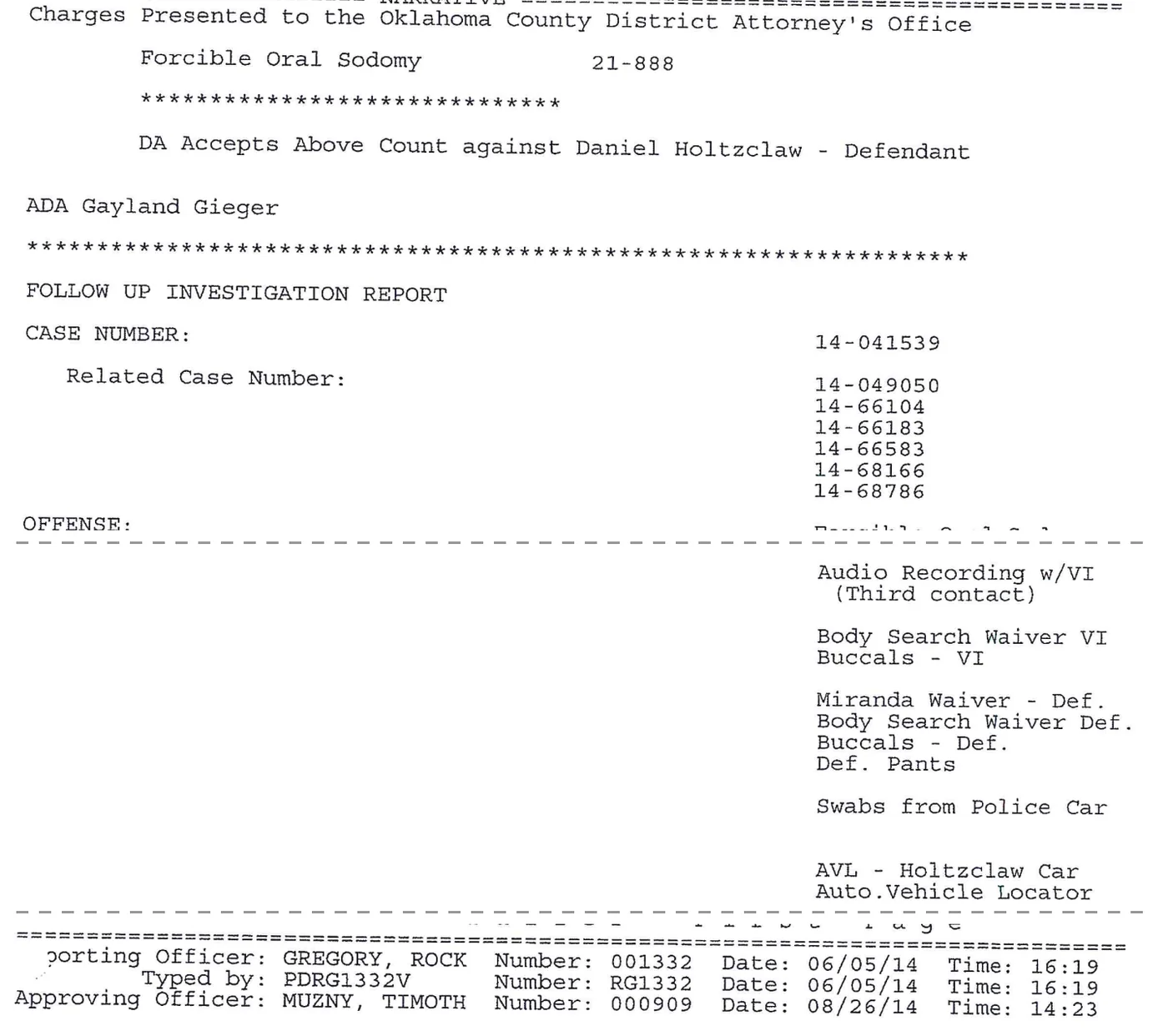
Reasons to doubt what Gregory wrote.
Three things about what Gregory wrote call for skepticism. His times are compressed past the point where they can describe what he says was done at each stop. He opens the May 30 search two hours after the first stop he records. And he cites a jail visit that took place five weeks after the date he put on the report, which means he finished it after Jannie Ligons came forward and after Daniel had become a suspect. Nothing in the department’s system shows what the report said on June 6, or whether it existed in this form at all.
This is one report out of well over a hundred in the case file. How the detectives wrote their reports, and what they left out of the ones that can be checked against recordings of the interviews, is discussed here.