
Terri Morris
Terri Morris's allegation eventually came to align with Daniel's records in date and location. Her description of him and his patrol car never did. That alignment came after repeated police contacts, a jailhouse meeting with a detective and his supervising lieutenant, a map, and a date police selected from Daniel's own data.
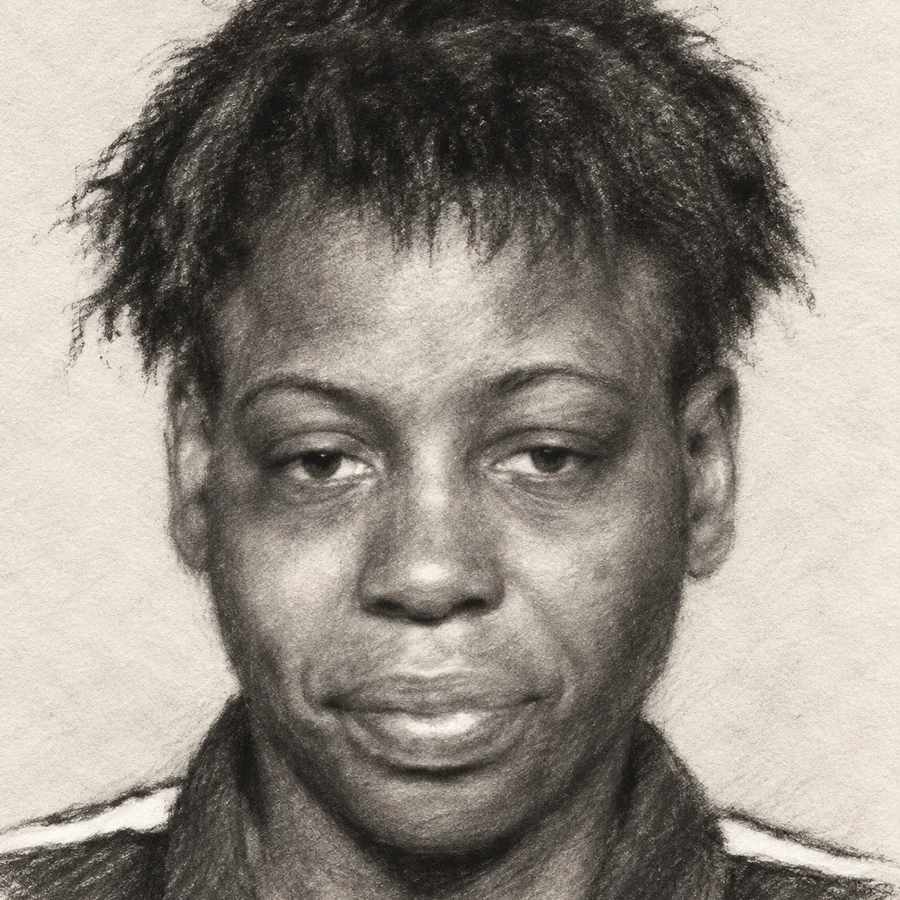
“The very first person to alert the police department.”
Terri Morris was crucial to the prosecution's timeline.
Detective Rocky Gregory told jurors that Morris was the very first person to alert the police department
about conduct involving Daniel Holtzclaw. Trial Tr. 3204.
Police affidavits told the same story:
That story made Morris the first warning: an allegation against Daniel on May 8, followed six weeks later by Jannie Ligons.
But nothing was reported on May 8. Police command did not identify Daniel as a suspect. They did not consider Morris credible. The case against Daniel began after Ligons came forward on June 18.
Only then did police go back to Morris.
What Morris said, and what police already had.
What Morris actually reported.
On May 24, 2014, Terri Morris reported that a police officer had sexually assaulted her several days earlier.
She placed the incident around May 20 or May 21, not May 8. She said she had been walking toward the City Rescue Mission downtown when an officer stopped her, and she could not identify the exact location where the encounter began or where she was later dropped off. Scott Adams 01116, 01124.
She did not identify Daniel Holtzclaw as the officer.
Morris described a dark-skinned White male with black hair, muscular and clean shaven, about forty years old. Gregory's later debrief of the responding officer added a height of around six feet. Scott Adams 01116, 01900.
Daniel was 27 and is pale-skinned.
In the women’s civil suits, plaintiffs’ lawyers read Morris’s description back to two of the commanders who had overseen the case, one item at a time. Maj. Denise Wenzel agreed that Daniel had dark hair, was muscular and was clean shaven, then stopped at complexion: I thought he was fair complected.
Asked, So you don’t agree that he is a darker skin?
she answered, I do not.
Deputy Chief Johnny Kuhlman, asked the same questions by a different lawyer, agreed with all of them: I can see him being described as dark-skinned, yes, sir.
Wenzel Dep. 33:2–18 (Apr. 29, 2019); Kuhlman Dep. 42:5–43:5 (Sept. 19, 2019).
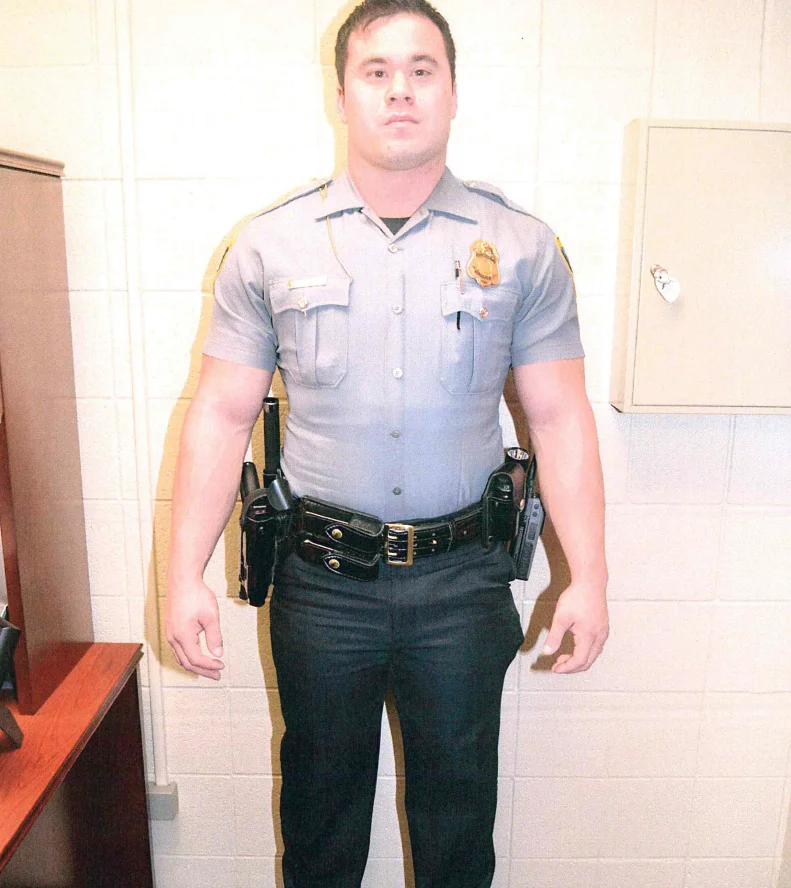
Morris also described the wrong kind of patrol car. She was sure it was black and white; Gregory's debrief compared it to a 2010 Crown Victoria with a thin light bar. Daniel's assigned take-home car was a solid-black 2013 Ford Police Interceptor. Scott Adams 00070, 00155, 01116, 01167, 01900.
Major Denise Wenzel later acknowledged under oath that the initial date, location and description did not match Daniel. Wenzel dep. 54.
The report arose during a disturbance involving Morris and a former boyfriend. The boyfriend told 911 she was intoxicated; responding officers described her as impaired, and Morris later testified that she had been high on crack cocaine at the time. Scott Adams 01116, 01125, 02027.
The department's contemporaneous reaction was blunt. On May 27, Wenzel described Morris in an internal email:
Lt. Michelle Holland had contacted the on-call Sex Crimes supervisor on May 24. Her report gives the answer: investigators would not be responding. Wenzel later testified that credibility concerns were the reason. Scott Adams 01125; Wenzel dep. 38, 138–39.
Morris remembered the reaction years later: Nobody believed me... none of them believed me at first.
Morris Dep. 40:17–18 (Dec. 13, 2018).
Three days after her report, Capt. Ron Bacy summarized what the department had for the officer running its computer searches: “She claims to have been approached by an officer on either May 20 or May 21st in the downtown area. We do not have a specific time of day. She can’t give a name, badge number, or a good description. She says she was placed in the back seat of his patrol vehicle and checked for warrants.” Bacy to Hill, May 27, 2014, OKC 29240. That was the lead the department then spent a week searching for her on, and the one it later matched to a May 8 stop by Daniel.
Police did not identify Daniel in the Morris case.
There was a basic reason Daniel was not a suspect: OCPD command did not treat Morris's account as a credible sexual-assault report in the first place. If investigators did not believe a sexual assault had occurred, there was no offender to identify, and no reason to suspect Daniel or any other OCPD officer. Scott Adams 01125; OKC 36361 / Wenzel dep. Ex. 8; Wenzel dep. 38, 138–39.
Two senior OCPD officials later said so under oath.
An internal September 2014 email is even more revealing. Lt. Timothy Muzny referred to Jannie Ligons, not Morris, as our first victim.
OKC 3721.
Morris was already detained and wanted to leave.
When Gregory finally located Morris on June 3, she was already in the back of Officer Kyle Maly's patrol car.
Gregory's own report says Maly had detained
her. Morris was banging her head on the cage and wanted to leave. She was the complainant, not a criminal suspect. Scott Adams 01141.
The report says an informant found her, called patrol, and patrol had her in custody
by the time Gregory arrived. It gives no other reason for the detention. Scott Adams 01141.
Gregory told her he wanted to speak about the sexual-assault allegation. She immediately said she did not want to cooperate and kept saying she wanted to let it go. Only after seeing her reluctance did Gregory offer her a Refusal to Prosecute form; when she agreed to sign it, he explained he had one downtown at his office, not with him, and asked to take her there so he could also speak with her a little more.
Scott Adams 01141.
At police headquarters, during the recorded encounter ↗, Morris repeatedly asked to be left alone:
Morris asked police to leave her alone at least nine times.
She signed a form declining prosecution. Her stated reason: Too scared just want to let it go moving in out of town at the end of month.
Scott Adams 01143.
View Morris's June 3 refusal-to-prosecute form →
Gregory later described what he did that day: I begged her to cooperate.
Scott Adams 01142.
The record shows no further contact with Morris until Jannie Ligons came forward on June 18.
Gregory returned after Ligons came forward.
On June 24, Gregory returned to Morris. She remembered having already gone through the story:
Gregory continued to press Morris for the location.
GREGORY: “And, now you're still saying a couple blocks from the Mission?”
MORRIS: “Yes.”
GREGORY: “I know I keep covering it, but you know there's a reason. Do you know which direction?”
MORRIS: “No, because I didn't even know my way around downtown, period.”
You know there’s a reason.
Scott Adams 01156. By June 24, Gregory had one. Records disclosed after trial show Maj. Denise Wenzel asked Sgt. Joseph Hill to check Daniel’s May 8 AVL on May 29. Gregory wasn’t copied on that request. Hill supplied the map and radio traffic on June 2, and Wenzel forwarded the complete package to Gregory, Muzny, and Capt. Ron Bacy that same day, with the note Here’s all of it together.
OKC 05087. A full week before the June 24 interview, Gregory had already written up what the package showed: a supplement he dated June 17 places Daniel at Liberty Station during the May 8 stop at which he ran Morris’s name. Scott Adams 01137–01138. When Gregory kept pressing Morris for a location and a direction, he already had that finding in hand.
At trial he told the jury the sequence ran in reverse: Morris supplied new information on July 10 about where the officer had driven her, he returned to his office, he pulled the AVL, and the two matched. Trial Tr. 3216. At trial, the State presented the match as independent corroboration. Prosecutor Gayland Gieger told jurors:
Gieger also told jurors that by design
detectives had waited to examine AVL records until after witnesses supplied their accounts. Trial Tr. 4301. In Morris’s case it ran the other way: Gregory had the AVL package more than five weeks before Morris supplied the location on July 10, and his own written analysis of it for more than three weeks. In his later deposition Gregory at first maintained the trial account. Confronted with the record, he said he could not use the data until later and did not remember studying it before then, testimony that conflicts with the supplement in his own name, dated June 17. Gregory Dep. 201:10–203:19, 241:25–246:7 (Jan. 17, 2019). Whatever he remembered in 2019, his June 17 write-up was already in the case file.
In the June 24 interview, Gregory asked Morris whether the officer had stopped her before up at Liberty Station.
She indicated that he had not. Scott Adams 01150. Sixteen days later, while Morris was in jail, Liberty Station became the revised location of the alleged assault.
Gregory also showed Morris two patrol cars: the newer all-black model and the older black-and-white. Morris was positive the car had been the older black-and-white model. Scott Adams 01150.
She left the encounter saying: Yeah, this is bullshit.
Scott Adams 01150.
The administering detective recorded no identification.
Gregory used a blind administrator. Detective Daniel Higginbottom had no involvement in the investigation; Gregory introduced him and stepped several yards away. Scott Adams 02004.
Higginbottom's report describes Morris moving between two photographs, saying she was confused, then saying no to all of them. He put the two photographs side by side and told her he would not pressure her. Asked whether she was positive about either man, she said she was not. Scott Adams 01145.
Gregory's supplement characterized the same encounter differently: Morris gave a tentative ID on Holtzclaw and
a second officer in the array, and said that officer's hair was dark like the man she remembered. Scott Adams 02004.
After seeing Daniel’s photograph, Morris’s description changed.
Morris's May 24 description contained no weight and no hair part. Scott Adams 01116, 01900.
On June 24, minutes after being shown Daniel's photograph, Gregory recorded a more specific description: a White male with olive skin, possibly some different race like Italian,
solid muscle,
6'00" to 6'02", 260 to 270 pounds, with dark hair parted on one side. Scott Adams 01150.
Daniel was 6'02" and approximately 260 pounds. Scott Adams 00072.
The height and weight changes moved sharply toward Daniel: a description with no weight at all acquired one within ten pounds of his, and the revised height is close to exact. The complexion change is murkier. Dark skin became olive skin and maybe some different race
, and Daniel is pale-skinned and half Japanese, not a clean match either way.
The hair part entered the interview through Gregory's question:
MORRIS: “It didn't look like none of his hair was out of place.”
GREGORY: “Did he have a part in his hair?”
MORRIS: “Yeah.”
GREGORY: “You're showing your left side. Is that right?”
MORRIS: “Well, I don't know which side, but he had a part.”
The third change moved away from him. The June 18 photographs taken at Springlake Station do not show a part in Daniel's hair. Scott Adams 00064, 00152. But Jannie Ligons had described a part six days earlier.
The shared hair-part detail cannot be treated as independent corroboration when Gregory introduced it to Morris after Ligons had already supplied it.
Why did Muzny ask for her file the day before she was arrested?
On July 2, Lt. Muzny emailed Gregory: Send me the report on Terry.
Internal OCPD email, July 2, 2014.
The record does not explain why the lieutenant wanted her file that day, and nothing in it establishes whether Muzny's request had anything to do with what happened next: Morris was arrested by VA Medical Center police, a separate agency, the next morning and booked into the county jail, and a week after that Muzny went to the jail himself, with the detective, to see an arrestee who had repeatedly said she wanted nothing to do with the case.
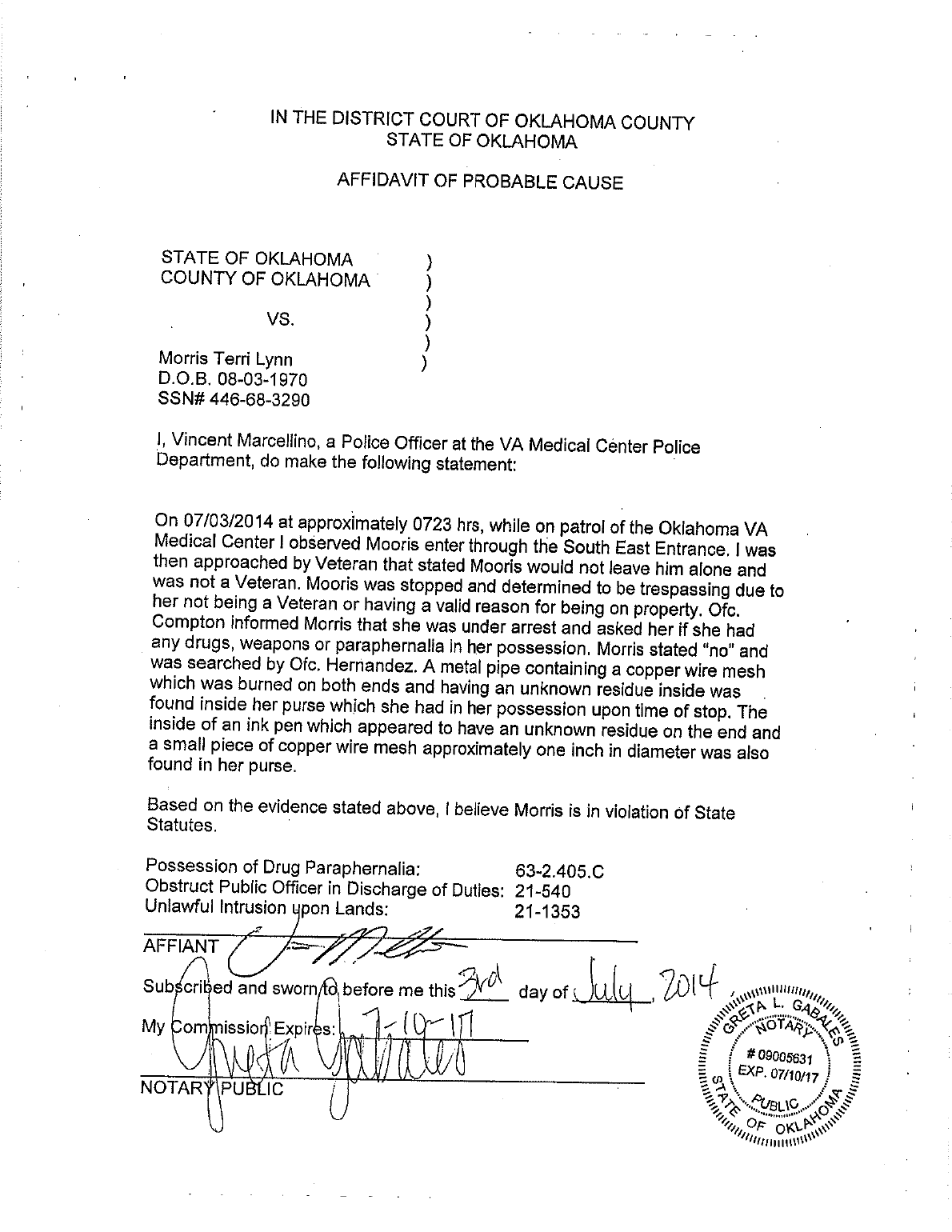
The arrest paperwork listed alleged offenses including possession of drug paraphernalia, obstructing a public officer, and unlawful intrusion upon lands.
Gregory and Muzny met with Morris in jail.
On July 10, Detective Rocky Gregory went to the Oklahoma County jail to see Terri Morris. He brought his supervising lieutenant, Timothy Muzny.
At trial, Gregory described the purpose as narrow. Investigators had unidentified female DNA from Daniel's uniform pants and wanted a reference sample.
Five years later, Muzny was asked why he had gone along.
Q: “Why did you go?”
A: “So I would have some first-hand knowledge on what was — on what she said, because I know and knew that I would get asked questions about it, what she said, and also just to have somebody else go with him.”
Muzny Dep. 211:19–212:6 (Mar. 26, 2019).
The two accounts do not fit together. If the trip was only to collect a swab, there was no account for Muzny to hear and nothing he would later be asked about. Muzny’s answer assumes an interview was expected; Gregory’s denies one was planned. Both could technically be true, with Gregory describing his stated purpose beforehand and Muzny explaining why he came along. What the recording establishes independent of either account: the visit became an interview, conducted with a map, in which Morris’s account moved to Liberty Station.
The location had already changed before the recorder was switched on. Gregory’s report presents it as spontaneous: Terri immediately told me once in the room that she gave me the wrong location to where her assault happened.
He wrote that she now placed the assault at Liberty Station and had given the wrong location earlier because she did not want her boyfriend to know she was using drugs again. The recording began afterward, when she restated it. Scott Adams 02018.
The explanation contradicts the May 24 record. The boyfriend was the one who called 911 that night and reported that she appeared intoxicated or on drugs. Scott Adams 02027, 01116, 01125. He already knew.
Gregory’s report gives a second reason for the change. Morris, he wrote, said she feels safe in the County Jail knowing the officer can’t get to her,
and since she has been clear headed she wants to proceed in going all the way with the investigation and criminal charges on the officer.
The same report records what she wanted while she was there: Terri said she doesn’t want to leave jail until she gets drug rehab and not ‘return to the east side’. I advised Terri whether she testifies or not on this case I will check into rehab for her.
Scott Adams 02018–20.
It is the same explanation Rosetta Grate later gave for why her account grew in jail: I sober up and memories start coming back.
Sobriety accounts for every new detail, and nothing can test it.
On cross-examination, Gregory acknowledged that he and Muzny used a map or satellite image while Morris worked through the location of the alleged assault. Trial Tr. 3278–80.
His report did not disclose the map.
Q: “Is there a reason you left that out of your report?”
A: “No.”
“As we figured.”
The stated reason for the jail visit was a DNA swab. Morris gave one. Thirteen days later, on the morning of July 23, Muzny circulated the result to command: Morris was not the female DNA on Daniel’s pants. Captain Ron Bacy, the officer over the investigation, answered two hours later: “As we figured.” OKC 1406, 1407, 1807 (Muzny, July 23, 2014, 10:31 a.m.); OKC 1808 (Bacy, 12:32 p.m.).
The captain had figured all along that Morris would not be on the pants, and sent a lieutenant and a detective to the jail for the swab anyway. The visit produced a new location, not a DNA match.
Police selected May 8 from Daniel's records.
The date ultimately charged was May 8, the date Daniel's own police records showed that he had encountered Morris.
The case file shows Gregory running Daniel's activity against the women under investigation. For Morris, the Varuna system returned four hits, including two on May 8. Investigators then pulled the Springlake lineup sheet and Daniel's daily activity records for that date. Scott Adams 01195, 01167, 02025.
Post-trial testimony confirmed where the date came from.
Detective Kim Davis testified that Gregory arrived at May 8 by cross-referencing Daniel's records. Davis Dep. 58:2–23, 257:3–11 (Jan. 29, 2019).
Asked whether he or the department came up with May 8, Gregory answered: That — that's correct, yes.
Gregory Dep. 53:13–54:12 (Jan. 17, 2019).
During Morris's deposition, the City's attorney put it plainly: police picked May 8th.
Morris Dep. 60:15–61:2 (Dec. 13, 2018).
Morris rejected it:
Lt. Muzny was later asked whether it would be improper for a detective to suggest an assault date that a complainant had never supplied. He answered: Yes.
Muzny Dep. 216:16–20 (Mar. 26, 2019).
The State called the mismatch a matter of weight. The City later called it a wrong date.
When the State offered Daniel’s May 8 records at trial, defense counsel objected that Morris had placed the assault three or four days before her May 24 domestic call, around May 20 or 21: They’re just manufacturing a date.
The prosecutor answered that May 8 was when Daniel ran Morris, which is the closest in time to the date that the victim has said she thought it might have happened,
and that the AVL would show him in the area exactly where Terri Morris said.
Any discrepancy, she argued, would go to the weight, not the admissibility.
The judge admitted the records. The jury acquitted on every count involving Morris. Trial Tr. 3218:4–3221:25.
Three and a half years later, the City’s own lawyer made the defense’s argument. In a May 2019 deposition in one of the civil suits against the City, Assistant Municipal Counselor Richard C. Smith asked another accuser whether she knew that Ms. Morris denied that the incident happened on May 8th.
Later he told her: Terri Morris gave a wrong location.
She gave the wrong date.
Gardner Dep. 184:14–22, 213:4–10 (May 22, 2019).
When the State was prosecuting Daniel, the mismatch went only to weight. When the City was the one being sued, it was a reason to doubt her.
The breast-exposure allegation also appeared later.
Gregory's June 2 debrief of Officer Jonathan Thomas notes that, when asked whether Morris's breasts were ever exposed, the answer was no, although Thomas said the officer had felt on her breasts a little bit.
Scott Adams 01134.
By July 10, Morris said she had exposed her breasts. Internal Affairs later alleged that Daniel had directed her to expose a breast. Scott Adams 01164, 05917.
Morris said she had always mentioned a condom. Gregory said she never had.
On direct examination, Morris was asked whether the officer ejaculated. She answered, “I don't know. He had a condom on.” On cross-examination, she maintained that this was not new: asked whether she had told the responding officers that the officer wore a condom, Morris answered, “I've always said he had on a condom.” Trial Tr. 3151, 3166.
Detective Gregory gave the opposite sworn account. After hearing Morris testify, he agreed that trial was the first time she had used the word “condom” and that she had not said it in his interviews with her, during the May 24 domestic-dispute response, during the later encounter at the girlfriend's door, or at the preliminary hearing. Gregory also confirmed that investigators found no condom evidence containing Daniel's DNA. Trial Tr. 3302–03.
The Morris file shows how the appearance of corroboration was created.
The jury acquitted Daniel on all three Morris counts. But Morris matters for a different reason: her file is the clearest documented case in this investigation of corroboration built rather than found.
The date-and-location match presented to jurors as independent confirmation wasn't independent. Police identified the May 8 contact from Daniel's own patrol records. Morris never supplied that date and rejected it under oath. Gregory had written up the Liberty Station finding a week before he pressed her for a location, and investigators worked the final location out with her using a map. OKC 05087; Scott Adams 01137–01138; Trial Tr. 3216.
Help fund the work.
UNCUFF funds investigation, forensic review, records work, post-conviction litigation, and telling the stories of wrongfully convicted people to the public.