
Who Daniel Was
Before June 18, 2014, Daniel was a 27-year-old patrol officer his supervisors described as eager, liked by all, and outstanding at his job. He had a girlfriend of several years, a habit of texting her a daily scripture, and nothing on his phone or his work computer that the State could use. When two detectives sat him down and accused him of rape, he gave them his DNA, his pants, and a standing offer to take a polygraph, and told them to go test everything.
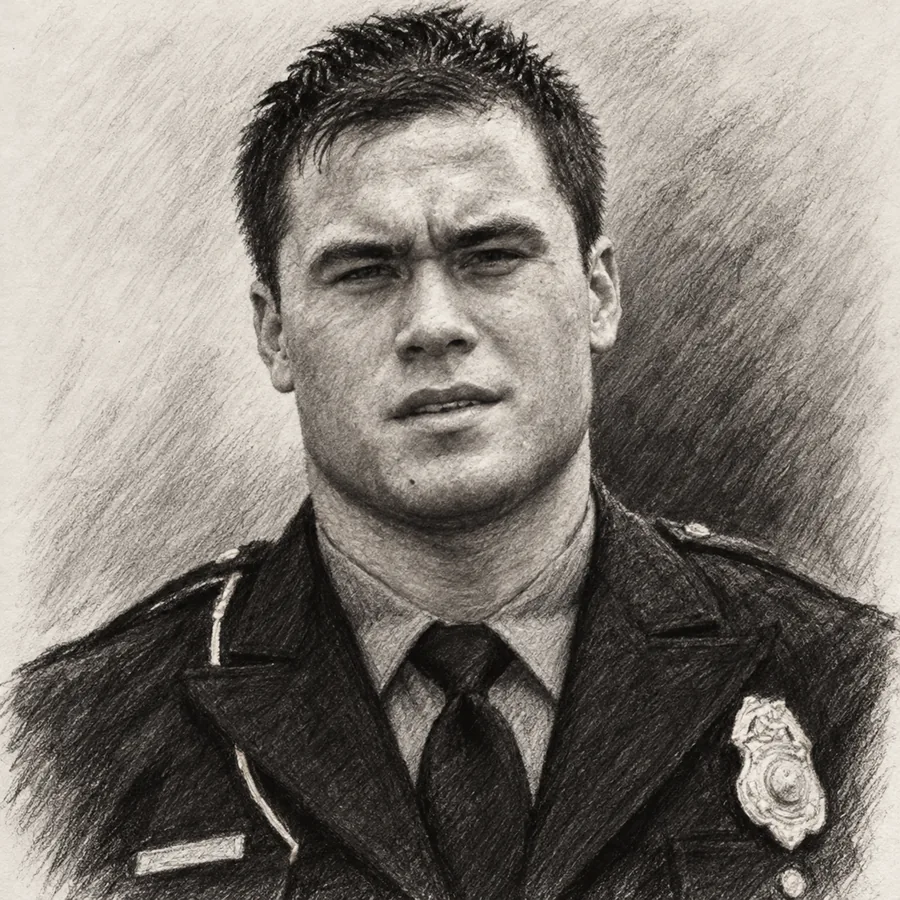
“Liked by all on the shift.” “No complaints on him.” “He will be a fine officer.”
Daniel joined the Oklahoma City Police Department in 2012 and was assigned to the Springlake Division, one of the busiest patrol areas in the city. In February 2013, at the end of his probationary year, his lieutenant wrote his review board evaluation: use-of-force incidents, zero. Complaints, zero. “Holtzclaw makes good decisions and calls if he has questions.” “Holtzclaw is liked by all on the shift and gets along with all officers.” “Holtzclaw has no problems communicating with the public. I have had no complaints on him.” “Holtzclaw makes good reports.” His activity ranked second on the shift: 40 felony arrests and 26 DUI arrests in six months. In the cover note to the division commander, the lieutenant added: “Holtzclaw is a little slow but does good work and eager. He is eager to learn all aspects of our job. He will be a fine officer.” Lt. Aven Bull, probationary review board evaluation and cover email, Feb. 17, 2013 (OKC 6592, 6596–98).
The division commander, Major Brian Jennings, sent him notes with his monthly activity sheets. May 2013: “Daniel, great month of activity. Keep up the outstanding work. It makes a difference.” February 2014: “Daniel, outstanding activity! Keep up the hard work. It is appreciated.” On June 11, 2014, one week before the Ligons stop, reviewing a use-of-force file, Jennings told his captain: “Tell Holtzclaw he did an outstanding job and to keep up the hard work.” When Daniel’s hometown paper ran a profile that March, “Enid Football Standout Now Chasing Felons as OKC Police Officer,” a gang-unit sergeant sent it up the chain and Jennings forwarded it to the deputy chief. OKC 6463, 6465, 6996, 4678–87.
In January 2013 Daniel worked a collision involving the daughter of Maj. Denise Wenzel, who commanded the Investigations Bureau; the girl’s father had been difficult at the scene. Wenzel emailed Daniel the next evening: “You took care of business and were very professional and fair to both girls… You represented us well!” Daniel replied two days later: “I appreciate the email, especially with my board coming up in a couple weeks (walking on egg shells). I was a bit worried especially after the captain coming to the accident scene after it was all said and done (confused b/c I’ve never been complained on).” OKC 1150, 1199 (Jan. 24 and 26, 2013). Deputy Chief Johnny Kuhlman, looking back after the arrest, said “he had never had any problems before.” Kuhlman Dep. 12:7–11 (Sept. 19, 2019). Lt. Brian Bennett, a Springlake lieutenant who said he had not been on many calls with Daniel, testified that he never saw him do anything inappropriate and knew of no complaint by a woman before Demetria Campbell’s, and of nothing else before Ligons. Bennett Dep. 347:17–348:19 (Sept. 19, 2018).
That activity had a cost, and the file shows it. In April 2014 Daniel searched a man for marijuana on the side of the road and pulled the man’s pants off doing it; it made the local news, and his major told the deputy chief he probably hadn’t followed the right search procedure. The deputy chief’s answer to the chief the next morning: “Officer Holtclaw is cut from the same cloth as Vontungeln. Big ex-football player who lives for the high activity, but has a good heart. We will correct his mistakes.” His use-of-force reports, six in a year, also tripped the department’s Early Intervention Program review twice, in February and March 2014. That is the review an officer gets for making more arrests than the officers around him. It is not discipline, and it produced none. OKC 4688 (Jennings to Jester, Apr. 30, 2014; Jester to Citty, May 1, 2014); OKC 4651, 4652, 6214, 6221.
Nobody who worked with him, before or after, described anything like the man the State would later put in front of a jury. The detectives who built the case went back to his high school and his college looking for one. Asked on camera what they found, Davis said the worst was that “he was a stud football player and he got away with things because he was a stud football player. Not things like rape.” Any sign of predatory behavior in college? “There were not.” Gregory: “Nothing pointed directly that he was that way.” Gregory–Davis interview for Michelle Malkin Investigates, Sept. 19, 2016 (transcript). Disclosure: Michelle Malkin is married to UNCUFF president Jesse Malkin.
He got her to the ER after she swallowed PCP, and then he tried to help her.
On December 20, 2013, Daniel stopped Shardayreon Hill. She was smoking PCP. When he confronted her she pretended to be disoriented, fell against the patrol car, and bit down on a vial of PCP in her mouth to destroy it, shattering the glass and swallowing the drug. Officers watched her do it; she admitted it under oath. Daniel got her to the hospital. He stayed with her in the recovery room while she came out of it. Trial Tr. 1329, 1331.
Two nurses cared for Hill that night, and Det. Rocky Gregory interviewed both in October 2014. Jamie Hong treated her in the ER, where the door to Hill’s room was open. Hong advised she never seen the officer do anything inappropriate to the patient.
Richard Watkins had sole care of her afterward in the observation unit. He stated he did not see anything inappropriate between the officer and the patient. She advised nothing to him in this regard as well.
Scott Adams 00650, 00652. The jury heard neither statement. The State called Watkins, who said he had no memory of Hill, and didn’t ask him what he saw; Daniel’s lawyer had no questions. Hong was on the State’s witness list and wasn’t called. Trial Tr. 1451, 1462.
Hill herself confirmed the point years later. In her 2018 civil deposition, she testified that she told neither the nurses nor the jailers about any sexual contact at the hospital. Asked whether, when the jail asked if she had suffered any sexual assault in the last 24 hours, she had denied it, she answered, Correct.
She also agreed that before she came forward to Det. Gregory, she had already seen a Facebook article about Daniel’s arrest. Hill Dep. 69:16–25, 71:8–15 (Dec. 17, 2018).
Afterward he did something he shouldn’t have. He found her on Facebook and sent her a friend request. Police later screenshotted the whole thread from inside her account, with dates, and the State put it in front of the jury as evidence of grooming. Here is how it starts. The first message is hers, her reply when she accepted, January 8, 2014, 1:51 a.m.: “Damn took u long enough i been waiting lol u still got my number right??” Then: “thanks for looking out for me that night lol..” with her phone number, “make it ring ;)”. His reply that afternoon: “I can’t tell a difference between you and your sister, obviously you guys are twins ….. You staying out if trouble !?! you better be.” Scott Adams 08663 (Facebook thread, dated capture); friend request, Scott Adams 00612, 00615.
That is the tone of the whole thread. February 10, Hill: “Iv been ok still working on gettin it together.” February 16, Daniel: “U in okc.” “Making sure your doing ok and staying out of trouble.” February 17, Hill: “Im back now and yea im trying to stay out tha way.” February 28, Daniel: “Hey how court go?” Hill: “Went back to jail n they made my charge wth intent.” Daniel: “Huh. What. How you go back to jail. ????” “I’m lost, how did you get arrested again. Did you f up again.” “Hey call me.” March 3: “Sharday? Last thing you said was you went back in let me know about it maybe I can help or explain what’s going on.” Hill: “Help how i dont get it??” Daniel: “You gota call me I can’t talk through Facebook I don’t know your details.” March 22: “Hey I’m going to pick you up where u at.” And the last message, April 30: “Sharday, hey you got a warrant out for your arrest. Try to get that taken care of. I’m worried about you, I know your a good person, stay out of trouble.” Scott Adams 08663–08667, 10040–10042; State’s Ex. 145; Trial Tr. 1339–40, 1354, 1381.
Contacting a woman he had arrested, off duty, on a personal phone, was a bad idea, and it cost him. But read the messages, starting with hers. She wrote first. She thanked him for looking out for her the night she nearly died. A cop asking a 24-year-old addict how court went, why she got arrested again, and telling her to take care of her warrant and stay out of trouble is not a predator’s script. It is a young officer who thought he could help someone he had watched nearly die, and a woman who, for four months, thought so too.
Hill accused him nine months later, after his arrest was on the news. Near the end of her recorded interview she said: “even if like, even if he didn’t like even rape nobody or nothing… he’s still gonna — he’s been in contact with people that he’s arrested.” Watch it here. According to the defense investigator who appears on the video, Brian Bates, the prosecutor had never heard that part of the tape before trial. If so, the State charged six counts on an interview nobody on its side had watched to the end. Had the last minute been cut, Daniel could well be serving another fifty-plus years on her word. The jury acquitted him on all six of her counts. Hill video interview with Det. Gregory, Sept. 19, 2014 (as posted); Trial Tr. 1422:20–1424:3, 1731:1–4, 4326; Motion for New Trial & Sentencing Tr. 24, 46 (Jan. 21, 2016).
He gave them his DNA, his pants and a polygraph offer, and told them to go test everything.
On June 18, 2014, hours after Jannie Ligons’s complaint, Detectives Kim Davis and Rocky Gregory brought Daniel in. He came without a lawyer and never asked for one. For more than two hours he answered every question. He signed a body-search waiver and gave four buccal swabs. He handed over the uniform pants he was wearing. He agreed to a polygraph on the spot, without conditions. Scott Adams 00013, 00025, 00072–00117; Trial Tr. 1145.
Told there was video of the stop, he said it would not show his penis out and would not show Ligons’s breasts. He was right on both counts; the camera was too far away to show much of anything. Told the pants would be tested, he pushed them to do it: “go, go at it — not my DNA.” “Please, go.” “I want to clear my name.” Scott Adams 00020, 00029, 00042, 00047, 00067.
The detectives who accused him that afternoon never interviewed him again. He got a lawyer after the first session, as anyone should, and the lawyer declined further interviews and the polygraph. The State later told jurors that a man who offers to take a polygraph is “just trying to sell it to you.” That is Gregory’s line, on camera, two years later. It is one way to read a suspect who willingly hands over his DNA and pants and urges prompt forensic testing. Gregory–Davis interview for MMI, Sept. 19, 2016.
The State seized his phone and gave it back the next day. His work computer showed nothing.
In October 2014 police obtained a warrant for his phone and his iCloud account, and seized the phone at his bond hearing, with a computer-forensics examiner on hand to keep its data from being erased. They gave it back the next day. The District Attorney, a captain wrote, didn’t want to mess with all of the issues involving attorney/client privileged information on the phone and a 3rd party having to redact information.
Nothing in the record shows what, if anything, the iCloud warrant produced. The State relied instead on his carrier records, subpoenaed back to December 2013, and put an analyst on the stand to map his cell-tower hits. What it found and used: the Hill messages, and one call from his personal phone to Adaira Gardner’s mother just before midnight on June 17. Some context for that call. Gardner was 17. At 10:47 that morning her mother had reported her to 911 as a runaway, after Gardner punched her in the face four or five times and ran. Daniel encountered Gardner twice that evening. At 11:42 p.m. he called the home number, identified himself as an Oklahoma City police officer, and asked for Adaira; her mother cursed at him and hung up. He ran the mother’s name fourteen minutes later. OCPD did not issue its officers work phones, so the call came from his own. The State introduced no other call or message between Daniel and any accuser. OKC 1141 (Bacy to Kuhlman and Wenzel, Oct. 2, 2014); OKC 1133 (Bacy to Wenzel and Kuhlman, Oct. 3, 2014); State’s Exs. 145, 397; Trial Tr. 3785–88; Scott Adams 11451, 11535 (runaway report #14-48792 and the 11:42 p.m. call); Gregory–Davis interview for MMI, Sept. 19, 2016 (“We’re not provided with work phones”).
The City also went through his work computer. In September 2014 the City’s information-security office pulled every logged internet hit from Daniel’s patrol-car account for the four and a half months before the Ligons stop: 342 of them. They were the state prison offender lookup, the state court-records site, the law-enforcement telecommunications system, Windows and Adobe updates, the department’s policy manual, eight search-engine hits and four on Facebook. The security officer who ran the search told the deputy chief the files “probable have no value.” The deputy chief passed them to the Sex Crimes lieutenant with “not sure if there’s anything of value.” The search and its results were not disclosed until civil discovery, three years after his trial. OKC 0883–0938 (Kuhlman to Muzny, Sept. 9, 2014, forwarding Gibson, Sept. 4, 2014, with Vantage reports).
His girlfriend of several years, Kerri Hunt, testified at trial. He sent her a scripture verse most mornings. Asked whether she had ever noticed anything odd or unusual about his sexual activities: “No.” Whether she had ever seen him view any type of pornography: “No.” Trial Tr. 4108–14.
There is no version of Daniel in the record that matches the man the State described.
UNCUFF has read the whole file. Every supervisor’s note, every message on his phone, every hit on his work computer, every word of the two hours he spent with the detectives who accused him. There is nothing in it. There is no version of Daniel Holtzclaw in the record before June 18, 2014, that matches the man the State described, and the man in the interview room that day did what an innocent man does: he asked them to test everything and waited for the results. They came back with less of one woman’s DNA on his fly than a car door handle carries, and the State built 263 years on it.
Help fund the work.
UNCUFF funds investigation, forensic review, records work, post-conviction litigation, and telling the stories of wrongfully convicted people to the public.