
The Circus-Like Trial
Daniel’s jury heard protesters chanting “give him life” during testimony, shared a hallway with the crowd on the way in and out, and was refused sequestration until deliberations. The Court of Criminal Appeals said none of that prejudiced him. UNCUFF thinks it did.
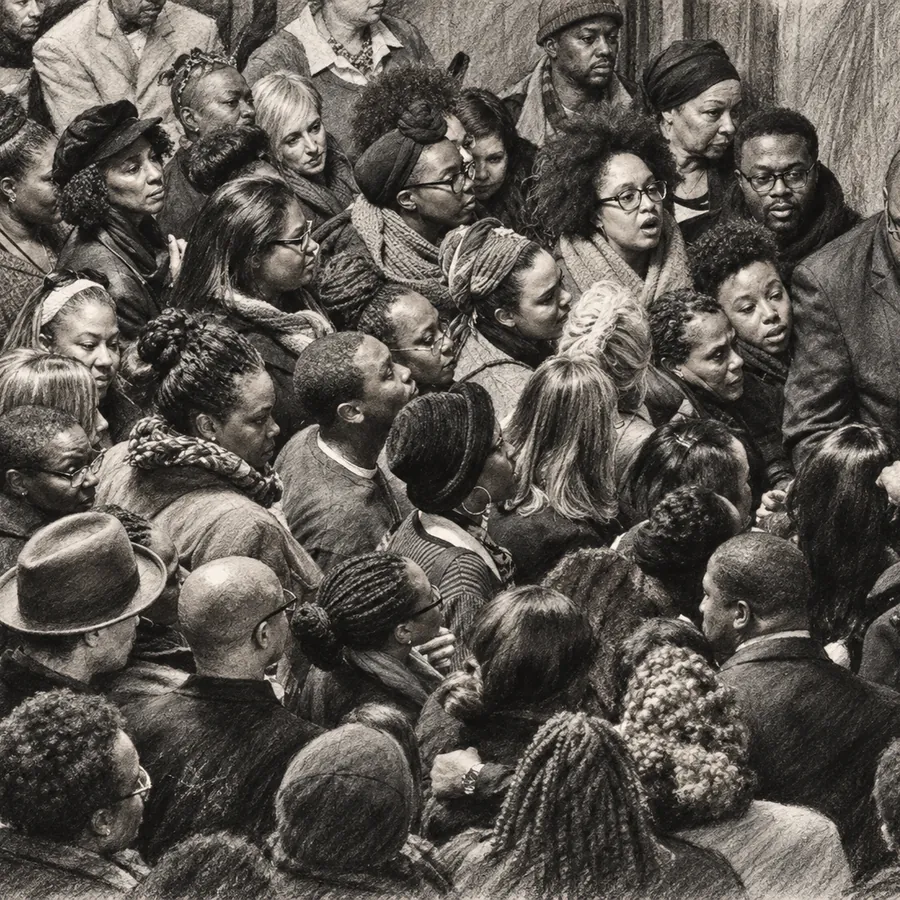
The jury could hear protesters chanting "give him life."
During testimony, protesters outside the courthouse chanted Give him life.
Defense counsel told Judge Timothy Henderson he couldn’t hear the witness, that the chanting had been going on ever since this morning,
and that its timing was odd: I don’t know how they know this but I’m up here making a record and they’ve just stopped as I was approaching.
Henderson agreed it was audible. Clearly the Court can hear it as well and probably the jury can hear it as well.
The district attorney had told him several weeks ago
that the organizers had a permit, and he said he didn’t know what can be done other than to admonish the jury.
Trial Tr. 2303:18–25, 2304:1–14.
Later, after a break, Henderson remarked on the silence outside. I haven’t heard a peep from the protesters outside. I don’t know if they’ve went on or just waiting for us to start back in court.
Trial Tr. 2318:5–8.
The prosecutor brought the riots into jury selection.
The pressure reached the courthouse before a juror was seated. During jury selection, Henderson put on the record that a woman in the courthouse snack bar had approached a juror from another trial, thinking she was on Daniel’s jury, and told her, in the judge’s account, we need to make sure we convict that -- or that that police officer gets convicted.
The defense asked the court to do whatever it could to keep such influences away from the panel. Trial Tr. 269:4–15, 270:1–19.
Inside the courtroom, it was the prosecutor who raised Ferguson and Baltimore. Gayland Gieger asked prospective jurors whether people protesting the way an officer had been accused should wait and find out the facts before they start burning the city down,
and whether they understood why people might riot and burn the place down if they thought police were doing wrong.
Trial Tr. 136:4–10, 137:15–18.
Defense counsel objected that the questioning was getting "dangerously close to societal alarm" and could leave jurors with the impression that an acquittal might bring the same kind of unrest to Oklahoma City. He told the court he could see jurors nodding as the subject was discussed. Trial Tr. 286–90.
Jurors shared the hallway with the crowd and media.
Jurors had to use the same hallway as the crowd and media covering the trial. Defense counsel told the court it was "literally getting nuts out there." During one break, the hallway reportedly held more than 100 people while media interviews were conducted. The prosecutor acknowledged that it was "very, very crowded" and full of activity. Trial Tr. 1530–32.
The jury also used the public restrooms and elevators off the same hallway, leaving jurors in that common area during breaks. The court tried to confine interviews to a roped-off area, still within sight of jurors, but the disruptions continued. Trial Tr. 1531–36, 2317, 4315.
A protester shouted "racist jury" in front of two jurors.
By the end of trial, the pressure was no longer directed only at Daniel. During a break on the tenth day, a protester in the hallway shouted "racist cop" and "racist jury" in front of two jurors. Trial Tr. 2315–18; Holtzclaw v. State, 2019 OK CR 17, 448 P.3d 1134, ¶ 31.
The court declined to sequester the jury.
As the protests intensified, the defense asked Judge Henderson to sequester the jury because of "all the protesting and yelling and screaming." The request was denied. Henderson instead instructed jurors to disregard the outside influences. Trial Tr. 2316–21. He took other steps as the trial went on: a deputy in the hallway at every break, the media cordoned away from the jurors' stairwell and elevators, jurors released first at recesses with the floor cleared behind them, and permission to wait in the courtroom until a recess ended. Holtzclaw v. State, 2019 OK CR 17, 448 P.3d 1134, ¶¶ 26–27, 31.
Sequestration came hours into deliberations, after every exposure described above. Trial Tr. 4315.
The verdict came on December 10, 2015, Daniel’s 29th birthday. Afterward, according to news reports, a group outside the courthouse sang “Happy Birthday” to him. Alfred Ng & Jason Silverstein, “Jury convicts ex-Oklahoma cop of rape, sodomy charges; faces life in prison,” New York Daily News (Dec. 11, 2015); “Victims Mock Daniel Holtzclaw’s Guilty Verdict By Singing ‘Happy Birthday’,” NewsOne (Dec. 2015).
The Court of Criminal Appeals found no prejudice.
Randall T. Coyne and J. Christian Adams sought leave to file an amicus brief arguing that the timing of the chants suggested a message directed toward the jury. The Court of Criminal Appeals denied leave on March 31, 2017, so the brief was never accepted as an amicus filing. Order Denying Motion for Leave to File Amicus Curiae Brief, Holtzclaw v. State, No. F-2016-62 (Okla. Crim. App. Mar. 31, 2017); Trial Tr. 2303–06, 2318.
Coyne and Adams argued that protesters had a right to speak but not a right to direct advocacy toward jurors deciding a criminal case. Their proposed brief urged measures such as moving the demonstrations, relocating the proceedings, or sequestering the jury so that the advocacy would not reach the fact-finders.
The Court of Criminal Appeals rejected Daniel’s claim on direct appeal. It counted sixty-six admonitions to the jury, listed the trial judge’s protective measures, found no evidence that a juror had been approached or improperly influenced, and noted that the defense had not requested a change of venue or a different courtroom. The court also treated the split verdict (eighteen convictions and eighteen acquittals) as evidence that jurors followed the instructions and considered the counts separately. Holtzclaw v. State, 2019 OK CR 17, ¶¶ 23–33.
UNCUFF disagrees with that conclusion. The measures Henderson imposed were substantial, but they did not prevent the two most serious documented exposures: punishment chants audible during testimony, and a protester shouting "racist jury" in front of two jurors. In our view, those incidents warranted sequestering the jury for the remainder of the trial.
Help fund the work.
UNCUFF funds investigation, expert review, records work, post-conviction litigation, and telling the stories of wrongfully convicted people to the public.