
The Analyst In Her Own Words
Elaine Taylor was the State’s only forensic witness on the only physical evidence in the case. Three years after the trial, she was asked under oath what her examination was for, what she tested, what she told the prosecutor, and what her opinions rested on. These are her answers, on video. In them, the State’s analyst explains that she went looking for touch DNA, that she could not say the DNA came from vaginal fluid, and that she accepted the vaginal-fluid claim anyway because the accuser said so.
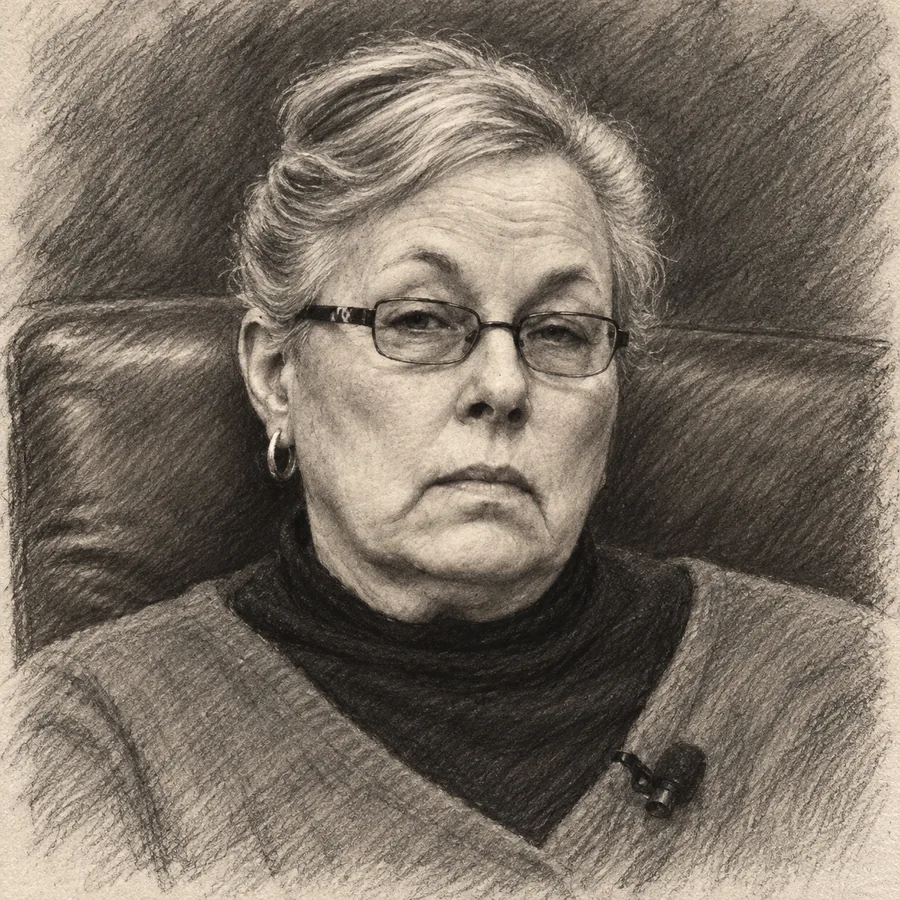
Three years after trial, under oath and on camera.
Forensic analyst Elaine Taylor analyzed the DNA on the fly of Daniel’s uniform pants and testified for the State at trial in November and December 2015. She was deposed on January 15, 2019, in Ligons v. City of Oklahoma City, No. CIV-16-184-HE (W.D. Okla.), questioned by attorney Kathleen Zellner, with the City’s counsel present. The deposition was video-recorded.
The clips are arranged by topic, from the examination of the pants to her testimony at trial, not in the order the questions were asked; each gives its page and line in the transcript. Each shows the full question and the full answer, with nothing removed, and the certified transcript is under each clip. Our analysis follows each clip, marked “What this shows.” Near the end, five sections set the deposition aside and go to what she told the jury in 2015, with the trial transcript linked. The full treatment of the DNA evidence is here.
She set out to find touch DNA.
Transcript (17:21–19:5)
Q That makes sense. Okay. So does finding a person's DNA on underwear or pants of another person mean that you have a sexual assault, can you automatically draw that conclusion? So person A's DNA is on the pants or the fly of person B, does that mean that a sexual assault occurred?
A No.
Q Have you worked on a case where you concluded that DNA transferred due to touch DNA or indirect touch DNA without body fluids such as saliva or blood?
A I'm sorry, have I ever worked on a case --
Q Yeah.
A -- of -- with touch DNA?
Q Yes, like that. Yes.
A Well, when I first started working on the Holtzclaw case, the scenario that I was told was that Jannie Ligons was stopped -- was stopped on a traffic violation and she was in Holtzclaw's -- the back seat of Holtzclaw's scout car, and that there was oral sodomy committed. Okay. From that point of view, I made a really big assumption that there was a possibility that I could find Jannie Ligons' epithelial cells on the front of his pants, just because I thought maybe she would try to steady herself, and --
Q Okay.
A -- that's what I went for was the epithelial -- the possibility of epithelial cells being on the front of his pants. I did not do any alternate light source testing of any kind because I was not thinking it was going to be saliva or vaginal fluids or semen at that point, I was only looking for her epithelial cells to corroborate her story that she told.
Taylor Dep. 17:21–19:5 (Jan. 15, 2019).
Start with the premise. Ms. Taylor agreed that finding one person’s DNA on another person’s clothing does not mean a sexual assault happened. Then she described the examination she actually designed: a search of the fly for skin cells Ms. Ligons might have left there while “steadying herself.” Taylor Dep. 17:21–18:1, 18:16–25.
No one told her that happened. No one has ever described steadying herself by taking hold of the fly of a man’s trousers, and Ms. Taylor admitted she did not know “if women do that or not.” She made what she called “a really big assumption,” and then built the State’s only forensic examination around it. Taylor Dep. 18:16–25, 55:2–6.
Then look at where she swabbed. She described her target again and again as the “front of his pants.” What she sampled was the fly, the strip of fabric that holds the zipper, and she said it was the only place she meant to test: she “wasn’t going to check for DNA on his lower pants.” A woman steadying herself against a man would be more likely to touch his thighs, front pockets, knees, or hips. None was swabbed. The Velcro belt came to her threaded through the belt loops as part of the same package, logged as Item 18, and it was never swabbed either. His uniform shirt was never collected. Her hypothesis was hands on the front of the pants. She tested the one part of the front the State would later tie to a sexual act. Taylor Dep. 18:16–25, 25:16–23, 31:17–24, 33:14–18, 38:17–22, 54:19–55:2, 149:9–13; Forensic Examination Report SD-14-273 (Nov. 12, 2014), at 2, 6–9; Bench Notes, SD-14-273, at 3–4, 18; Scott Adams 04341–42 (property receipt), 04831–32, 04834 (interview transcript).
And suppose she had found Ms. Ligons’s skin cells on the fly. What would that have proved? By his own account that afternoon, Daniel searched her car with her consent: he looked under the driver’s seat, went through her purse “like she said,” checked the name on her pill bottles, and sniffed her cup of Kool-Aid for alcohol. She also sat in the back of his patrol car. Scott Adams 00036, 00079, 00081, 00084. Her cells on his clothing would have been the expected result of a traffic stop that nobody disputed took place. The test could not tell an assault from a stop. As it turned out, none of Ms. Ligons’s DNA was found on the fly.
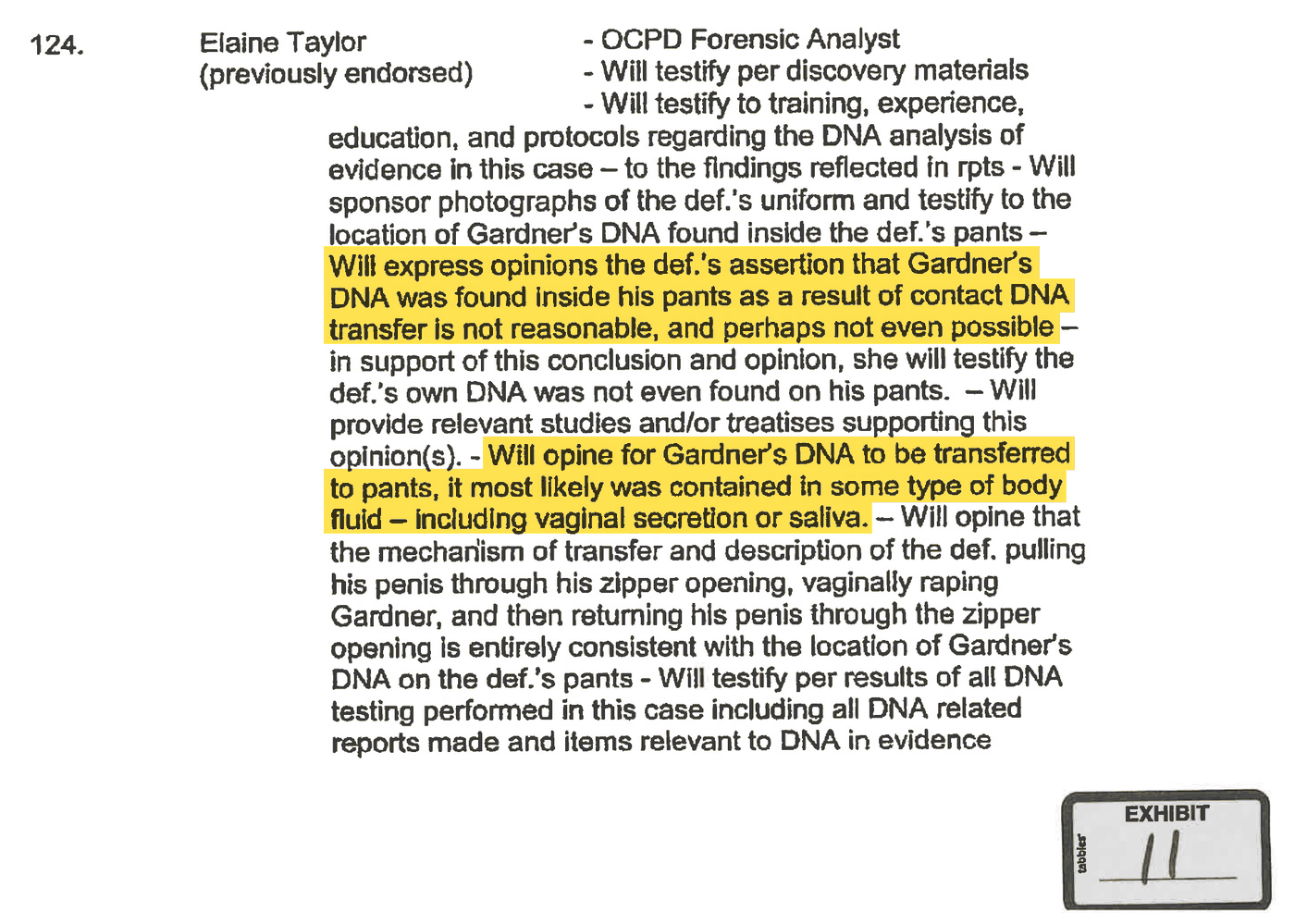
Finally, look at what she was searching for: touch DNA, left by ordinary contact. The State’s witness endorsement, filed with the court before trial, described that kind of transfer as “not reasonable and perhaps not even possible.” Shown it, she said: “these are Gayland’s words, not mine.” The State’s analyst designed her examination around a mechanism the State’s prosecutor would call nearly impossible. State’s Endorsement of Witnesses, item 124, O.R. 240 (Ex. 11 to Taylor Dep.); Taylor Dep. 132:24–25.
She asked for his family’s DNA. She did not check her own.
When the first fly swab came back with a female profile that was not Jannie Ligons’s, Ms. Taylor’s first thought was innocent contact. She told the jury she had asked the detectives for references “from possibly a family member or somebody that could’ve come in contact with his pants.” The prosecutor repeated the point on redirect. Trial Tr. 4079:19–23; Trial Tr. 4092:22–25.
Three years later, under oath in the civil case, she was asked about the people she knew for certain had handled the pants: the laboratory’s own staff, herself included.
Transcript (50:23–51:18)
Q Okay. Did your staff database contain DNA profiles of Detective Davis and Detective Gregory?
A No, we didn't have detectives in our staff database, only ourselves and some of the crime scene people, simply because they --
Q Did you --
A -- come in contact with the evidence initially.
Q Okay. When you were testing the fly of Holtzclaw's pants to eliminate people, did you, in fact, do elimination of people that were in contact with the pants that worked for the lab?
A No, I did not, I felt like there was -- there was no precursors that there was anything wrong with the collection of the evidence.
Q Did you -- did you check to make sure that your own DNA wasn't on the pants?
A Not really.
Q Okay. Is your DNA profile, was it kept on file in the lab?
A Yes, it should still be there.
Taylor Dep. 50:23–51:18 (Jan. 15, 2019).
Put the two answers side by side. In 2014 the analyst considered it plausible enough that a relative’s hand had left DNA on the fly that she asked detectives to collect references from Daniel’s family. Yet the one woman she knew had handled the pants was herself, in a laboratory that kept her profile on file for exactly this purpose. Asked whether she checked, she said “not really,” and no one asked what that meant.
A staff elimination database exists so that an unknown profile can be run against the people who touch evidence before it is reported as someone else’s. The comparison takes minutes. Nothing in the laboratory file shows it was done for the fly swabs, and Ms. Taylor’s stated reason for skipping it, that there were “no precursors” of a collection problem, is not a reason the database contemplates; contamination is checked for because it leaves no precursors. The point is not that the profile was hers. The point is that the laboratory never ruled it out, and told no one.
There was a precursor, too. In the interview room Detective Gregory told Daniel, Alright, man, put your pants in this bag,
and the interrogation video shows the paper sack unsealed. Ms. Taylor’s report lists the pants as a tape sealed BPS
transferred by the property clerk the next day, without saying who sealed it or when. For Daniel’s cheek swabs, taken in the same interview, the report records that they were received from Gregory. For the pants, it doesn’t say who turned them in. The detectives who handled the pants were not in the staff database, and no one who handled them was ruled out. Scott Adams 00109–11 (interview transcript); interrogation video, June 18, 2014; Forensic Examination Report SD-14-273 (Nov. 12, 2014), Scott Adams 02939–40.
No one told her what was alleged.
Asked what she knew about the case when she began, she explained that she does not read police reports, then qualified the answer.
Transcript (21:21–23:22)
Q Okay. Other than the information that you received from Kim Davis, did you, in fact, look at any more file documents about the Holtzclaw case before you started testifying, did you look at any police reports or anything like that?
A I do not ever read police reports. I don't ever want to be prejudiced by what they think, I want the science to speak for itself.
Q Okay. So the reason you know you didn't look at the police reports is because you never looked at them, right, in any case?
A That's correct. I don't look at the police reports in any of the cases I work.
Q Okay.
A Well, that's not --
Q Were you ever --
A Can I --
Q I'm sorry, go ahead.
A Can I clarify, that's not true, I will get a crime scene report and look at the -- the actual report itself simply because I can't figure out where a sample has come from or the order in which the crime scene people have collected it. So that -- to say that I never read reports is really not accurate because I will read crime scene reports.
Q And did you read the Holtzclaw crime scene report on any of these cases?
A I don't believe so because it was very clear from the crime scene envelopes where the samples were collected from, from Jannie Ligons' vehicle, from Holtzclaw's scout car, and then the sexual assault report was separate.
Q Did you review the sexual assault report?
A I tried to, it was extremely difficult to read because we usually get the third or fourth copy, and it's -- the paper that -- I can't remember what it's called, it's -- there's multiple copies and you write on the top and it goes all the way through, it's kind of like a carbon copy and we've --
Q Okay.
A -- never changed that, that format.
Q Okay. So your recollection is you would have gotten the report, but it was a hard to read carbon?
A Yes, I tried -- I try reading them --
Q Okay.
A -- to get little bits and pieces of information, but that particular report was extremely difficult to read.
Taylor Dep. 21:21–23:22.
Her principle has real support. Current federal guidance calls for keeping analysts away from task-irrelevant information, such as a suspect’s record or investigators’ theories, because it can bias a forensic judgment. But the same guidance says the system must also ensure that all task-relevant information reaches the analyst. What was alleged is task-relevant. For an analyst examining the fly of a man’s trousers, the difference between alleged oral contact and alleged intercourse decides what to look for: saliva, semen, vaginal fluid, skin cells from ordinary touch, or a mixture from more than one route. Those are not prejudicial details. They define the biological question.
That information never reached her. The first request, in 2014, told her “this was an oral sodomy case,” and she built her examination on it. The form requesting the interior swabs in 2015, nearly a year after Adaira Gardner and others alleged vaginal rape, still described the offense as “Forcible Oral Sodomy,” the Ligons allegation, while asking her to look for another woman’s DNA. The system meant to shield her from irrelevant context withheld the relevant context too. It is as if a hospital laboratory, properly shielded from gossip about a patient, received a requisition naming the wrong condition, chose its tests for that condition, and then had its results read as proof of another. Taylor Dep. 20:5–10; Scott Adams 03602; National Commission on Forensic Science, Ensuring That Forensic Analysis Is Based Upon Task-Relevant Information (2015); NIST IR 8503, Forensic DNA Interpretation and Human Factors (2024), § 3.2.1 and Glossary.
This matters because of the question her results were later used to answer. “Whose DNA is on this swab?” is a question about source; an analyst can answer it knowing nothing about the allegation. “How did Ms. Gardner’s DNA get onto the fly?” is a question about activity, and it cannot be answered without knowing what activity is alleged. The federal guidance notes that an investigation may begin with the first question and turn into the second. Here it did, and no one told the analyst. NIST IR 8503, Forensic DNA Interpretation and Human Factors (2024).
If Ms. Taylor believed every allegation was oral sodomy, she never designed or evaluated her examination around the possibility that Ms. Gardner’s DNA was vaginal material deposited during intercourse. Yet that is exactly what the State told the jury the DNA showed. The question is not only whether her DNA typing was right. It is that the State’s interpretation of what the DNA meant went far beyond the question her examination was built to answer.
The gap was not only the system’s. By 2015 she knew two other women had come forward and that she was swabbing the pants for their DNA; she could not later recall their names, and nothing shows she asked what they alleged. At trial she said she thought the allegations “were all oral sodomy,” and in the same testimony, asked whether transfer was “much more likely” in a liquid “such as vaginal fluid,” she called it “a very good possibility.” She had no basis for that opinion either way. Not knowing the allegation meant she never designed an examination to address it. Knowing it would have given her a hypothesis to test, not an answer, and no test for vaginal fluid was ever run; her laboratory had none. Taylor Dep. 59:15–16, 66:23–67:4; Trial Tr. 4064:4–5, 4073:20–24.
Her laboratory could not identify saliva or vaginal fluid.
Transcript (55:7–56:17; 59:13–60:6)
Q And I think that you testified, you said at trial, "At the time, I felt that an amylase test would not have aided anybody in the investigation of this particular case," that was your trial testimony, that's at Page 4092. Why did you think that doing the amylase test would not have potentially helped the investigation?
A Because amylase is found in more than just saliva.
Q Did anyone ever request that you test the pants for saliva?
A Yes.
Q And who was that?
A Detective Davis, but our lab --
Q She asked you to --
A Excuse me.
Q Okay. I was just trying to track what you're saying. So Detective Davis asked you to test the pants for saliva, and then what -- what was your response to her?
A Okay. Because we are no longer proficiency tested on that body fluid, I could not do it.
Q Okay. So even if you had wanted to test for saliva, you could not have done that?
A That's correct.
Q Okay. Can you tell me what the different -- first, let's go just through a couple things that -- was any proficiency testing done for saliva at all at the lab?
A No.
MR. SMITH Ever? Sorry, go ahead and answer.
THE WITNESS No.
Q Never?
A Never.
…
Q What about a presumptive test for vaginal fluid cells?
A For vaginal fluid by themselves, we have none.
Q Okay. So you did not have the Lugol's iodine test?
A No.
Q What about the Dane's staining method for the vaginal fluid?
A Ma'am, the only staining method that we ever used and have in our laboratory is the Oppitz, the Christmas-tree stain.
Q And that's for sperm; correct?
A Yes.
Q Okay. So just -- just so the record's clear, so there was no testing available at the time you were doing the testing on Holtzclaw's pants for vaginal fluid cells?
A I don't believe there is a test.
Taylor Dep. 55:7–56:17, 59:13–60:6.
She gave three reasons, at three different times, for not testing the pants for saliva. At trial, an amylase test “would not have aided anybody.” At her deposition, amylase “is found in more than just saliva.” That limit applies to every presumptive test, including the semen test she did run on Ms. Ligons’s samples, and it misses the point: on an oral-sodomy allegation, a saliva screen would have produced relevant information, within the limits of a presumptive test. Trial Tr. 4092; Taylor Dep. 55:7–15; Forensic Examination Report SD-14-273 (Nov. 12, 2014), at 6; Bench Notes, SD-14-273, at 1, 17. A more specific test, using antibodies to human salivary amylase instead of the enzyme reaction, had been validated for forensic use in 2009. It is still a screening test, but it was built to answer the objection she raised. Old et al., J. Forensic Sci. 54 (2009): 866–73; Sakurada et al., Diagnostics 10 (2020): 693. Then came the real reason. Her laboratory was not proficiency-tested for saliva (“no longer,” she said first, then “never”), and for vaginal fluid it had no test at all. Taylor Dep. 56:2–3, 56:16–17, 58:14–19, 59:15–16.
Nothing in the record shows anyone considered sending the pants to a laboratory that could do the work. She testified that Detective Davis asked for a saliva test; Davis testified she never did. On either account, the only physical evidence in a sexual-assault prosecution was never tested for any body fluid. Taylor Dep. 55:16–20; Davis Dep. 113:12–18 (Jan. 29, 2019); Ruddock Dep. 36:1–6.
Asked about the absence of any stain, she answered a different question.
Transcript (64:20–65:8)
Q Okay. Would you find it unusual in a sexual assault case if a man's pants were in contact with a woman's vaginal area for ten minutes or more during a rape, that there were no stains or deposits visible on the fly of the pants? So the pants are in contact with the woman's vaginal area for ten minutes, would it be unusual not to find any stains that are visible on the fly of those pants?
A Ma'am, I'm not really sure how to answer that, because I did not look for semen stains on his pants per se. I was -- that was information that was not part of the Jannie Ligons investigation. So looking for seminal fluid, no; looking for skin cells, yes.
Taylor Dep. 64:20–65:8; deposition video at 1:36:51–1:36:57 (pause).
This is a basic question of forensic serology: if a man’s pants were in contact with a woman’s vaginal area for ten minutes, would you expect to see a stain? The State alleged two vaginal rapes through the same fly within a day of the pants being collected.
She paused for about seven seconds, sighed, and answered a different question, about semen and about the Ligons investigation, neither of which Ms. Zellner had mentioned. Then she summed up her own examination better than anyone else has: “looking for seminal fluid, no; looking for skin cells, yes.” At trial she had told the jury she examined the fly under bright light and magnification and found “nothing on there suspicious.” Taylor Dep. 64:20–65:8 (video 1:36:51–1:36:57); Trial Tr. 4084:2–7.
Before trial, she told the prosecutor there was “no way.”
Transcript (128:21–129:22; 132:1–25)
Q If you could review it, review it, please, and tell me if this is an accurate description of the testimony that you were planning to give in the Holtzclaw trial.
MR. SMITH I'm going to object to the form of the question since it's not her document, but she can certainly look at it.
(Witness reviews document)
THE WITNESS Okay. This is from Gayland Gieger, I assume.
Q That was my question, do you recall providing Mr. Gieger with your planned testimony, did you provide him with this information?
A I -- I supplied Mr. Gieger with all of my reports and he and I had a pretrial conference the Friday before they started picking a jury. This -- I don't -- I have never seen this, this -- this document. I -- actually, I told Gayland that there is no way I could determine whether the sample came from vaginal or saliva in his pants, you know, it could have come from vaginal secretions from a sexual assault, I have no idea, I was not present. I mean, if that's what Ms. Gardner said happened, I'm not going to refute it. But I have no way of knowing what the body fluid is and I will not and I do not know it today.
…
Q All right. And so his DNA is not found in his pants, so how did that lead you to the conclusion that Gardner's DNA to be transferred to the pants, it -- it most likely was contained in some type of body fluid, including vaginal secretion or saliva?
A Well, Gayland and I discussed this, he said, is it possible it could be vaginal secretions, I said, it is possible. But the defense said, is it possible for him to have gotten his DNA -- her DNA on his hands from rustling through her purse, well, I guess it's possible, but then again, is it probable, that's DNA that is, you know, kind of transient. So, you know, a scientist would have to make a little bit of an assumption that the sample, to stay as preserved as it was and to be, you know, a almost pristine sample, that it was probably a liquid. Now, vaginal secretions are generally rather liquid, as well as the mixture of the vaginal secretions with ejaculation. Now, I don't know if he ejaculated, I have no idea what happened, but my testimony was that it could be from vaginal secretions, I have no way of knowing. Now, this is -- these are Gayland's words, not mine.
Taylor Dep. 128:21–129:22, 132:1–25; Ex. 11 to Taylor Dep.
She testified that before trial she told the prosecutor there was “no way” she could determine whether the sample came from vaginal fluid or saliva. The State’s filed summary of her testimony (shown above) said the opposite: the DNA “most likely” came from a body fluid “including vaginal secretion.” She disowned the words. Taylor Dep. 129:14–16, 132:24–25; State’s Endorsement of Witnesses, item 124, O.R. 240.
Her “no way” took something for granted. Either answer, vaginal fluid or saliva, assumes the DNA came from a body fluid at all, and she had tested for neither. Her only reason for assuming a fluid was that a sample so well preserved was “probably a liquid.” Her supervisor, Campbell Ruddock, the laboratory’s DNA manager, made the same assumption in his own deposition, saying the DNA “did come from a biological fluid,” then conceded when asked that a skin cell “is not fluid.” Taylor Dep. 132:15–19; Ruddock Dep. 31:20–22, 32:23–33:4 (Mar. 21, 2019).
Then she explained how the vaginal-fluid idea arose. The prosecutor asked whether it was possible, and she said it was. At trial he asked whether transfer was “much more likely” in a liquid “such as vaginal fluid,” and she answered: “That’s a very good possibility.” No test was run between her “no way” and her “very good possibility,” and no new evidence came in. What changed was how the prosecutor phrased the question. Taylor Dep. 132:7–9; Trial Tr. 4073:20–24.
The vaginal-fluid opinion came from the accusation, not a test.
Transcript (140:8–142:16)
Q Next question, if a prosecutor were to claim based on your DNA evidence from the fly of Holtzclaw's uniform pants that it was a fact that Ms. Gardner's DNA came from the walls of her vagina, was transferred in vaginal fluids to the outside or inside of the fly, would that claim be correct, that it was a fact that Gardner's DNA came from the walls of her vagina and was transferred with vaginal fluid?
A If that's the way Ms. Gardner testified, I am not -- I would not be one to dispute her. She knew what happened to her, I didn't.
Q If the prosecutor said it was a fact that the D -- that Gardner's DNA came from vaginal fluid, would you disagree, based on what you've testified to today, that it was a fact, an undisputed fact that Gardner's DNA came from vaginal fluid, would you agree or disagree with that statement?
A I wouldn't disagree because that was what the young woman testified to then. I mean, she testified before I did. I didn't know what the fluid was at the time, but it was -- to me, that is -- that is not something that is in my purview to disagree with. She knew what happened to her, not me.
Q My question, though, earlier to you, and I believe you answered it, was you couldn't say definitively that Gardner's DNA came from vaginal fluids, did I understand you correctly?
A Yes, I said that.
Q Right. You said that you weren't certain that Gardner's DNA came from vaginal fluids?
A At the time I did all this testing, I had no idea.
Q You had no idea where the Gardner's DNA came from?
A Well, it could have come from her mouth, it could have come from her -- her skin, it could have come from her vaginal vault, it could have come from, I don't know, her sneezing on him, I don't know, ma'am. But I -- I do know that if that's -- if she testified to the jury that it was penile vaginal penetration, and then I was told that, in fact, this victim had testified to that, why would I dispute the woman's testimony by saying, oh, no, it couldn't have come from vaginal secretions, because I do not have a test?
Q Right. And I was asking you not as a trial observer, I was asking you as a scientist, if you could say, based on a reasonable degree of scientific certainty, not witness testimony, scientific certainty, that Gardner's DNA came from vaginal fluid?
A No, I can't because I do not -- our laboratory --
Q Thank you.
A -- does not have a test for vaginal secretions, period.
Taylor Dep. 140:8–142:16.
This is the center of the case, and it is worth considering carefully. The DNA on the fly was offered to the jury as independent, scientific corroboration of Ms. Gardner’s account. Asked where that DNA came from, the State’s analyst said she did not know. It “could have come from her mouth,” her skin, “her vaginal vault,” or, in her words, “her sneezing on him.” She could not say to any degree of scientific certainty that it came from vaginal fluid. Taylor Dep. 141:19–142:16.
Yet she would not dispute the prosecutor’s claim that it was vaginal fluid, and her reason was the accuser: “She knew what happened to her, I didn’t.” “Why would I dispute the woman’s testimony… because I do not have a test?” Taylor Dep. 140:17–19, 142:2–5.
Follow the logic. The State told the jury the DNA proved Ms. Gardner was telling the truth. The analyst’s basis for the most important part of that proof, that the DNA arrived in vaginal fluid, was that Ms. Gardner was telling the truth. The accusation supplied the science, and the science was then offered to prove the accusation. Forensic evidence exists to test a witness’s account. Here the witness’s account was used to interpret the evidence, and the evidence was presented to the jury as independent confirmation of the witness.
Her basis was personal experience.
At trial she told the jury that a young woman of Gardner’s age “would be very likely to have quite a bit of lubrication and that lubrication could transfer cells.” Trial Tr. 4065:18–20.
Transcript (147:3–148:12)
Q What are the areas of expertise that you were qualified to testify in court about?
A Basically serology and DNA. I guess it was considered under biology.
Q Have you ever been testified -- have you ever testified as an expert in physiology of sex organs and reproduction?
A No, that was the SANE nurse's job.
Q And you're not -- right. You're not -- you're not a forensic nurse; correct?
A Correct.
Q Had you had any training in regard to rape victims and the human body's response to sexual intercourse?
A I attended a sex crimes school and then we were given a little bit of training at the FBI in sexual assaults.
Q Okay. Did you get specific training about a young woman, a 17 year old, and her ability, physical ability to produce lubrication?
A No, but at one time I was a 17-year-old female and I kind of remember what it was like to be well-lubricated.
Q And so the testimony you gave at trial at Page 4065, quote, A young woman of her age would be very likely to have quite a bit of lubrication and that lubrication could transfer cells, if, in fact, that is what occurred." That was not based on your expertise as a serologist, but rather just personal experience?
A I would say personal experience, I mean, I'm a female, I think I have an idea of how my body responds to things and how other females do. Now, I'm not sure if a male could testify to a 17 year old's response to a sexual type situation.
Taylor Dep. 147:3–148:12.
The jury heard this as expert testimony, grounded, she told them, in training, prior cases, and “the way hormones are produced.” At her deposition she agreed her expertise was “basically serology and DNA” and that she had no specific training on the subject. Her basis, she said, was “personal experience”: “at one time I was a 17-year-old female and I kind of remember what it was like to be well-lubricated.” Trial Tr. 4065:21–4066:12; Taylor Dep. 147:3–148:12.
Consider what she offered as a qualification: having once been seventeen. She added: “Now, I’m not sure if a male could testify to a 17 year old’s response to a sexual type situation.” The research does not support “very likely” either. A 2024 review of the published studies on genital arousal during nonconsensual sex found that it can occur, but that its frequency could not be determined and the subject had not been studied systematically. Vandervoort et al., “Victim Sexual Arousal During Nonconsensual Sex: A Scoping Review,” Arch. Sex. Behav. 53 (2024): 2305–18. Her own laboratory’s DNA manager later testified the subject was “definitely not something I would include in the testimony.” Ruddock Dep. 40:24–41:12 (Mar. 21, 2019). This memory of adolescence is what supplied the sexual mechanism for the State’s DNA evidence.
Her basis for a related opinion was no stronger. At trial, when Gieger asked whether cells were much more likely to transfer in a liquid such as vaginal fluid,
she called it a very good possibility.
Asked in 2019 what that rested on, she said, It is based on 27 years of experience. When I dampen a cotton swab and I collect a sample with that cotton swab, that’s a liquid.
A wet swab picks up a sample in a laboratory. It says nothing about whether a woman’s cells reached a man’s trousers in vaginal fluid. Trial Tr. 4073:20–24; Taylor Dep. 143:5–21.
She told the jury it was unfortunate that the exam found only Ligons’s DNA.
The next passages come from the trial, not the deposition. Testifying for the State, Taylor described the oral wash from Jannie Ligons’s sexual-assault exam. The laboratory splits a sample like that into sperm cells and other cells and tests each portion. Both portions held only Ligons’s own DNA: no sperm, and no DNA from any man. Unfortunately in this case,
Taylor told the jury, both the epi and the sperm fraction are consistent with Ms. Ligons.
Trial Tr. 4038:1–7.
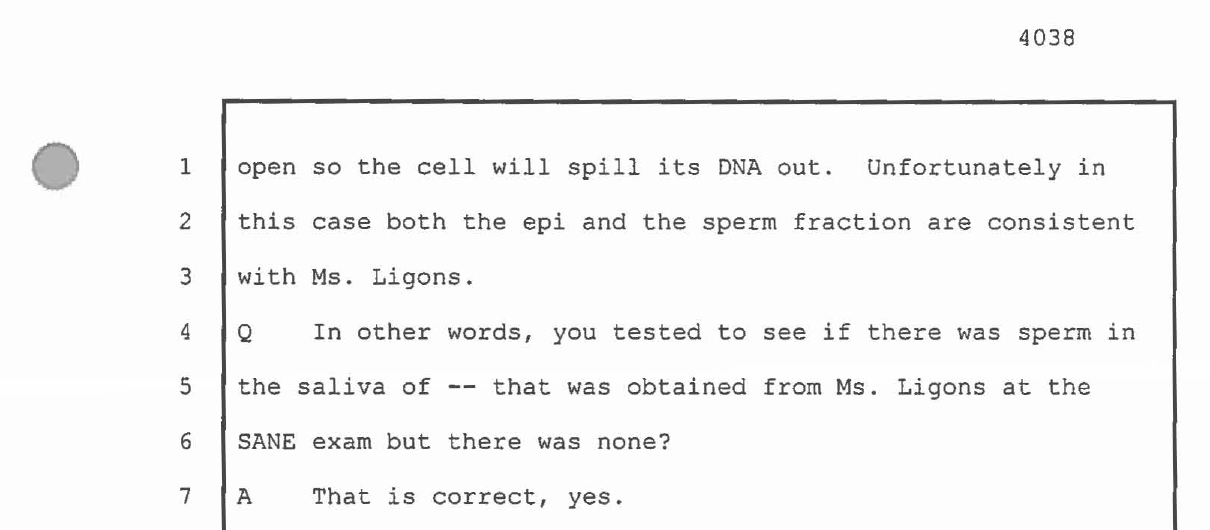
A 2017 panel of six forensic scientists that included Peter Gill pointed to this word. It wrote that the analyst’s errors appear to have arisen from, or contributed to, her pro-prosecution bias that is clearly demonstrated by her testimony that ‘unfortunately in this case’ Mr. Holtzclaw’s DNA was not found,
and warned that such emotional bias has the potential to create cognitive bias.
Gill et al. (2017), p. 41.
She told the jury the minor DNA couldn’t be compared, then excluded Daniel from it.
On December 2, 2015, Taylor took the jury through the swab from the flap behind the zipper. Most of the DNA on it came from one woman. The rest, a minor contributor, was too faint to use. The minor component of the profile is not suitable for comparison purposes,
she said. Essentially I’m saying I don’t have anybody that I feel comfortable trying to compare to the few alleles that are left in that minor component.
Trial Tr. 4056:6–25.
Two pages later in the transcript, the prosecutor asked whether she could exclude Daniel. She pointed to one location where that minor component showed a 13 but not the 16 Daniel carries. Gieger summed it up: whatever the mixture is from the seam on the outside of the pants or the flap on the inside of the pants, it’s not Officer Holtzclaw’s DNA.
She answered, That’s my conclusion, sir.
For the two swabs taken inside the fly in 2015, she excluded him because the minor component, which Gieger called a minor below your cutoff for comparison,
held an 11 that Daniel doesn’t have. When Gieger pointed her to a location where Daniel’s type did appear, she said, But one location does not make a match.
Trial Tr. 4058:10–4059:10; 4071:1–4072:13.
Trial transcript (4056:6–25; 4058:10–4059:10; 4071:1–4072:5)
Q There is a minor component of that DNA material, not enough to get a profile; correct?
A The minor component of the profile is not suitable for comparison purposes.
Q For comparison.
A Yes.
Q But you also have I notice a Y in that red category for 17Q2A; correct?
A Yes.
Q Tell me again what that Y means.
A Essentially because it is in that what is -- what I told you before was called the stochastic area. It was the area that we could use for exclusion but we could not use it for inclusion. And the statement that best suits that minor contributor is that it is not suitable for comparison purposes.
Q All right.
A Essentially I'm saying I don't have anybody that I feel comfortable trying to compare to the few alleles that are left in that minor component.
…
Q Knowing that there is no 18 at that location can you exclude him as contributing to the DNA mixture that you have?
A Well, I excluded him from the very first location because he is a 13,16 and I have a 13 at D8 but no 16.
Q Fair enough. And I'm sorry. I just picked one at random.
A Right.
Q But you can exclude him from the first location as well.
A Yes.
Q Can you also exclude him from the DNA evidence you obtained on the inside on the flap on the inside behind the closed zipper?
A Can we use the same location?
Q You can use any location you can show that you can exclude him. Tell me which one you're on.
A Okay. Now the minor, there is a 13 present.
Q Yes.
A But there is no 16.
Q And is that at the first location?
A Yes.
Q All right. So knowing that, whatever the mixture is from the seam on the outside of the pants or the flap on the inside of the pants, it's not Officer Holtzclaw's DNA.
A That's my conclusion, sir.
…
Q Which is a minor below your cutoff for comparison; correct?
A Yes.
Q But nevertheless, there was some type of DNA material there that had an 11; right?
A That's correct.
Q Okay. If I look at Officer Holtzclaw, does he have an 11 in his DNA profile at that location?
A No.
Q So can you exclude him as a contributor to the 17Q4 mixture?
A Yes.
Q Similarly, ma'am, is there a location where Officer Holtzclaw can be excluded and it appears that it's gonna be the second yellow one, the TH, is that a 1?
A You mean included?
Q Yes, ma'am. Officer Holtzclaw has a 9.3 there; is that correct?
A He has a 6,9.3. And that is there. But one location does not make a match.
Q Okay. So is there a way to exclude him from the mixture at the top?
A The mixture? The minor component --
Q Yes.
A -- in both these -- these profiles is not suitable for comparison purposes. Even if you should see, you know, some numbers that are similar I -- I can't -- I can't do a statistical analysis on that. And it just is not suitable for comparison.
“Not suitable for comparison” means the data can’t include anyone and can’t exclude anyone. Her written reports said the minor components were not suitable for comparison purposes, due to insufficient genetic material.
On the stand she said it too, and then excluded Daniel anyway. She told the jury faint results could be used to exclude but not to include. Her own reports had already found these too thin for either. Gill et al. (2017), p. 26 (quoting O.R. 182, 253).
Both exclusions fail on their own terms. The first rested on a missing number. When there’s very little of a person’s DNA in a sample, some of his types simply fail to show up. Analysts call it drop-out, and her laboratory’s own interpretation manual calls for an inconclusive result when it’s in play. A 16 that isn’t there is what drop-out looks like. The second rested on a number that wasn’t his. An 11 that doesn’t belong to Daniel shows that someone else contributed DNA. It says nothing about whether he did too. The 2017 panel that included Peter Gill found that Daniel couldn’t be excluded on her data: most of his types (22 of 32 on that flap swab, 19 and 21 of 32 on the two inside swabs) were present in the mixtures, many of them at low levels. Gill et al. (2017), pp. 23–26.
Set her answers side by side. One location where Daniel’s type appeared was not enough to include him. One location where his type didn’t appear was enough to exclude him. That exclusion is what the prosecutor built his next questions on.
She told the jury there was no male DNA inside the fly, and that Daniel’s absence was hard to explain.
Gieger turned to the two swabs from inside the fly. Did you find evidence of male DNA at either one of those locations, epithelial cells?
There’s no Y so the answer is no.
So even though Officer Holtzclaw was wearing these pants, his DNA is not inside them; correct?
That is correct.
Asked whether that surprised her, she said it did, and offered that someone else might have worn the pants. She agreed she had no evidence of that, and called his absence very difficult to try and explain.
Gieger’s next question was whether transfer is much more likely in a liquid such as vaginal fluid.
Trial Tr. 4072:14–4073:24.
She had already set aside a man’s marker on the flap swab. Asked whether its major contributor was female or male, she said, It was a female because as you can see from the chart, the X is in black and the minor contributor is a Y, but it’s in red so it really basically doesn’t count.
On redirect Gieger came back to the absence: had she found Daniel’s DNA where he would touch his pants to unzip them? No, I did not.
Trial Tr. 4044:14–18; 4087:13–18.
Two weeks earlier, Taylor had testified about a chair in Rosetta Grate’s room. Daniel’s DNA wasn’t on it. The same prosecutor then asked her whether a person could spend time in a room and leave no DNA behind. Yes, it’s possible.
Scientifically we’re just limited on it. We can’t -- we’re not that good yet?
Right.
Trial Tr. 2729:16–2730:17 (Nov. 18, 2015).
Trial transcript (4072:14–4073:24)
Q All right. Additionally, ma'am, at both of the locations where you obtained the mixtures, I notice that both at 17Q3 and 17Q4 you only have an X there, you don't have an XY.
A So those profiles originated from a female.
Q Did you find evidence of male DNA at either one of those locations, epithelial cells?
A There's no Y so the answer is no.
Q There's none there. So even though Officer Holtzclaw was wearing these pants, his DNA is not inside them; correct?
A That is correct.
Q And that would also -- even though there was a minor Y on the outside right here, you excluded him as being a contributor of that; correct?
A Yes, I did.
Q Does that surprise you as a DNA forensic analyst that the person actually wearing the clothes, their own DNA is not on them?
A It does, but contact DNA is very tricky sometimes. And sometimes the individual that is the wearer of the item of clothing, they give it to someone else to wear. And either one of those people could potentially be the major person in that profile.
Q And to be clear you don't have any evidence that Officer Hol- -- somebody else was wearing Officer Holtzclaw's pants?
A I do not.
Q All we know is he was wearing these pants and his DNA is not on his pants.
A Yes, which is very difficult to try and explain.
Q Does that fact and this evidence also contribute to your opinion about when discussing contact DNA it is much more likely for it to be transferred if the epithelial cells are contained in a liquid such as vaginal fluid?
A That's a very good possibility.
The DNA profile from the inside swabs showed no Y. The laboratory’s own measurement of the same samples found male DNA in both. Its quantification report of October 1, 2015, which Taylor initialed, lists 0.0102 and 0.0117 nanograms per microliter in the column headed “Qty Male,” about one part male to twenty parts female. That may be too little to type. It isn’t none. Whether any of it was Daniel’s, no one knows, because the laboratory never ran the male-specific test that could have said. Scott Adams 03610; Gill et al. (2017), pp. 22–23.
Nor was his absence hard to explain. Studies published before the trial had found that people often leave no detectable DNA on their own clothing or on things they touch, and that hands can carry someone else’s DNA to an object without leaving their own. Gill et al. (2017), pp. 26–27 (citing Goray & van Oorschot (2015), Breathnach et al. (2016, published online Oct. 2015), and Meakin & Jamieson). Taylor had agreed to the short version two weeks earlier, when it explained why the chair carried none of Daniel’s DNA. A person can be somewhere and leave none behind.
On December 2 the same absence did different work. If Gardner’s DNA had come off Daniel’s hands, Gieger argued, his own would be there too. It wasn’t, so the DNA must have come in a fluid. The argument rested on a fact that was wrong, the missing male DNA, and on a premise the science had already rejected. Gill et al. (2017), p. 22 (on Trial Tr. 4087–89).
She told the jury she couldn’t say how the DNA got there.
Gieger asked it himself at the end of his direct examination: Ms. Taylor, you can’t say how that DNA got there, can you, from a scientific standpoint?
The only thing I can tell you is it is a biological material that originated from Ms. Gardner.
Trial Tr. 4074:12–15.
On cross-examination, Daniel’s lawyer Scott Adams asked her to assume Daniel went through Gardner’s purse, and whether that could be the source. Sir, what I would tell you right now is anything is possible and that what I found was biological material on Mr. Holtzclaw’s pants that was consistent with Ms. Gardner. And how it was put there or how it got there, I wasn’t there, I didn’t see what happened so I can’t really tell you exactly what happened.
Could it have been secondary transfer? I can’t disagree with that.
She had tested nothing on the pants but the zipper area, inside and out: no pockets, no waistband, no pant leg. Trial Tr. 4077:13–4078:9; 4083:1–22; 4084:9–22.
On redirect, Gieger first asked whether the State’s scenario made the transfer more likely.
The judge sustained an objection to the form of the question. Rephrased, it asked only whether intercourse and then Daniel putting his penis back through the zipper was possible. It’s possible, yes.
Was the DNA consistent with that? It is consistent with the biological material I found.
Trial Tr. 4087:19–4088:16, 4089:1–11.
Trial transcript (4077:13–4078:9; 4083:1–22; 4089:1–11)
Q But for instance -- for instance, if Officer Holtzclaw came into contact with her on two occasions -- on June the 17th of 2014, let's assume that that is a fact. Assume that the fact is on one of the occasions he dug through her purse. You would expect to have her DNA in her purse, would you not?
A It's possible. I don't know for sure.
Q Would you -- would you agree with me that a woman tends to get in her purse? There's things in her purse that she wants to get -- get to?
A Sure.
Q And that's the whole purpose of carrying a purse?
A Yes.
Q Certainly that could be a source of the DNA that you eventually discover on the zipper; correct? Or on -- that you've testified here today?
A Sir, what I would tell you right now is anything is possible and that what I found was biological material on Mr. Holtzclaw's pants that was consistent with Ms. Gardner. And how it was put there or how it got there, I wasn't there, I didn't see what happened so I can't really tell you exactly what happened.
…
Q Okay. But you certainly agree with me that it could've been a secondary transfer?
A From Ms. --
Q The one that you did find.
A Gardner?
Q Yes, ma'am.
A I can't disagree with that.
Q Okay.
A Again, like I said, I have to say it is a biological material.
Q But there is a way that we could go back and even confirm more fairly that it would be a secondary transfer such as if you had tested the pockets. Did you ever test the pockets of Officer Holtzclaw's pants?
A The pockets?
Q Yes, ma'am, the inside of his pockets.
A No, sir, I did not.
Q Did you test any other area on Officer Holtzclaw's pants other than what you've testified here in court which basically is the outside and the inside of the zipper area?
A That is correct.
Q Okay. There was no other area on the pants?
A No, sir.
…
Q Ms. Taylor, hypothetically could a secondary transfer occur if Officer Holtzclaw's penis went into the 17-year-old vagina of Adaira Gardner and then he removed it and put it back in his pants through -- without undoing his gun belt but just through his zipper?
A It's possible, yes.
Q And is that consistent with the location of the DNA evidence that you found it matches Adaira Gardner on his pants?
A It is consistent with the biological material I found.
The defense’s explanation and the State’s got the same answer from her: possible, and consistent. That was the scientifically honest answer, because her results couldn’t tell one from the other. Her testimony never said the State’s account was more probable than an innocent one. Before trial, the State had told the court she would call ordinary touch transfer not reasonable and perhaps not even possible.
She said nothing of the kind. Nothing else she did could either. The areas that might have, such as the pockets, were never swabbed. Why the pockets mattered is set out on the DNA page.
Compare what the jury was told in closing. Gieger said the DNA came from the walls of her vagina
and was transferred in vaginal fluids
to the fly. The State’s only forensic witness had told the same jury that she couldn’t say how it got there. Trial Tr. 4307:8–13.
She told the jury she returned the pants to the property room. They stayed in her laboratory for ten months.
Taylor collected the pants from the property room on June 19, 2014, the day after they were taken from Daniel. At trial Gieger asked how they had been kept before he asked for more swabs in 2015. When I completed my original analysis on these pants I placed them back into the original brown paper sack I received them in. I tape sealed them shut. I initialed it and I then returned them back to the Oklahoma City Police Department evidence storage facility. And they remained there until your request.
She agreed that was consistent with the policies for certified DNA laboratories. Trial Tr. 4059:25–4060:15; 4080:10–17, 4081:7–9.
The property receipt shows when they went back. Taylor released the pants and the belt to the property room at the end of April 2015, more than ten months after she took them out and more than five months after her report of November 12, 2014. In her deposition she said she had put the sealed sack in our evidence storage area within the laboratory,
and when asked about the April 29 date, she said, I’m not going to disagree with that.
Scott Adams 03633 (property receipt); Forensic Examination Report SD-14-273 (Nov. 12, 2014); Taylor Dep. 51:19–52:24.
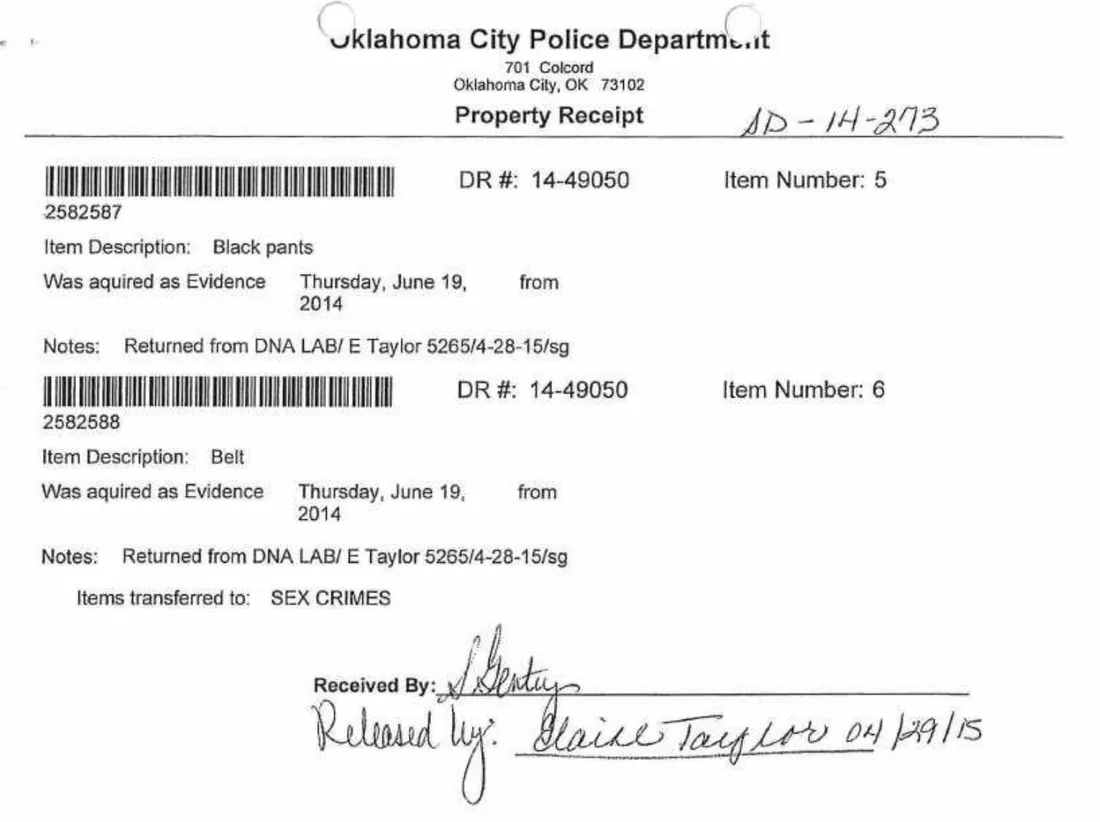
Where the pants sat matters because of what else came through the laboratory while they were there. The reference swabs attributed to Adaira Gardner reached the laboratory on October 24, 2014, and were extracted on November 4. Taylor had the pants the whole time. The DNA; Scott Adams 04664 (extraction worksheet, Nov. 4, 2014).
None of that shows contamination. It does mean the jury heard an account of custody in which the pants went from her bench back to the property room, when for more than ten months they sat in the same laboratory, with the same analyst, that handled the reference sample they were said to match. No one corrected it. The defense had stipulated to the chain of custody, and told her so on cross-examination. Trial Tr. 4081:2–5.
She would not change a word.
Transcript (95:20–96:6; 124:11–22; 134:25–135:9)
Q Okay. And tell me -- I've got a quote from the trial and I will read it to you, and tell me if you still concur with this. "Essentially I'm saying I don't have anybody that I feel comfortable trying to compare to the few alleles that are left to that minor contributor."
A If that's my testimony as you stated it, then that's my testimony --
Q Right.
A -- and I have to agree with it. Because I, absolutely, ma'am, I will not change a single word in my testimony.
…
A If that's what my testimony says, then that's what I said, ma'am. As I started out in the very --
Q You never claim that you --
A As I started out in the very beginning, whatever I testified in court to, I am not changing it. So if you are reading what my answer is, that's what I said. And I'm not changing it.
Q So even if you made a mistake, you would not change your testimony?
A Ma'am, I don't believe I made any mistakes.
…
Q So you're looking at what Mr. Gieger drafted on your behalf, and I am giving you the opportunity to correct it. If you don't want to, fine.
A I am going to revert back to my testimony, whatever I testified to is what I testified to that day. I'm not changing it, I'm not correcting it, if there's something wrong, so be it, I -- I don't -- I am not changing anything, ma'am. And I'm not trying to be rude.
Taylor Dep. 95:20–96:6, 124:11–22, 134:25–135:9.
By 2019 the record contradicted her trial testimony on several points: her report did not permit the exclusion she gave, her own data measured the male DNA she said was not there, and the vaginal-fluid opinion rested on no test. Given the chance to revisit any of it, she refused. “I will not change a single word.” Asked whether she would correct a mistake: “I don’t believe I made any mistakes.” Shown the prosecutor’s summary of her testimony, which she had just disowned: “if there’s something wrong, so be it.” Trial Tr. 4058:18–4059:10, 4071:11–13, 4072:19–25; Supp. Forensic Exam. Rep. SD-14-273 (Oct. 7, 2015); Ex. 15 at 15-058, 15-060; Taylor Dep. 96:4–6, 124:21–22, 132:24–25, 135:4–9.
The male DNA is the plainest case. Earlier in this same deposition, asked whether the laboratory had measured male DNA on the two swabs from inside the fly, she read out the figures herself: it was quanted at .0102 and .0117,
a male-to-female ratio of 1 to 20 and 1 to 21. Forty-four pages later, asked whether male DNA was found on the fly swabs, she answered Nope,
and said the two inside swabs only show to be female DNA.
A measurable quantity of male DNA is not a profile anyone can compare, and the laboratory never obtained one. But it is male DNA, and at trial she had told the jury there was none. Taylor Dep. 99:20–25, 143:22–144:4; Trial Tr. 4072:14–25.
Science corrects itself when the data require it. She treated her testimony as a position to defend, and said so on video.
Her supervisor was in the courtroom. Mr. Ruddock watched one of her two days on the stand, and before trial he had given her a review article on contact DNA. His word for her testimony, again and again, was “confused.” That is the testimony that gave the jury the exclusion and the missing male DNA, and neither was ever corrected. He said analysts should “restrict ourselves to DNA unless we have data.” What he did at the time was talk with her back at the lab, with no written review. He described that talk as general advice about contact DNA, not about her testimony in this case, and could not recall raising the lubrication testimony with her. Nothing in his deposition indicates he told the prosecutor or the court. Ruddock Dep. 15:6–15, 19:8–10, 20:14–15, 26:21–23, 28:7–10, 28:22–29:6, 31:15–17, 41:13–20, 42:12–14.
Help fund the investigation and litigation.
UNCUFF pays for records work, forensic review, investigation, post-conviction litigation, and telling the stories of wrongfully convicted people to the public.