
“I Don’t Know How He Did It.”
Jannie Ligons said that at trial, describing how Daniel exposed himself through the fly of fastened duty pants with his equipment belt still on. Eight of the nine women who alleged rape or oral sodomy gave accounts in which the pants stayed on and the penis came out through the fly. Trial testimony indicated that the compression shorts he wore underneath had no fly, and police never collected the pair he said he had been wearing. The evidence does not establish that exposure was physically impossible, but it raises significant doubt about the mechanics described by a majority of the accusers.
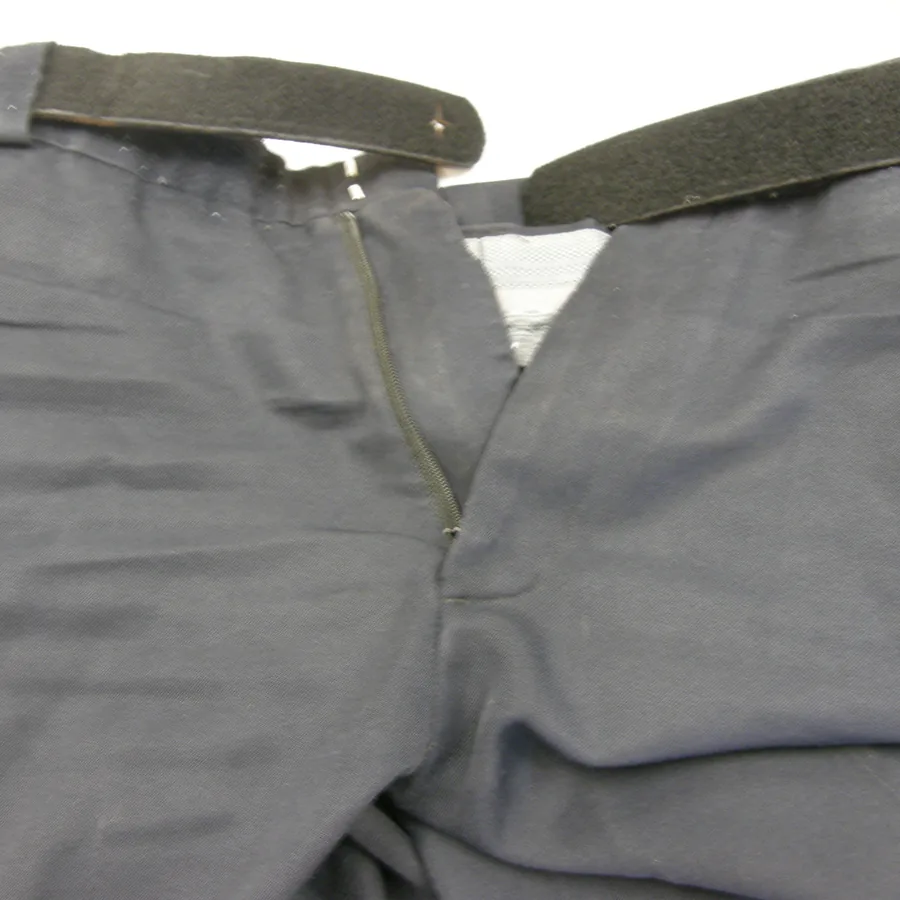
The recurring account was exposure through the fly, with the belt still fastened.
Detective Kim Davis summarized the pattern at a September 2014 hearing: “On him he always just unzipped his pants. He doesn’t remove his gun belt or unfasten his pants; he just unzips them.” At trial, when asked why Kala Lyles’s description mattered, Davis answered, “Because all the other women that I had interviewed had said the same thing.” Mot. Hr’g Tr. 88 (Sept. 3, 2014); Trial Tr. 3737.
The individual accounts were not identical, but the same mechanics appeared repeatedly:
- Jannie Ligons: “He didn’t undo — he just unzipped it and took it out.” At trial she added, “I don’t know how he did it.” Prelim. Tr. I, 266–68; Trial Tr. 508, 510.
- Terri Morris: she did not see the exposure occur and testified that the belt remained fastened; she believed it was through the fly. Prelim. Tr. II, 12–13; Trial Tr. 3149–50.
- Sherry Ellis: she said the penis was already erect and in front of her when she looked up, with the pants still up. Scott Adams 00794–95; Prelim. Tr. I, 284; Trial Tr. 2988–89.
- Rosetta Grate, Syrita Bowen, and Kala Lyles: each described exposure through the zipper or fly without removal of the duty belt. Trial Tr. 2542–45, 2593–94, 3363–67, 3626–28.
- Adaira Gardner: she said her back was turned, that she heard a zipper, and that the penis was later returned through the fly. Trial Tr. 3776–78; Prelim. Tr. I, 207–08.
- Regina Copeland: she did not see the penis and did not describe how it was exposed; on cross-examination she agreed that afterward he “zipped up his pants.” Asked how he would have redressed, Detective Davis answered, “zip up his pants.” Trial Tr. 2830, 2862, 2944.
Trial testimony described flyless compression shorts.
Kerri Hunt, Daniel’s girlfriend, testified that she had watched him dress for work and that the compression shorts introduced as a defense exhibit had no fly. Asked whether that was all she had ever seen him wear with his uniform, she answered yes. Trial Tr. 4118–19 (Def. Ex. 4).
During his recorded interview, Daniel told detectives that the pair he had worn was in the washing machine. Police did not collect it. Davis agreed at trial that no consent to search the home was requested and no warrant was sought. Scott Adams 00104; Trial Tr. 1146; Scott Adams 01391.
The interrogation video showed fitted, thigh-length underwear that appears to be compression shorts, but the court noted that the garment visible on the video was not necessarily the pair worn during the Ligons stop. No undergarment was examined. Collecting the washer pair would have established its construction and allowed testing.
Officers can use the fly without removing a duty belt, but the underwear question remained.
At trial, Captain Ryan Boxwell demonstrated the equipment belt and testified that officers who need to urinate typically leave the rig on and unzip the fly. That evidence addressed the pants and belt, not whether the compression shorts underneath could be moved quickly enough to match the accounts. Trial Tr. 943–47.
The closest direct answer came from Hunt. Asked whether it would be impossible to pull the compression shorts down and expose the penis through the pants fly, she answered, “I definitely think it would take some work.” Asked whether that would be less work than removing the belt, she said it would probably be easier “just to take it all off.” Trial Tr. 4126–27.
That testimony cuts against a claim of absolute impossibility but leaves a mismatch between a maneuver that would take work and accounts in which Daniel’s erect penis supposedly appeared immediately, in every case without the complainant describing any adjustment of the underwear.
The State also placed the DNA transfer at the fly.
Across thirteen accusers and thirty-six counts, the only forensic evidence the State offered to corroborate a sexual assault was DNA recovered from the fly of Daniel’s uniform pants and matched to Adaira Gardner. The State told the jury how it got there. Its witness endorsement said the analyst would testify that Daniel pulling his penis through the zipper opening, penetrating Gardner, and returning it through the zipper was “entirely consistent” with where her DNA was found; in closing, the prosecutor called it a fact that her DNA had come from the walls of her vagina and been carried in vaginal fluid onto the outside and inside of the fly. In June 2014 the laboratory had swabbed the outward-facing surfaces of the fly, along the zipper line and on the flap behind the zipper; in September 2015 it swabbed the inside surfaces. Trial Tr. 4028–29, 4035:3–11, 4059:22–4063:15, 4307; Forensic Examination Report SD-14-273, p. 2 (Nov. 12, 2014); State’s Endorsement of Witnesses, item 124, O.R. 240; Scott Adams 09880; Ex. 11 to Taylor Dep.
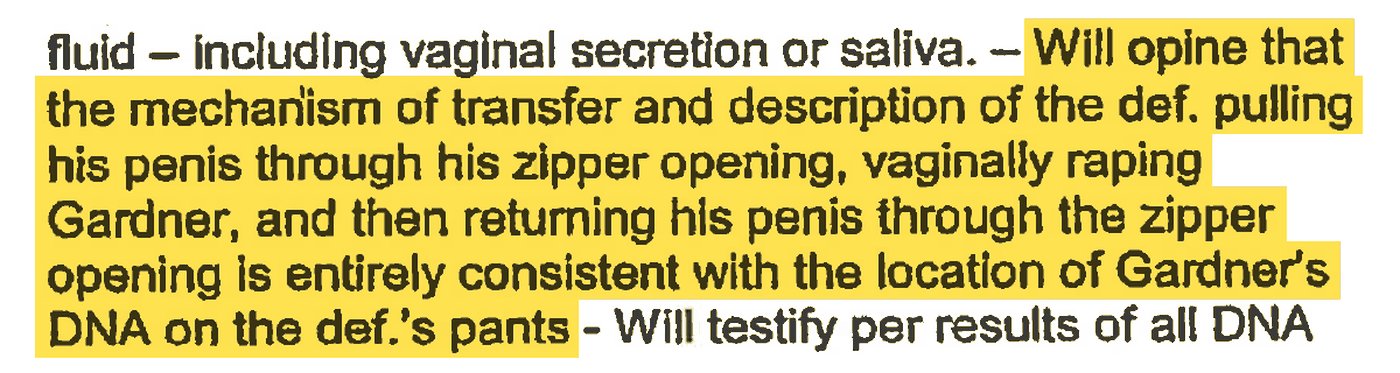
That is the same maneuver the clothing evidence puts in doubt. The State’s account of the DNA depends on the penis coming out through the fly of fastened pants, over compression shorts with no fly, exactly as the accusers described. If that maneuver is in question, the State’s explanation for how Gardner’s DNA reached the fly is in question with it, and the alternative the State dismissed at trial, transfer from Daniel’s hands after he went through Gardner’s purse the day before, becomes, in UNCUFF’s view, the much more plausible scenario.
The garment that would have settled it was in his washing machine. Police never took it.
Nobody can prove from a courtroom that a man in flyless compression shorts under a duty belt cannot get his penis out through a trouser fly. What can be said is this. Eight women described the same maneuver, and not one of them described the one thing it would require, the underwear being pulled down. On June 18, 2014, Daniel told detectives what he was wearing and where the pair was. It was a few miles away, in a washing machine. No one asked for it, no one sought a warrant, and no one has examined it since. The one physical test that could have answered a question at the center of eight allegations was available that afternoon, and the investigation walked past it. Scott Adams 00104, 01391; Trial Tr. 1146, 4118–19, 4126–27.
Help fund the work.
UNCUFF funds investigation, forensic review, records work, post-conviction litigation, and telling the stories of wrongfully convicted people to the public.