
Sherry Ellis
Ellis's allegations produced four convictions and sixty-two years, the longest sentence tied to any one accuser. Police found her while reviewing Daniel's contacts. Her initial description did not match him. The patrol car's location data leaves under four minutes for the entire sequence, not just the alleged act, which she estimated lasted five to ten minutes on its own. Years later, Ellis testified under oath that she had never seen Daniel before trial.
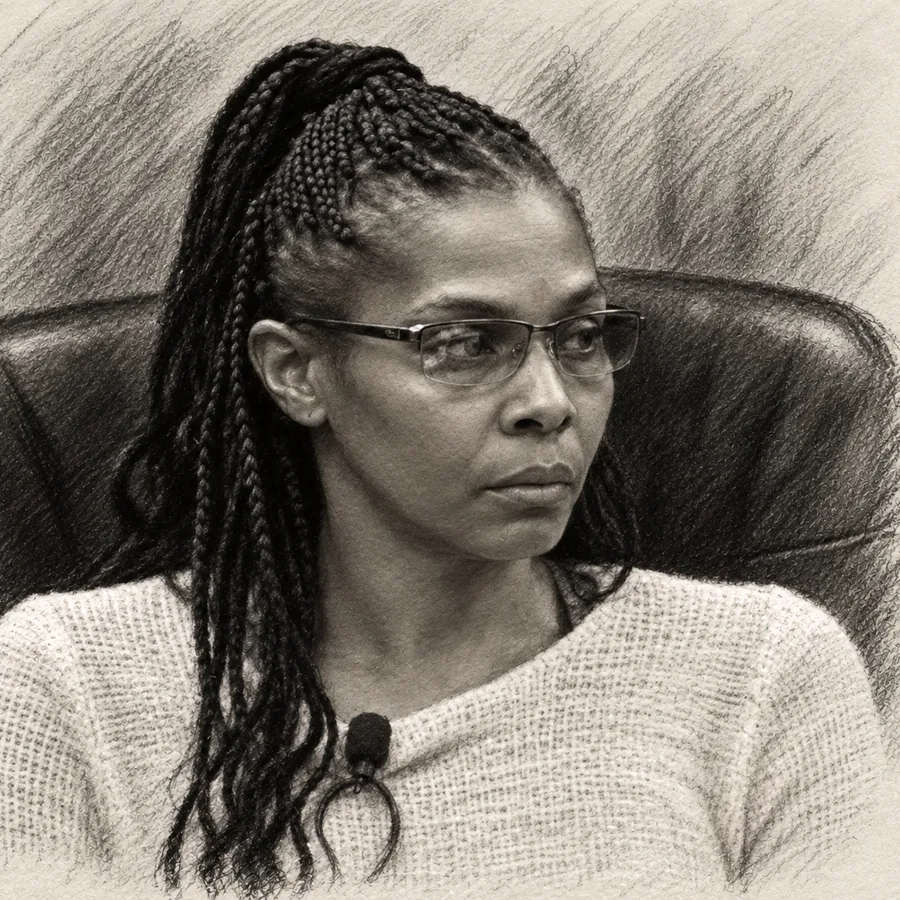
Ellis did not report Daniel. Police found her.
Investigators found her name while reviewing his police contacts after Jannie Ligons's complaint, then went looking for her.
An internal email from July 30, 2014, shows what investigators had at that point. It discusses two women, identified as “Stacy Ellis” and “Kayla Liles” (misspellings of Sherry Ellis and Kala Lyles), and says:
Investigators pursued Ellis because Daniel had run her name several times and because a Varuna entry described her as a suspected prostitute.
OKC 1035.
Running a name for warrants is routine police work. Officers are trained to do it and use it as a basic safety practice on patrol.
The first mention of an assault came from Davis, not Ellis.
On cross-examination, Detective Kim Davis agreed that as of early August 2014 Ellis had not reported anything inappropriate between herself and Officer Holtzclaw.
Trial Tr. 3114:9–13. Davis reached her through a records search: a Facebook message that went unanswered, a run of Ellis’s Facebook friends through Varuna, a call to a relative at work, and a message for Ellis to call. When Ellis called back, Davis told her what I was investigating,
and Ellis, in Davis’s words, started kind of talking fast and said that she was a victim.
The in-person interview followed on August 5 at the Sex Crimes office.Trial Tr. 3058:7–3059:18.
Ellis’s recollection of how Davis opened stayed consistent for years (a tip
that she’d been assaulted by an officer), whether recounted at the preliminary hearing, at trial, or at her 2021 deposition. Trial Tr. 2998:12–2999:14 (reading Prelim. Tr. 297); Ellis Dep. 45:13–20 (Mar. 19, 2021).
Davis has explained under oath what the supposed tip was. At the September 3, 2014 bond hearing, asked whether she had told a woman she’d been sexually assaulted after seeing only that an officer had run a records check on her, Davis answered: No, I wasn’t gonna go tell her: Hey, we’re investigating a police officer and he’s assaulted six women and we want to see if you’re one. I didn’t want her to know all that because then people are gonna jump on the bandwagon; yeah, that was — I was assaulted too. So I just said — yes, I lied, I had not received a tip. I told her I received a tip that you may have been sexually assaulted by a officer.
Mot. Hr’g Tr. (bond reduction), Sept. 3, 2014, 112:16–113:15.
At trial Davis testified that I received a tip
was her approach, and that she used it with women who then told her nothing had happened.Trial Tr. 2423:15–2424:19.
Ellis described a Black man who came up to her shoulders.
The report of her first account describes the officer as a muscular Black male, darker-skinned than she is and shorter than her own height of 5′11″. She could not remember whether he had facial hair. Scott Adams 00794–95.
Near the end of that interview, Davis came back to the description:
DAVIS: “When you described him as a black male, what… and I don’t know… everybody’s… like what are you? Are you a medium color? What’s your skin tone to you?”
ELLIS: “Uhh… I’m light.”
DAVIS: “You’re light. Ok what was he?”
ELLIS: “He’s darker.”
DAVIS: “He’s darker than you?”
ELLIS: (nods yes)
DAVIS: “Darker than your skin tone?”
ELLIS: (nods yes)
Davis interview of Ellis, Aug. 5, 2014 (video).
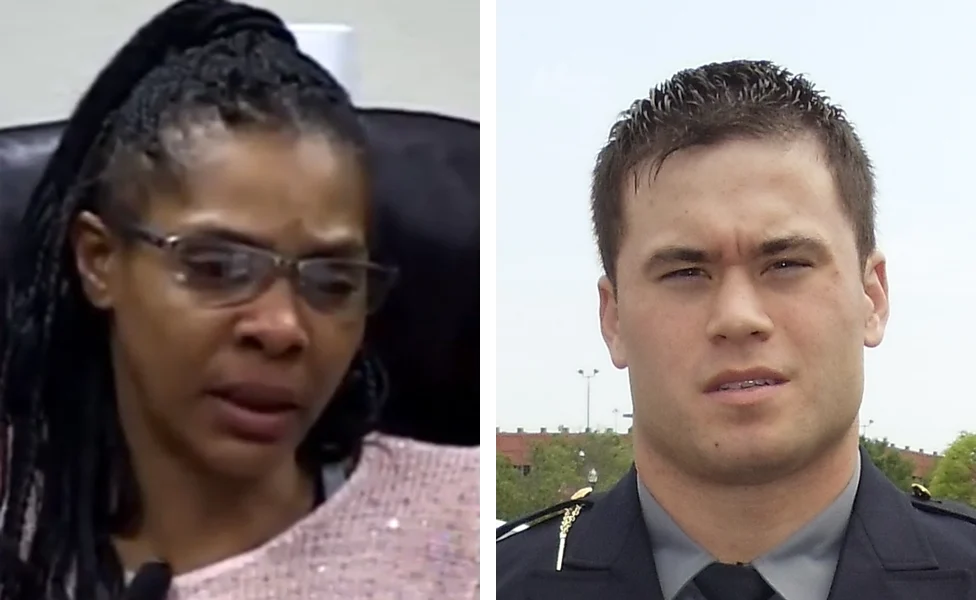
Daniel is not Black. Department booking information and the probable-cause affidavit listed him at 6′02″; an OLETS return listed him at 6′01″. Scott Adams 00072, 00239, 00438.
In 2021 Daniel’s lawyer showed Ellis a still from her August 2014 interview with Davis (the video above), her hand raised to show the officer’s height, and asked whether he came up to about her shoulders. Yeah.
So maybe 5′5,″ 5′6″?
Yes.
Asked how else she would describe him, she said, I said that he was black, he was dark complected, I think black is what I said.
Ellis Dep. 47:1–48:4 (Mar. 19, 2021). That is seven to nine inches shorter than Daniel.
Ellis later said the darkness explained why she thought the officer was Black. At the preliminary hearing, she said: Because it was dark — and it was dark and he looked like a darker — his skin was dark tone.
When asked whether she still thought so, she answered: I don’t know.
Prelim. Tr. I, 295 (Nov. 17, 2014). At trial she said: He looked like he was a black man because it was dark.
Trial Tr. 2996.
Ellis could not identify Daniel at the preliminary hearing.
From the beginning, detectives knew Ellis could not identify the officer. The report of her first account says simply: she cannot pick him out of a line-up.
Scott Adams 00795.
At the preliminary hearing, with Daniel sitting at counsel table, the prosecutor asked whether she saw the officer in the courtroom:
Q: “Is that individual in the courtroom? Do you see him in the courtroom? And take a minute and look around.”
ELLIS: “It was dark and I really didn't — it was dark — it was really dark. I didn't really know.”
Q: “Do you think you could identify him if you saw him?”
ELLIS: “No. Because it was dark.”
Q: “Does anybody look familiar to you, ma'am? Don't know?”
ELLIS: “I don't know.”
Prelim. Tr. I, 294–96.
No photographic lineup is documented in the record cited here. Ellis did not identify Daniel at the preliminary hearing, even with him sitting in the courtroom. At trial, the prosecution did not ask her to identify him. Trial Tr. 4245–46; Scott Adams 00795.
Ellis estimated five to ten minutes for intercourse. The AVL leaves 3:49 for everything.
Ellis alleged that the events occurred early on May 7, 2014. At trial, she estimated that intercourse alone lasted five to ten minutes; the police report put it at about ten. Trial Tr. 3007, 3088–89 (trial estimate); OCPD Report 14-066104(002), Det. Davis, Aug. 13, 2014, at 2–3, Scott Adams 00794–95 (“She said it lasted about 10 minutes”).
The patrol car’s location records leave less time than that. AVL logged the car at the cul-de-sac at 1:14:28 and on Miramar at 1:18:17, three minutes and forty-nine seconds later. That interval had to include the drive, parking, both people leaving the car, the instructions Ellis described, her walking away, the alleged sexual conduct, and Daniel’s return. Trial Tr. 3118–23.
Touching absent from the first call later became two sexual-battery counts.
Ellis's account of physical contact grew across three tellings. In her first telephone account, as Davis recorded it, Ellis did not say the officer groped her. The in-person interview that followed added touching over her clothes. At trial, she testified that his hands went inside her bra, touching the skin of her breasts, and inside her underwear. Scott Adams 00794–95; Trial Tr. 2985:11–2986:11. Two of Daniel's four Ellis convictions, the sexual-battery counts, rest on the touching that wasn't in her first account.
Ellis later said she had never seen Daniel before trial.
In March 2021, as a plaintiff in the civil suit, Ellis was deposed. Daniel’s lawyer showed her two photographs of Daniel and asked whether the man resembled the person who assaulted her. No,
she said, and I don’t know him.
Deposition of Sherry Smith (formerly Ellis), Ellis v. Holtzclaw, No. CIV-15-0019-HE (W.D. Okla. Mar. 19, 2021), 34:4–16. On her own lawyer’s questions she recognized a photograph of Daniel from court
and agreed she had not seen him before: I haven’t ever seen him before trial, that’s when I finally seen who the accused of raping me.
Asked why she believed Daniel was the officer, she pointed to his build: His built, his muscular.
She described him as Spanish,
with brown skin, about six feet tall.Ellis Dep. 62:17–64:13.
She said the assault happened, that Daniel was the man, and that she had no doubt; asked how she explained that he is not Black and is taller than she is, she said it was dark, and that she had been standing on a curb. She also testified that no one had told her what to say and that she felt no pressure from detectives or prosecutors.Ellis Dep. 54:12–55:11, 59:22–60:15, 63:12–16. Ellis did not recant the assault. She continued to say Daniel was the officer. But her deposition produced a direct conflict with that position: she also testified, I haven’t ever seen him before trial, that’s when I finally seen who the accused of raping me.
That statement is difficult to reconcile with her claim that Daniel was the man she encountered in May 2014.
Ellis's allegations resulted in sixty-two years.
The jury convicted Daniel on four Ellis counts: sixteen years on Count 10, forcible oral sodomy; thirty years on Count 11, first-degree rape; and eight years each on Counts 33 and 34, sexual battery. Trial Tr. 4324–26.
The records place Daniel's patrol car in the area, but no eyewitness or forensic evidence independently corroborated the sexual acts Ellis described. Those four convictions depended on her account. Her original description materially differed from Daniel, she could not identify him at the preliminary hearing, and the AVL left less than four minutes for a sequence in which she estimated intercourse alone lasted five to ten. Years later, she testified that she had never seen Daniel before trial.
Help fund the work.
UNCUFF funds investigation, forensic review, records work, post-conviction litigation, and telling the stories of wrongfully convicted people to the public.