
How the State Distorted the DNA Evidence
The State said three women had sexual contact with Daniel through the fly of his uniform pants in the twenty-four hours before they were seized. Two left no DNA there at all. For the third, the laboratory reported a trace, in a mixture, at a level no higher than a car door handle.
Five things the jury wasn’t told, or was told wrong.
Three women, one fly, one day. Two left nothing.
The State said three women had sexual contact through the fly of Daniel’s uniform pants within a day of the seizure. Two were excluded. For the third, the laboratory reported a trace, in a mixture, at about the level a car door handle carries, with no stain on the fabric.
No one ever tested for a body fluid.
The prosecutor called it a fact that the DNA came from vaginal fluid. No test for vaginal fluid or saliva was ever run, and the analyst later said she had no way of knowing what the body fluid is.
The jury heard two things the lab file contradicts.
The jury was told there was no male DNA on the swabs from inside the fly, and that Daniel’s own DNA was missing from his pants. The laboratory measured male DNA on both swabs, and its report says the minor contributor was not suitable for comparison, so Daniel was never excluded.
Daniel went through Gardner’s purse the day before.
She testified to it herself, and the State never disputed it. The analyst and her supervisor both testified that they couldn’t say how the DNA got there.
An unidentified trace became a hunt for more victims.
Detectives treated the unknown profile as proof of another victim and took reference swabs from eleven women over four months. That search is how a case with one accuser became a case with thirteen.
Taylor Dep. 129:20–22 (Jan. 15, 2019); sources for each point in the sections below.
Thirty to forty minutes of alleged sexual contact, and less DNA than a car door handle.
The uniform pants Daniel handed over to detectives on June 18, 2014, are the only physical evidence offered to corroborate any of the sexual-assault allegations, and the State was specific about what had happened in them in the preceding 24 hours.
Prosecutors alleged that Daniel had penile-vaginal intercourse with Adaira Gardner for roughly ten minutes through the unzipped fly of his buckled uniform pants, and raped Kala Lyles for twenty to thirty minutes through the same opening. They also alleged Jannie Ligons had oral contact with him through that fly, all within twenty-four hours of the pants collection. Trial Tr. 3768–73, 3627, 501, 511.
Three women, three alleged acts through the same few square inches of fabric, inside a single day. The fly is the one place in this case where the accusations and the physical evidence meet.
Saliva and vaginal fluid are loaded with DNA. A single milliliter of saliva carries around 17 micrograms of it. A vaginal swab taken after intercourse yields thousands of nanograms of the woman’s DNA, so much that laboratories routinely have trouble finding the man’s sperm underneath it, and a penile swab after intercourse carries far more female DNA than one after ordinary skin contact. If the fly had been saturated with “sloppy sex remnants,” to borrow Detective Davis’s phrase, the female DNA on it would have been orders of magnitude greater than what the laboratory found. Gudiseva et al. (2016), BMC Medical Genomics 9:17 (saliva yielded 17.6 micrograms of DNA per milliliter); Benschop et al. (2010), Forensic Sci. Int. Genet. 4(2):115–21 (post-coital vaginal swabs yielded thousands of nanograms of female DNA in the non-sperm fraction, an “overwhelming quantity of female cells”); Bouzga et al. (2020), Science & Justice 60(3):234–42 (penile swabs after intercourse carried significantly more female DNA than after skin contact); Gregory–Davis interview for MMI, Sept. 19, 2016 (transcript, file 542_0930, at 2).
These measurements come from different substrates and collection conditions and are not directly interchangeable. They illustrate the scale of the recovered quantity rather than predicting an exact expected yield from these trousers.
Excluded.
The complainant whose report led to the seizure of the pants was the first woman compared to the fly. Her reference swab was taken the same day the pants were collected, hours after the contact she described, and forensic analyst Elaine Taylor was clear about the result.
Excluded.
Lyles is the woman the State said Daniel raped for twenty to thirty minutes through that opening on the morning of June 18, 2014, the same day the pants were seized. In probable-cause affidavits sworn before a judge, Detective Kim Davis wrote that Lyles's buccal swabs were compared to the profile on Daniel's pants and It was not a match.
Charges involving Lyles were filed anyway. Scott Adams 05878, 05880.
A trace, in a mixture.
The State's laboratory attributed DNA on the fly to Gardner. There was very little of it, and it was not alone. The fly swabs contained low-level DNA. Dr. Michael Spence, a forensic DNA expert retained on appeal, compared those yields with another swab from the same investigation and found that a car door handle yielded roughly four to four and a half times more DNA than three of the four fly swabs, and a comparable yield to the fourth. Spence Aff. ¶14.
The samples were also mixtures of DNA from several individuals. An international panel of forensic scientists that reviewed the case observed that complex mixtures of this kind are typical of indirect transfer. Gill et al. (2017), p. 12.
Nothing suspicious.
In closing, prosecutor Gayland Gieger told the jury:
The State’s analyst hadn’t told the jury that. Asked by Gieger whether she could say from a scientific standpoint how the DNA got there, she answered, The only thing I can tell you is it is a biological material that originated from Ms. Gardner.
Trial Tr. 4074:12–15.
She had also told the jury that a woman of Gardner's age would be very likely to have quite a bit of lubrication. Trial Tr. 4065.
If that is what happened, the fly should have shown signs of it. The international panel cited research finding visible staining after as little as two minutes of consensual intercourse without ejaculation, and concluded that the State's own scenario created an expectation of visible staining on the fly when the pants were seized less than a day later. Gill et al. (2017), pp. 11–12.
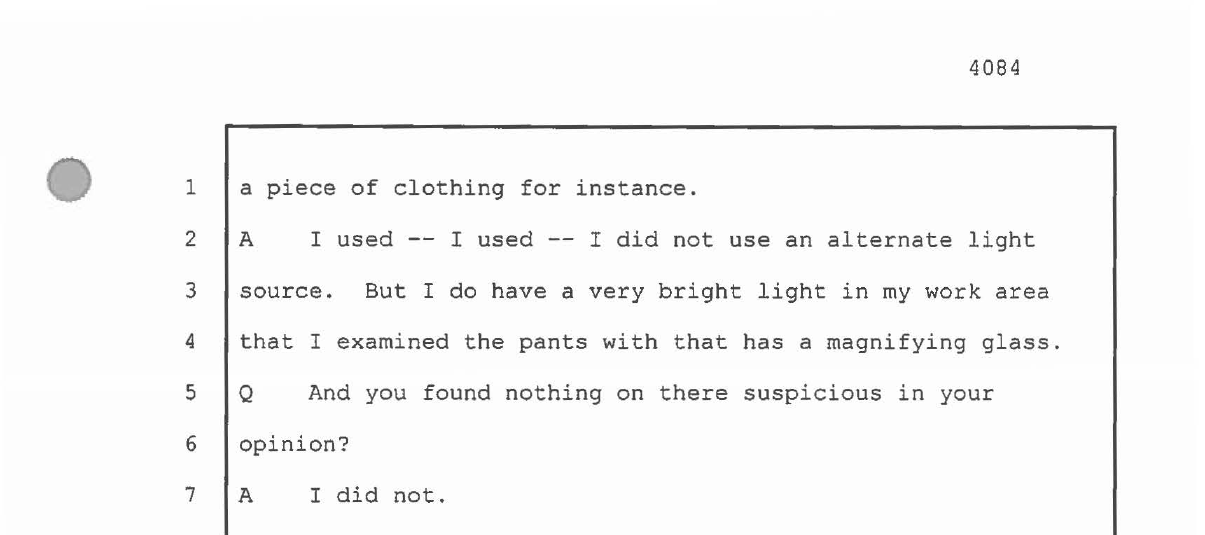
Taylor examined the pants under a very bright light with a magnifying glass, confirming that she examined and tested the inside and outside of the zipper-front area. Asked whether she found anything suspicious, she answered: I did not.
Trial Tr. 4084:2–22.
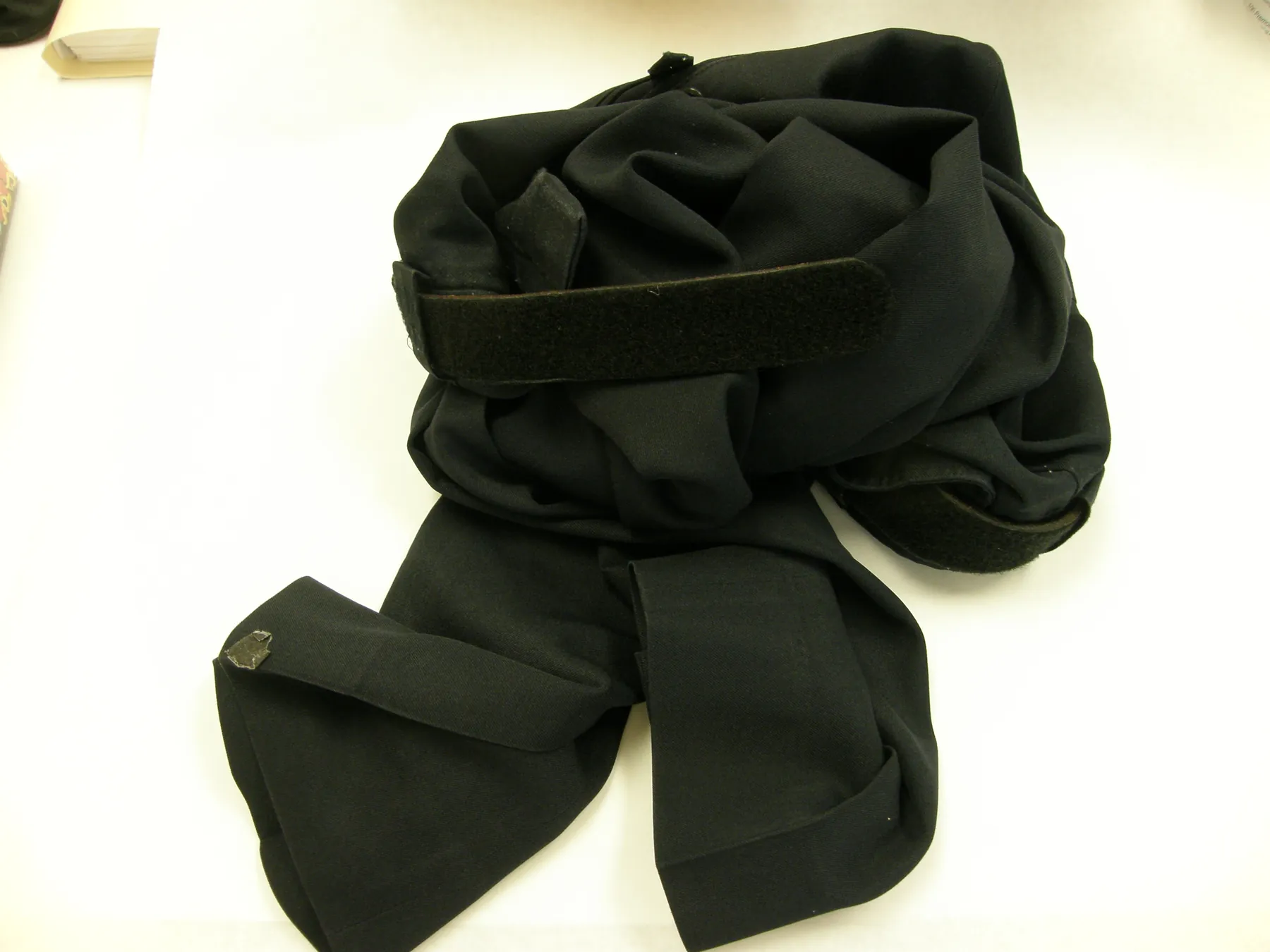
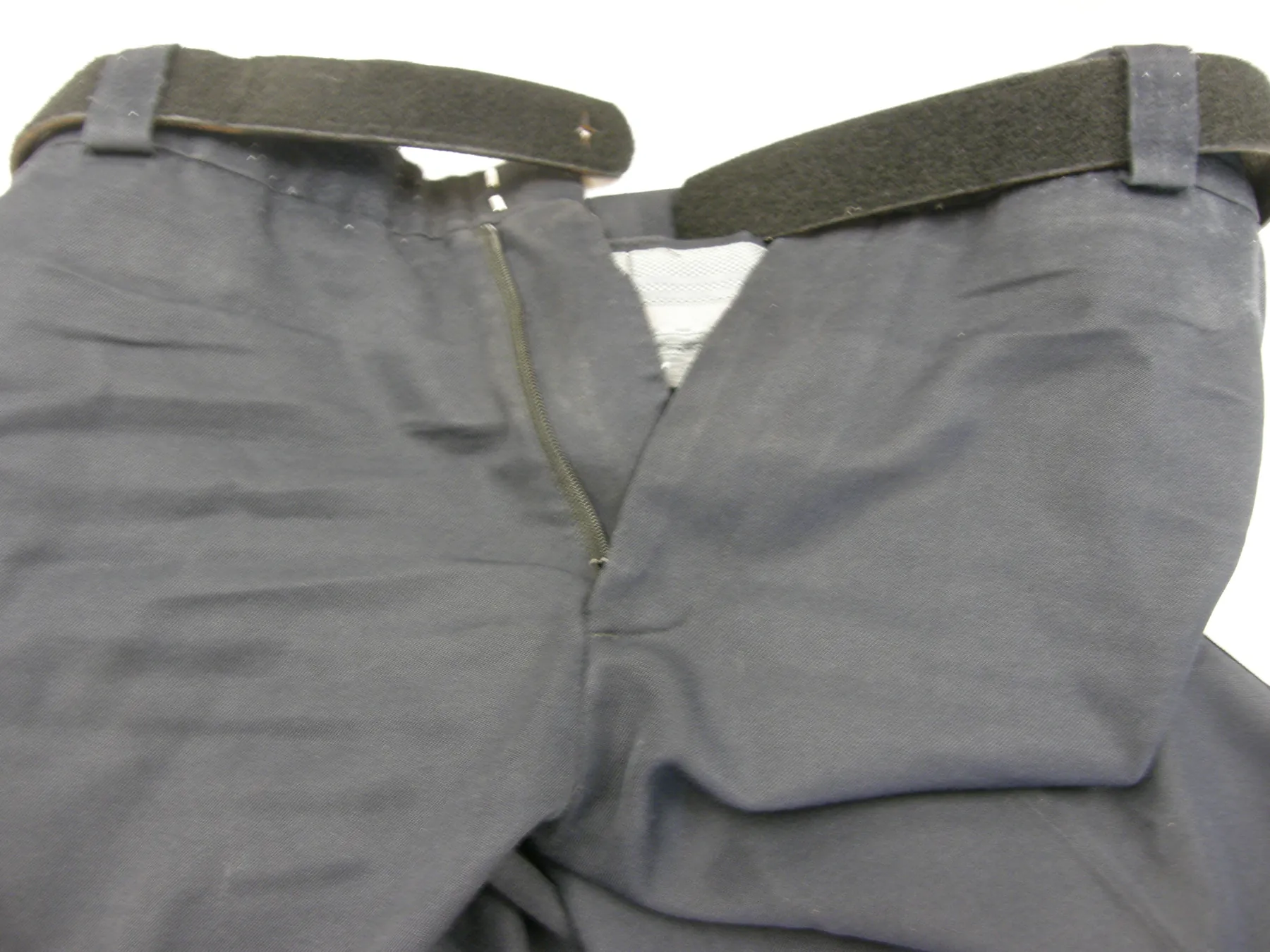
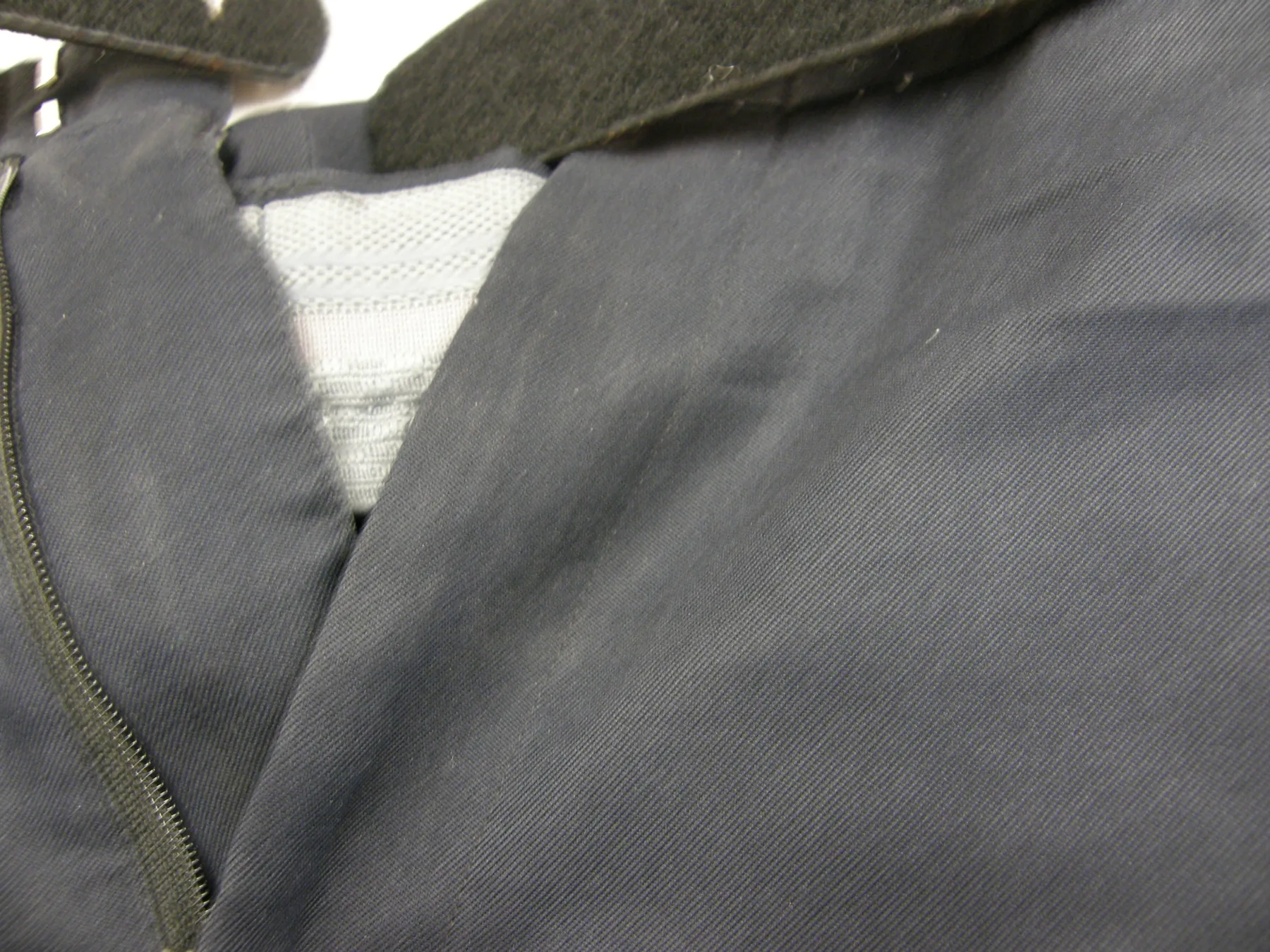
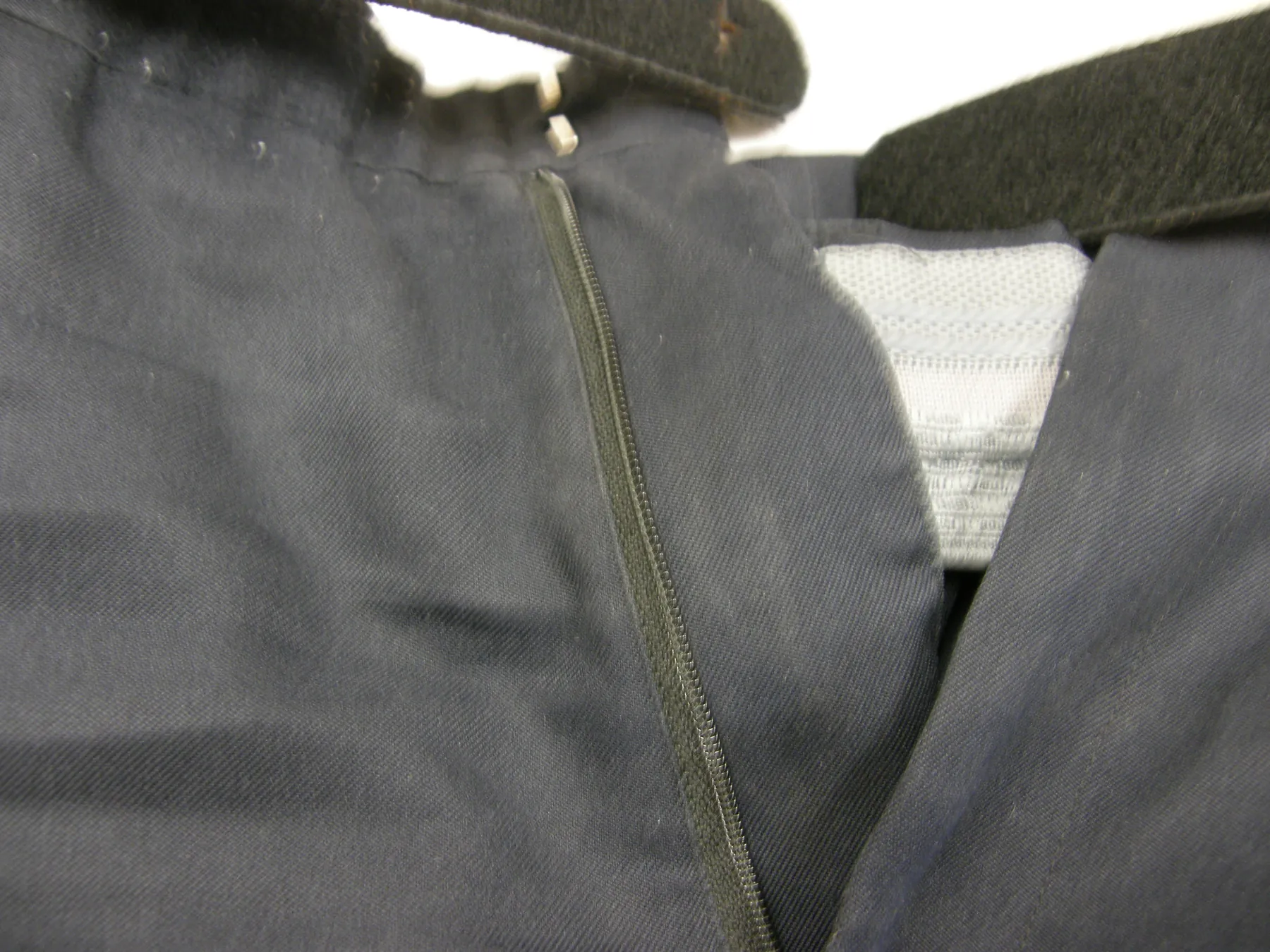
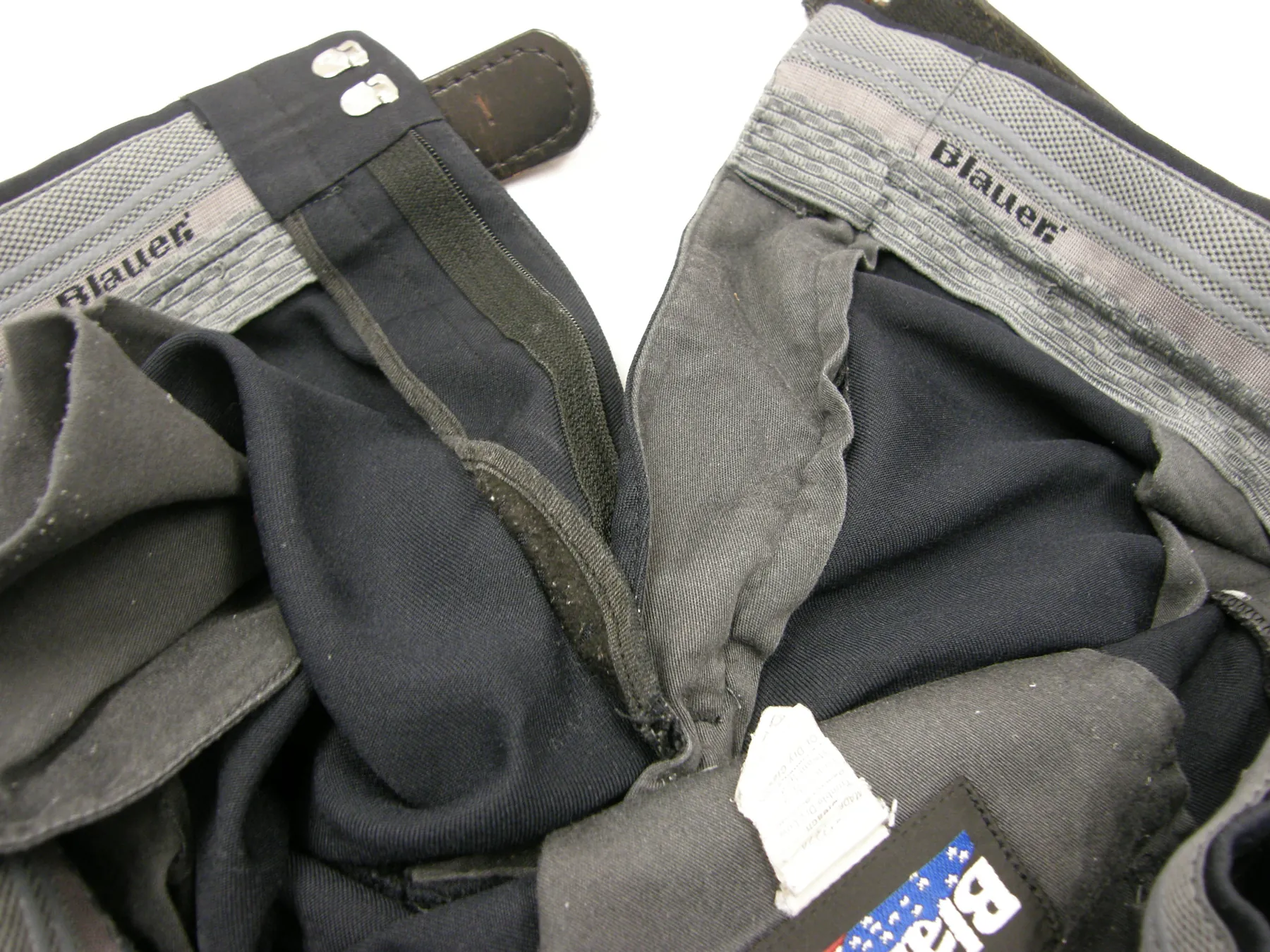
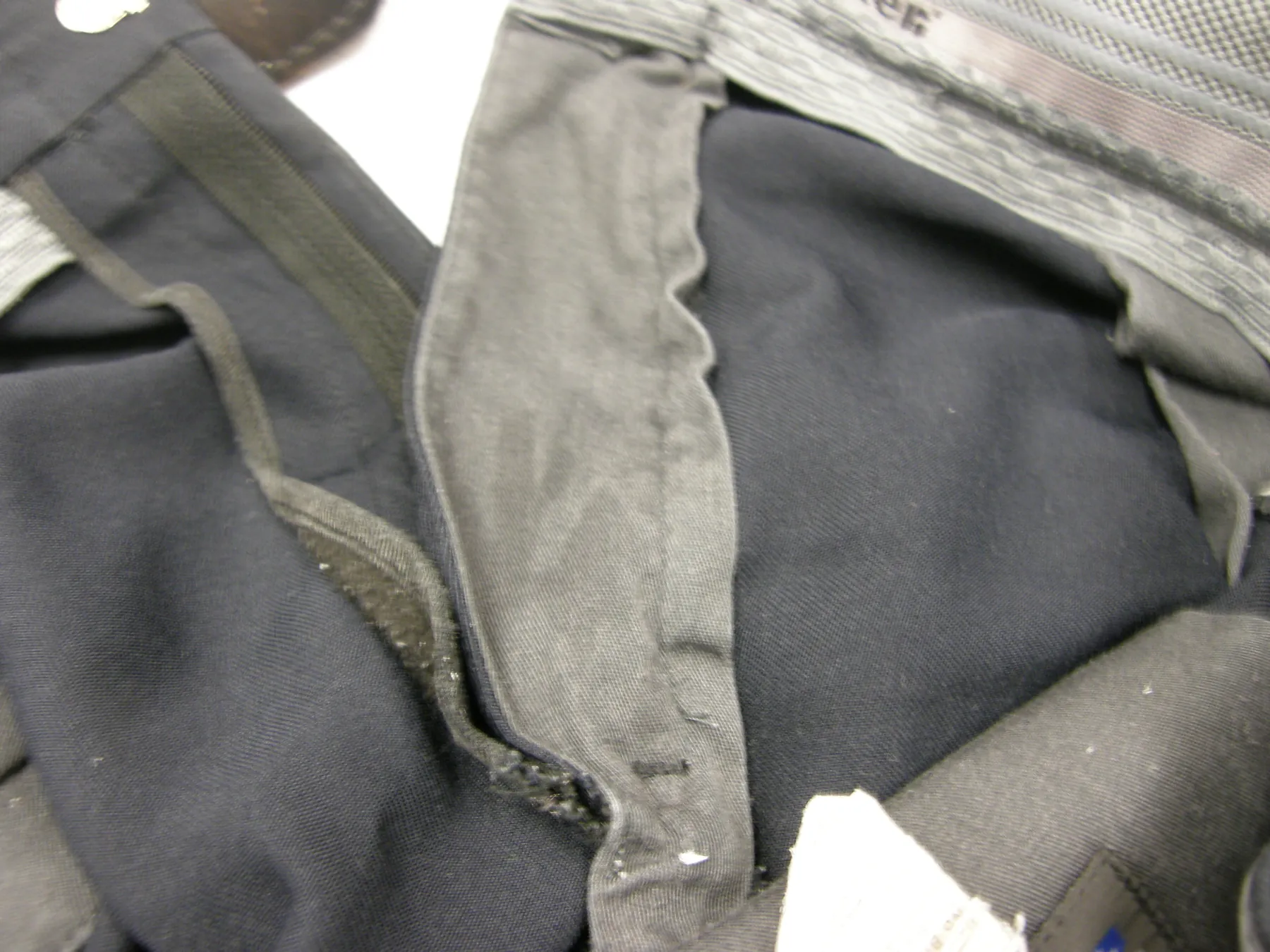
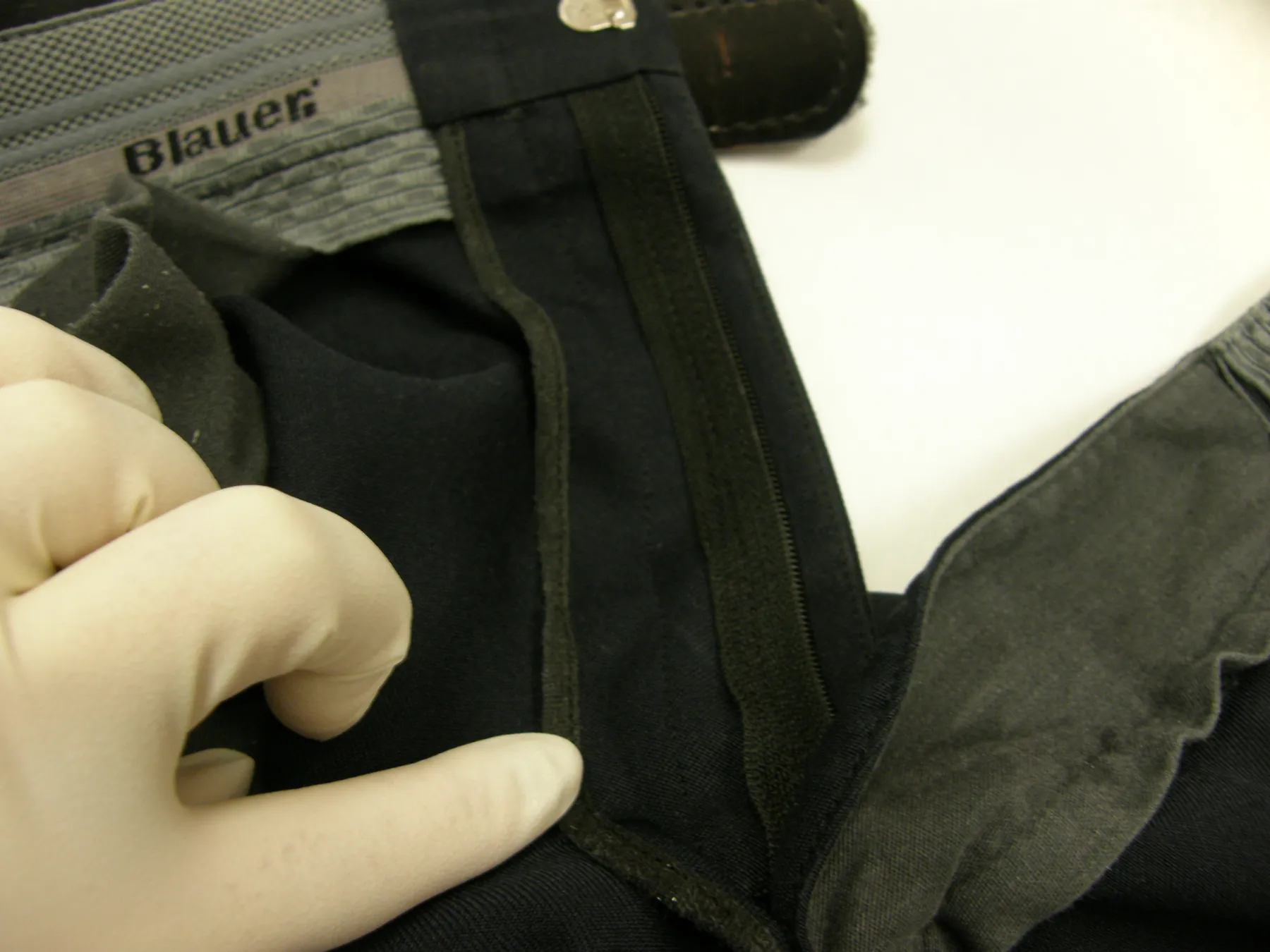
The photographs of the pants agree. Taken on June 20, 2014, two days after the seizure, and again on September 28, 2015, they show no stain on the outside or the inside of the fly.
 June 20, 2014
 June 20, 2014, outside
 June 20, 2014, outside
 June 20, 2014, outside
 Sept. 28, 2015, inside
 Sept. 28, 2015, inside
 Sept. 28, 2015, inside
No visible staining. Nothing suspicious. This was the spot the State identified as the site of two rapes within the previous 24 hours.
Taylor did not screen the pants with an Alternate Light Source. Spence and the international panel criticized that omission. ALS instruments are routinely used to screen clothing for fluorescence that may indicate biological material; Taylor went from bright light and a magnifier to DNA swabbing. Spence Aff. ¶9; Gill et al. (2017), pp. 15–16. She knew what a screen could show. Oral saliva samples, you can look at them under UV lights and see a fluorescence in that sample as opposed to there’s no fluorescence from skin cells,
she testified in 2019. The allegation that brought her the pants was oral sodomy, and the fluid oral sodomy leaves is saliva. Asked why she didn’t test the pants for body fluids, she said, Because I was only looking for touch DNA on the front, I wasn’t looking for a liquid, like saliva.
Asked again, given the allegation of oral sodomy, she answered, Not on the front of his pants.
Her reason for not looking for saliva was that she had decided to look for something else. In the same investigation she did screen for a fluid, on a chair back in Rosetta Grate’s case, because Grate said she had wiped saliva there. Taylor Dep. 16:2–6, 54:17–55:2, 98:6–22 (Jan. 15, 2019). No test was ever run to identify a body fluid on the swabs: not for saliva, not for vaginal fluid, not for anything. Taylor said so herself, under oath, in 2019: I have no way of knowing what the body fluid is and I will not and I do not know it today.
Taylor Dep. 129:20–22 (Jan. 15, 2019).
The analyst’s lubrication testimony was not science. Her own boss said so.
At trial, the opinion was presented as science. Gieger asked whether, once she knew a 17-year-old was alleging penile-vaginal rape, Taylor believed there was merit in swabbing those areas. She did: A young woman of her age would be very likely to have quite a bit of lubrication. And that lubrication could transfer cells if in fact that is what occurred.
Asked whether she had training in regards to rape victims and the human body’s response to sexual intercourse,
she answered: Yes, sir.
Trial Tr. 4065:9–25.
Nonconsensual contact, she testified, would not change that opinion: The body — the human body reacts to arousal in different ways, whether it be consensual or whether it be a rape,
and, as an older woman I think there would probably be damage in a rape case as opposed to somebody that was quite a bit younger than myself.
Trial Tr. 4066:1–9.
At her deposition, she was asked what the opinion rested on. She has never testified as an expert in the physiology of sex organs and reproduction (that was the SANE nurse’s job
), and she is not a forensic nurse. Asked whether she had any specific training about a 17-year-old’s physical ability to produce lubrication: No, but at one time I was a 17-year-old female and I kind of remember what it was like to be well-lubricated.
The trial opinion, she agreed, was not based on her expertise as a serologist but on personal experience: I’m a female, I think I have an idea of how my body responds to things and how other females do. Now, I’m not sure if a male could testify to a 17 year old’s response to a sexual type situation.
Taylor Dep. 147:3–148:12 (Jan. 15, 2019).
Her supervisor was asked about that testimony. Campbell Ruddock, the laboratory’s DNA manager, was asked at his own deposition whether a scientist testifying about the biological capability of a 17-year-old to produce lubrication
is within the realm of that scientist’s expertise: No. No, I don’t. As a DNA analyst we’re really encapsulated within DNA.
He would look on that as more anecdotal or medical related.
It is definitely not something I would include in the testimony,
he said; analysts should restrict ourselves to DNA unless we have data to support that.
Ruddock Dep. 40:20–41:12, 42:10–14 (Mar. 21, 2019). Taylor never reconciled the contradiction in her own testimony: abundant lubrication, yet nothing suspicious and a trace-level yield.
The pants fit a search better than a rape.
Two of the three women the State said had sexual contact through that fly within a day left nothing on it. For the third, the laboratory reported a trace, in a mixture of several people's DNA, at a level at or below a car door handle, with no stain a trained analyst could find under a magnifying glass. That is the whole of the physical evidence the State offered against Daniel.
Over the next four months, that trace was turned, reference swab by reference swab and finally in one closing argument, into proof of multiple sexual assaults.
What the laboratory reported.
The State's laboratory reported a reference sample attributed to Adaira Gardner as matching the major contributor to both fly swabs at every genetic locus tested, with random-match probabilities in the sextillions. Supplemental Forensic Examination Report, SD-14-273, October 7, 2015 (Scott Adams 03597). What that report could not establish is when the DNA arrived, how it arrived, or whether a sexual assault occurred.
How the unidentified DNA drove the investigation.
Across thirteen accusers and thirty-six counts, the DNA recovered from Daniel's uniform pants was the only forensic evidence the State presented as corroborating a sexual-assault allegation. Brief of Appellant, Holtzclaw v. State, No. F-2016-62 (Okla. Crim. App. Feb. 1, 2017), Prop. II, p. 30 (“Only the allegations of Adaira Gardner are substantiated by any physical evidence”); Prop. V, pp. 42, 47 (the Gardner DNA was “the only independent evidence substantiating the claims of any of Appellant’s accusers” and “only directly pertained to Count 32”).
On June 18, 2014, following Jannie Ligons's complaint, Detectives Kim Davis and Rocky Gregory interviewed Daniel. He answered every question, did not ask for a lawyer, offered to take a polygraph, signed a body search waiver and gave four buccal swabs, and handed over the uniform pants he had worn. Scott Adams 00072–00117, 00074–00076, 00025, 01147.
Testing of the fly found low-level DNA from a female contributor who was not Ligons. Taylor testified that she relayed that exclusion to Kim Davis early on, in June 2014. Trial Tr. 4045:24–4046:2.
The first candidate investigators pursued was the obvious innocent one. On July 1 they took a reference sample from Daniel's girlfriend, the person whose DNA would be least surprising on the inside of his trousers. It did not match her either.
At that point the laboratory had established two things: female biological material was present on the fly, and it did not match the complainant or the girlfriend. It had not identified the source as vaginal fluid or as evidence of sexual contact of any kind.
Police treated the unidentified DNA as proof of another victim.
Investigators did not treat the unknown profile as unexplained. They treated it as proof that another woman had been assaulted.
Earlier in the trial, asked why the profile mattered, Davis answered: Because I knew we had another female out there;
asked That he hadn't told us about?
, she answered Right.
Trial Tr. 1081:12–15.
Rocky Gregory described the same driver when explaining his July 10 jail visit to Terri Morris: Detective Davis and I knew we had some DNA of an unknown female on the inside of Officer Holtzclaw's pants and we had not found that — that subject, that DNA.
Trial Tr. 3212:20–22.
By October the inference had hardened into a claim of certainty. Arguing for higher bond, Assistant District Attorney Gayland Gieger told the court: The undeniable fact that there is at least one more woman out there, because we have her DNA, that he has had sexual contact with. And we still don't know who she is or where she is.
Mot. Hr’g Tr. 62:5–8 (Oct. 2, 2014) (Gieger).
A DNA profile can identify whose biological material is present. It cannot say when it arrived, how it arrived, or what happened. It cannot distinguish intimate contact from incidental transfer, or consensual contact from assault. International Forensic Expert Panel, Report on Scientific Issues in Oklahoma v. Holtzclaw (July 25, 2017), p. 21; Affidavit of Michael J. Spence, Ph.D. (Jan. 30, 2017), ¶18.
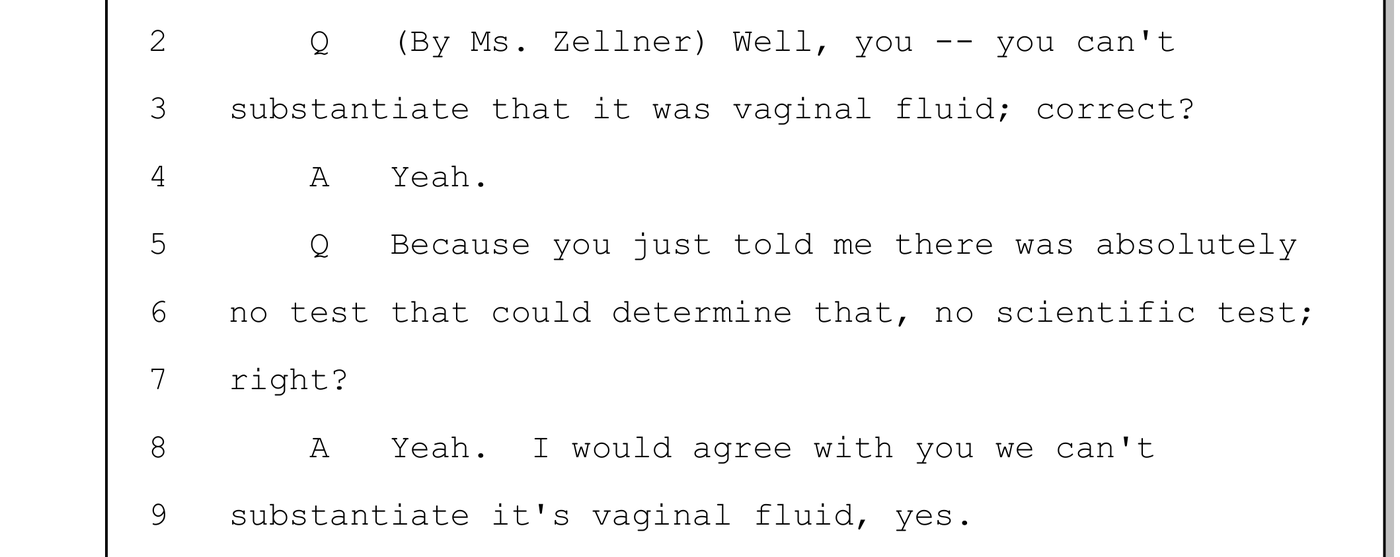
The State's own laboratory later confirmed the limit. Ruddock agreed under oath that the vaginal-fluid claim could not be substantiated because no scientific test could determine it. Ruddock Dep. 43:2–9.
Taylor said the same. She testified that she told Gieger before trial there was no way to determine whether the sample came from vaginal fluid or saliva, that she had no idea and was not present, and that she still could not say at the time of her deposition. Taylor Dep., Jan. 15, 2019.
Compare: how a Maryland analyst handled the same questions
Al-Atiyyat v. State (Md. App. Ct. 2025, unreported) ↗
A Maryland State Police analyst tested evidence in a case alleging oral sexual contact. The trial judge was critical of her work: he called her testimony bizarre
and was puzzled that no one had tested for saliva, though she had explained why she didn’t: a saliva test would have used up part of the swab she needed for DNA. A saliva test can show only that saliva is present; the DNA could say whose material it was. At each point where Elaine Taylor skipped a step or went beyond her data, this analyst did the opposite.
| Question | Maryland analyst | Elaine Taylor |
|---|---|---|
| The allegation | Tested the items the allegation pointed to: the containers the complainant said held what she spat out, and pajama pants with dried semen. | Was told only “oral sodomy,” and did not read the reports in this case. At trial she thought the allegations “were all oral sodomy”; some were vaginal rape. |
| Screening | Examined the pajama pants under an alternate light source and reported body fluids. | Never screened Daniel’s pants with an alternate light source. |
| Saliva | Chose DNA over a saliva test that would have used up swab she needed, and said why. | Ran no saliva test. Her laboratory was not proficiency-tested for it, and an amylase test “would not have aided anybody.” |
| How the DNA got there | Declined to say, even when the judge directed her to answer: her testimony was “to discuss the source of the DNA that [she] found, not necessarily the activity.” | Asked whether cells were “much more likely” to transfer in a liquid “such as vaginal fluid,” answered, “That’s a very good possibility.” Told the jury a young woman of Gardner’s age “would be very likely to have quite a bit of lubrication.” Never said Gardner’s DNA came from vaginal fluid, and agreed it could have come from secondary transfer. Asked in 2019 what that opinion rested on, she said: “at one time I was a 17-year-old female and I kind of remember what it was like to be well-lubricated.” |
| A question she couldn’t answer | Said so plainly, and explained why: questions about how DNA came to be on an item were outside her expertise. | Asked whether it would be unusual to find no visible stain on a fly after ten minutes of vaginal contact, she paused for about seven seconds, sighed, and said, “Ma’am, I’m not really sure how to answer that,” then spoke about semen and the Ligons investigation, neither of which the question mentioned. |
Al-Atiyyat v. State, No. 2378, Sept. Term 2023, slip op. at 4–6, 13 (Md. App. Ct. June 18, 2025) (unreported); Taylor Dep. 19:1–5, 20:5–10, 22:2–23:22, 55:16–56:17, 64:20–65:8 (video at 1:36:51–1:36:57), 139:2–3, 147:20–25; Trial Tr. 4064:4–5, 4065:18–20, 4073:20–24, 4091–92.
Watch Ms. Taylor’s answers on video: The Analyst In Her Own Words.
Reference samples from eleven women, over four months.
- June 18Daniel and Jannie Ligons are swabbed; the uniform pants are seized.
- July 1Daniel’s girlfriend is swabbed; extracted July 8.
- July 10Terri Morris.
- August 5Sherry Ellis.
- August 14Florene Mathis and Carla Johnson.
- August 27Rosetta Grate.
- September 16Kala Lyles.
- October 13Regina Copeland.
- October 24Adaira Gardner.
- November 3Syrita Bowen.
When another woman was excluded, investigators kept testing women. They did not reconsider whether the unidentified DNA represented a victim at all.
An internal OCPD victim summary states the investigative bias plainly. Discussing Kala Lyles, it says: We are hoping that it will be her DNA on his pants.
Scott Adams 05912.
It was not. Davis's own probable-cause affidavits say so, and charges involving Lyles were filed anyway. Scott Adams 05878, 05880.
Gardner's reference arrived after eight other women had been tested.
Adaira Gardner's reference swabs reached the DNA laboratory on October 24, 2014, four months and six days after the pants were seized, after reference samples from eight other women had been collected and compared.
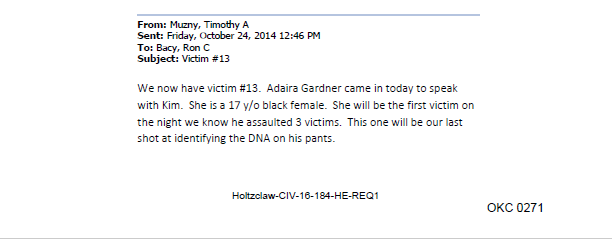
That same day, Sex Crimes Lieutenant Timothy Muzny emailed Captain Bacy that Gardner would be the investigation's last shot at identifying the DNA on his pants.
The preliminary hearing was already set for November 17 and 18. Muzny email to Bacy, Victim #13
, Oct. 24, 2014, 12:46 p.m., OKC 0101 (also at OKC 0266, 0268).
Gardner's swabs arrived October 24 but were not extracted until November 4, eleven days later. Every earlier reference sample in the case had been extracted within seven days of reaching the laboratory, and the file gives no reason for the gap. During that period Elaine Taylor also had custody of Daniel's pants. Scott Adams 04664 (extraction worksheet, Nov. 4, 2014), 04669–04670; Taylor Dep. 51:24–52:24.
The laboratory then reported that the reference sample attributed to Gardner matched.
The question changed three times. The DNA never did.
Before trial, the State told the court what its analyst would say about how Adaira Gardner’s DNA reached the fly. Transfer by ordinary contact, its witness endorsement said, was not reasonable and perhaps not even possible.
Shown that description years later, Elaine Taylor said the words were Gayland Gieger’s, not hers. State’s Endorsement of Witnesses, item 124, O.R. 240; Taylor Dep. 132:24–25.
It was not where the testing began. In June 2014 the only allegation was Jannie Ligons’s, and Taylor designed her examination around touch. She said she set out to find Ligons’s skin cells on the front of the pants, on the theory that Ligons might have steadied herself, and she ran no screen for saliva. The State’s own examination started from the premise that ordinary contact could leave a woman’s DNA on the fly. Her full answer is quoted in The Analyst In Her Own Words. Taylor Dep. 18:11–19:5.
Ligons’s DNA was not there. From July to November the same result served a second purpose: finding the woman it belonged to. Investigators treated it as proof of another victim and compared reference swabs from one woman after another, as set out above, until Gardner’s matched.
In late September 2015, five weeks before trial, there was nothing left to identify. At Gieger’s request the pants went back to the laboratory, and Taylor turned them inside out and swabbed two more areas inside the fly. No other part of the pants was swabbed for comparison. The retest could not say how Gardner’s DNA had arrived. What it could add was her DNA on the inside, which is the point Gieger pressed in the closing argument quoted above. The only reason the laboratory file gives for the retest is that the prosecutor asked for it, and no bench notes for the retest appear in the laboratory file produced to the defense. Supplemental Forensic Examination Report, SD-14-273 (Oct. 7, 2015), Scott Adams 03597; Trial Tr. 4059:22–4063:15.
Nothing about the DNA changed between June 2014 and trial. The fly held the same low-level mixture it had held all along. What changed was the question put to it: first whether Ligons had touched the pants, then whose DNA this was, then where on the pants a known woman’s DNA could be found. An examination that began by assuming touch could leave a woman’s DNA on the fly ended with the State telling the jury it could not.
The laboratory file tells a different story.
“There's no Y so the answer is no.”
Asked at trial whether male DNA was found on the two fly swabs, Taylor told the jury there was none, and agreed that Daniel's own DNA was not inside his own pants.
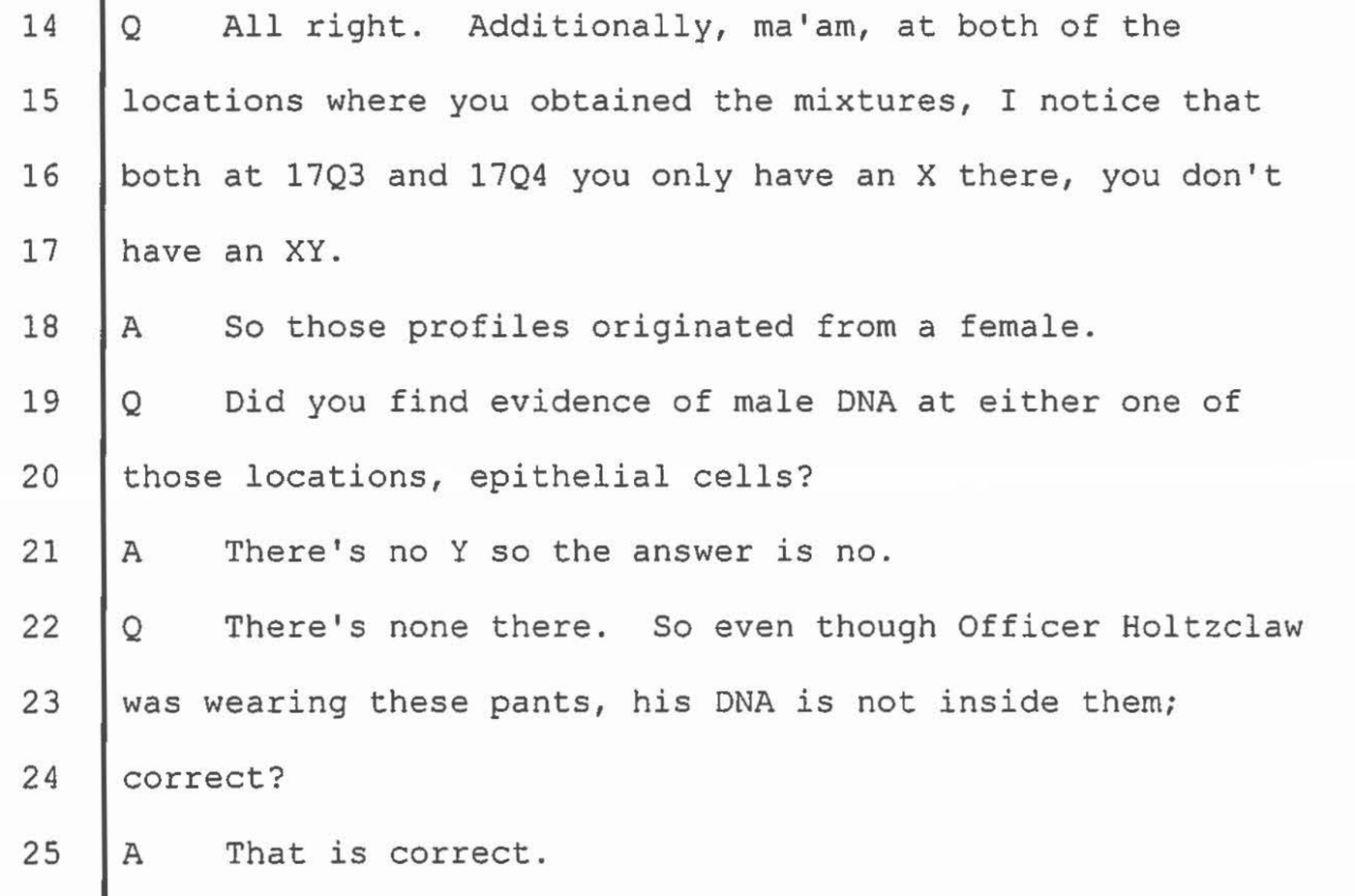
There's no Y so the answer is no.She then agreed Daniel's DNA was not inside the pants. Trial Tr. 4072:14–25.
The laboratory's Quantifiler Trio qPCR report for those same two items records Y-chromosome DNA on both:
| Item | Small-autosomal quantity (total human DNA) | Y quantity | Reported male-to-female ratio |
|---|---|---|---|
| #17Q3 | 2.19E-01 ng/µL | 1.02E-02 ng/µL | 1:20 |
| #17Q4 | 2.60E-01 ng/µL | 1.17E-02 ng/µL | 1:21 |
The laboratory quantified male DNA on both fly swabs on October 1, 2015. Nine weeks later, on December 2, Taylor told the jury there was no male DNA at either location. Dr. Spence, reviewing the same report, put it plainly: her testimony suggesting the presence of only female DNA, was entirely inaccurate.
qPCR Report for SD14-273, plate qPCR093015DR, Quantifiler Trio, run Oct. 1, 2015, technical review Oct. 7, 2015, Scott Adams 03610; Trial Tr. 4072:14–25 (Dec. 2, 2015); Spence Aff. ¶ 7 (Jan. 30, 2017).
The 2015 quantification was not the first sign of it. The June 25, 2014 electropherogram for the earlier fly swab, 17Q2, called a Y peak at 170 RFU beside an X peak at 4,709. Ruddock reviewed that page on November 8, 2014. Scott Adams 04425 (GeneMapper ID-X printout, June 25, 2014, page 3 of 3).
The male DNA undercuts the mechanism the State sold the jury. The State’s story was that the DNA on the fly could not have arrived through ordinary touch and instead came from vaginal fluid during a rape. But the laboratory found male DNA on the fly along with the female DNA. Men don’t produce vaginal fluid. The male-DNA result establishes that at least some DNA on the fly arrived by a mechanism other than Gardner’s vaginal fluid. That directly contradicts any claim that all of the DNA on the fly can be explained by vaginal-fluid deposition. Handling, secondary transfer, and contamination are all possible routes; the result does not say which, and the evidence was sitting in the State’s own file. The jury was told the opposite. Taylor’s no Y
answer took that proof off the table.
The exclusion that could not be made.
The State did not only argue that Gardner's DNA was on the pants. It argued something further and more powerful: that Daniel's own DNA was not there.
That claim answered the defense theory of innocent transfer before it could be made. If ordinary handling deposits skin cells on clothing, why was the wearer's DNA missing from his own trousers?
But the laboratory never made that exclusion. Its report says:
Not suitable for comparison
is not an exclusion. It means the laboratory did not make a comparison to the minor component, and therefore did not rule Daniel out of it.
The two claims were not independent. Taylor’s vaginal-fluid opinion was built on the exclusion: she testified that because Daniel was not a contributor to the sample, there was a good possibility the cells had arrived in a liquid such as vaginal fluid. The appellate court recorded the premise in exactly those terms. Holtzclaw v. State, 2019 OK CR 17, 448 P.3d 1134, ¶ 46. The laboratory’s own report says the exclusion was never made. Without it, the vaginal-fluid opinion loses its stated basis. The jury was told two things; they fail together.
On the same sample, Dr. Michael Spence identified ten alleles at 17Q4 that could not have come from Gardner, and nine consistent with Daniel. Spence Aff. ¶¶8, 13.
The State’s argument depends on treating Daniel’s supposed absence as meaningful. If some of the minor-component DNA is Daniel’s, his DNA was not absent, and the reason the jury was given for dismissing innocent transfer goes with it. Wearer DNA on one’s own clothing is unremarkable; a 2018 study of worn upper garments detected the wearer in every interpretable profile from collars and cuffs. Magee et al., Forensic Sci. Int’l: Genetics 34:152–161 (2018).
If none of the minor component is Daniel’s, his absence proves nothing either: wearers often leave no detectable DNA on their own clothes. In a study cited by the international panel of forensic scientists that reviewed the case, the wearer was detected in only about half of samples from the waistbands of underpants worn for twelve hours. Pants without their wearer’s DNA are ordinary, not something only a rape can explain. Breathnach, Williams, McKenna & Moore, Forensic Sci. Int’l: Genetics 20:53–60 (2016); Gill et al. (2017), pp. 26–27.
The argument outlived the trial. A year after the verdict, Gieger told a local television reporter: Daniel Holtzclaw’s own DNA was not found on the inside of his uniform pants. I think that speaks louder than anything I could argue as to the ability about someone’s skin cells to get transferred to a piece of fabric.
The exclusion he was still treating as decisive had never been made. KFOR.com, “EXCLUSIVE: Daniel Holtzclaw’s family speaks out about conviction, appeal one year later,” Dec. 13, 2016.
There was documented, undisputed non-intimate contact.
By Adaira Gardner’s own account, Daniel went through her purse when he stopped her on June 17, 2014, the day before he handed over the pants. Daniel told detectives he had searched her too. Trial Tr. 3757:2–15; Trial Tr. 4013:23–4014:4 (Daniel’s interview account of a back-handed search, as described by the prosecutor).
Her purse passed through his hands the day before the pants were seized. Nobody disputes that.
Nobody knows how Gardner's cells reached the fly. Not Taylor, not Ruddock, as both said under oath. Taylor Dep. 129:14–16, 132:15–19 (Jan. 15, 2019); Ruddock Dep. 30:2–7, 42:21–43:1 (Mar. 21, 2019).
Published research documents the transfer of one person’s DNA to another through social, non-intimate contact; secondary and tertiary transfer through intermediate surfaces and people; and the need to evaluate competing explanations for how DNA arrived rather than assume the most incriminating one. Helmus, Bajanowski & Poetsch (2016); Cale et al. (2016); van Oorschot et al. (2019); Johannessen et al. (2022); all summarized below.
Elsewhere, the testing did not identify Daniel.
Items seized in the Rosetta Grate investigation (a black leather seat back, a pair of underwear and a pair of black panties) were negative to acid phosphatase, the presumptive test for seminal fluid. Microscopic examination of the underwear and panties found no spermatozoa, and DNA testing of both returned no results at any locus. Scott Adams 04153–04155.
Re-testing of the seat back in 2015 developed a mixture whose major contributor is an unknown male, and Daniel's reference sample is expressly excluded as a contributor to it, as is Grate's. Scott Adams 04095.
On the one item from an alleged crime scene that yielded a usable male profile, the State's own laboratory ruled Daniel out.
“I’m not saying this on recording.”
In September 2016, nine months after the verdict, Gregory and Davis sat for an on-camera interview for Michelle Malkin Investigates. On camera, they were asked whether there was any innocuous, non-nefarious reason the DNA could be on the pants. Gregory answered No.
Davis also answered No.
Disclosure: Michelle Malkin is married to UNCUFF president Jesse Malkin.
The pockets had not been tested. Asked why not, Davis answered: Why?
Gregory–Davis interview for MMI, Sept. 19, 2016 (transcript, file 542_0929, at 38). The pockets were a control. If Gardner’s DNA had turned up in a pocket, where no sexual act was alleged, it would have shown her DNA reaching the pants through non-sexual contact, and the fly finding would have stopped proving anything. Untested, the pockets could never undercut the fly.
Gieger did more than leave them untested. He argued from them. In closing, he told the jury the DNA was found not of his pockets, not of his cuff, not where he sits, but of the exact location she says his penis came in contact.
No pocket, cuff, or seat swab was ever tested. The absence Gieger offered the jury as proof of guilt was an absence nobody had looked for. Trial Tr. 4307:11–13.
Pressed on touch transfer, Davis said she had never worked a sexual-assault case with transfer DNA, then allowed: Anything is possible. I would never say it’s not possible.
Michelle Malkin Investigates, Daniel in the Den, Pt. 2 (CRTV 2017), as-aired transcript.
When the formal questions ended and the crew was wrapping up, the conversation turned back to the DNA, and Davis, retired seven weeks earlier, prefaced her answer: I’m not saying this on recording.
Gregory agreed: we preach it all the time. Transfer DNA is just almost but impossible right now with what we have.
Davis added a standard: You can’t use mixtures. You have to have a … solid profile that they say is one person.
The fly samples were mixtures. And the sloppy remnants had already been looked for: Elaine Taylor examined the fly under a very bright light and a magnifying glass, and found nothing suspicious. No stains. No remnants. Same transcript, at 2–3; Trial Tr. 4084:2–22.
By his 2019 deposition, Rocky Gregory acknowledged that touch DNA exists and repeatedly disclaimed expertise, but resisted treating non-intimate transfer as a serious possibility, explaining that he was going by what the laboratory had told him, and that the sex explanation was what I was told.
Gregory Dep. 115:17–116:6, 116:17–18, 118:17–18, 119:18–24, 120:7–17 (Jan. 17, 2019).
The laboratory
was his mother-in-law. Elaine Taylor, who by her own account told the prosecutor before trial that no test could say whether the material was vaginal fluid, and who under oath in 2019 said she has no way of knowing what the body fluid was, is the source the detective gave, three years after the verdict, for his certainty that sexual contact was the only explanation. Taylor Dep. 8:8–9 (Jan. 15, 2019) (Rocky is my son-in-law
); Davis Dep. 28:18 (Jan. 29, 2019).
The Court of Criminal Appeals put the gap on the record: the claim that the DNA came from Gardner’s vaginal walls was a claim Taylor never made
. It was made to the jury anyway, by Gieger in closing, and it reached Gregory as what I was told.
Holtzclaw v. State, 2019 OK CR 17, 448 P.3d 1134, ¶ 47.
Timothy Muzny went further.
Q: “Have you heard of touch DNA?”
MUZNY: “Yes. And I understand how it works. That’s not possible that on that.”
Q: “Could you tell me what leads you to say that?”
MUZNY: “There are people that are shedders and people that are not. I can shake somebody’s hand and my DNA may or may not be on them, and vice versa. Nobody is ever going to convince me that … Adaira Gardner’s DNA was on the inside of his pants from just casual contact.”
Q: “What about an expert — an expert in forensic DNA transfer?”
MUZNY: “No. You can get an expert that will tell you whatever you want.”
Muzny Dep., Mar. 26, 2019, 225:17–226:6.
Asked next whether Gardner or Daniel actually was a shedder, he answered I have no idea
and I do not know.
Muzny Dep. 226:20–227:1.
Muzny also did not know what his own laboratory had found. Asked whether he was aware there was unidentified male DNA on the fly, he answered No, I’ve never heard that it was an unidentified male.
Asked whether learning of it would at least make him consider the possibility that Daniel had not committed the assault, he answered No.
Muzny Dep. 227:6–16. The lieutenant who supervised a four-month hunt to identify the DNA on the pants had never heard of the male DNA in his laboratory’s own report, and said that learning of it would change nothing.
Asked the same questions under oath, Detective Davis said: That science is over my head. I’m not going to say yea or nay on that.
She agreed that touch transfer can happen under certain circumstances
and, asked what the source of Gardner’s DNA was, answered: I don’t think they can say that.
Asked whether there was any scientific basis for the vaginal-secretions conclusion, she said: I’m not going to say it is or isn’t because I don’t know.
Davis Dep., Jan. 29, 2019, 119:13–120:17, 257:17–20, 258:23–259:4.
Captain Ron Bacy, to whom Muzny reported, would not call transfer a reasonable explanation because, he said, I’m not qualified to make that assertion.
He would not rule it out either: I agree that anything is possible.
Bacy Dep., Mar. 27, 2019, 159:19–160:7, 160:25.
The categorical statements about how the DNA arrived came from Gregory, whose mother-in-law performed the testing, and Muzny, who had not heard the contents of her report when he was deposed.
Touch transfer is not a defense theory. It has been documented in the peer-reviewed literature for more than two decades and is summarized below; no forensic scientist disputes that it happens. The lieutenant who supervised the investigation ruled it out in advance of any evidence, invoked a shedder distinction he could not apply to either person involved, and dismissed the entire discipline of forensic DNA transfer as purchasable, in a case the State built on the findings of a forensic scientist.
By then Gill et al. had published their report and Dr. Michael Spence had called the vaginal-fluid theory junk science.
Spence Aff. ¶ 8 (Jan. 30, 2017); Gill et al., “Scientific Issues in the Case of Oklahoma v. Daniel Holtzclaw by an International Panel of Forensic Experts” (July 25, 2017).
So here is where the DNA stands. In Dr. Spence’s assessment, the quantity is consistent with incidental handling and difficult to reconcile with the State’s vaginal-fluid theory: fluid that rich in DNA leaves a lot of DNA behind, and the fly carried less than a car door handle. Spence Aff. ¶¶ 14, 19 (Jan. 30, 2017). The fabric doesn’t support it either: no stain, nothing suspicious under a bright light and a magnifying glass, and no Alternate Light Source screening because nobody thought to do one. And the detectives’ misreading of that trace did real damage. They took an unidentified speck of DNA as proof of a victim nobody had found, then spent four months testing eleven women to find her. That hunt is how a case with one accuser became a case with thirteen.
Non-intimate DNA transfer is well documented.
Show the seven studies
Helmus, Bajanowski & Poetsch (2016) ↗
International Journal of Legal Medicine 130:121–125. Demonstrated secondary and tertiary transfer through a carrier, with donor DNA reaching surfaces the donor never touched.
Cale et al. (2016) ↗
Journal of Forensic Sciences 61(1):196–203. After handshakes, secondary DNA appeared on tested knives; in some samples the person who never touched the knife was the only or major contributor detected.
van Oorschot et al. (2019) ↗
Forensic Science International: Genetics 38:140–166. A comprehensive review of transfer, persistence, prevalence and recovery, and why competing explanations must be evaluated.
Johannessen et al. (2022) ↗
Forensic Science International: Genetics 60:102750. DNA from the other participant was detected after both intimate and social contact, with a vaginal-mucosa marker detected in one non-intimate sample.
Bouzga et al. (2020) ↗
Science & Justice 60(3):234–242. Intercourse produced substantially more female DNA on penile swabs than secondary transfer from skin contact, but secondary transfer to the penis also occurred.
Magee et al. (2018) ↗
Forensic Science International: Genetics 34:152–161. On 44 worn upper garments, the wearer’s DNA appeared in every interpretable profile, averaging about 20 ng; DNA from people other than the wearer was also recovered.
Roersma et al. (2024) ↗
Forensic Science International 361:112097. On women’s worn underwear, larger amounts of male DNA went with positive semen or saliva tests; where intercourse would be expected to leave both, their absence supported the conclusion that it had not occurred. Where women had no male partner or housemates, male DNA turned up only where the wearer’s own hands touch the garment, which the authors suggest may have arrived through her hands.
Courts have warned against over-reading low-level DNA.
Show the four rulings
State v. Phillips (S.C. 2020) ↗
Murder conviction reversed where touch-DNA testimony was inadequately explained and risked misleading the jury on secondary transfer and the meaning of a non-exclusion.
State v. Dawson (Conn. 2021) ↗
Touch DNA on a gun could not establish beyond a reasonable doubt that the defendant had even touched it, because the analyst could not say how or when the DNA arrived.
State v. Glass (Conn. App. 2022) ↗
Burglary and robbery convictions reversed where touch DNA was the principal identifying evidence and the State offered nothing on primary versus secondary transfer.
Dunning v. State (Tex. Crim. App. 2019) ↗
Ruling against the applicant on post-conviction testing, the court reasoned that touch DNA has low probative value because it is easily transferred and may have been deposited by an innocent person; an unknown profile on the complainant's clothing did not exonerate him.
Help fund the work.
UNCUFF funds investigation, forensic review, records work, post-conviction litigation, and telling the stories of wrongfully convicted people to the public.