
The Questions Nobody Asked
Police built a victim-generating machine. They never built one to check what the accusers said. Most were never asked to describe Daniel’s penis, whether a condom was used, never taken back to the scene, never had their phones pulled. The camera and tape-recorder were off for the conversations that mattered most. And when a description pointed at a different officer, nobody went looking for him.
Police searched hard for accusers and did far less to check what they said.
By August 2014 the hunt for accusers was an organized, resource-intensive operation. It even ran backward into Daniel’s college years: the day after Ligons’s report, a detective called Eastern Michigan University to ask whether he’d ever been a suspect there. He hadn’t. Scott Adams 00149.
The women that search turned up got nothing like that scrutiny. Turvey and Mares, reviewing the whole file, found that many were never asked for a precise location, date or time. Only two of the thirteen, Morris and Gardner, were asked whether a condom was used, which decides how much biological evidence there is to look for. Turvey & Mares, Forensic Report (July 1, 2020), at 11–12.
Ligons told Davis she could tell he was circumcised and didn’t know whether he had pubic hair. After her, the detectives’ own checklists record “didn’t ask.” The closest anyone came was Gregory asking Morris whether anything about it “looked different”; she said no. The detectives did ask Daniel, in his June 18, 2014 interrogation: was he circumcised, did he groom, did he have any identifying marks. So they knew the questions. After Ligons, they stopped asking the women. Scott Adams 00064; Turvey & Mares at 11–12; Holtzclaw interview with Dets. Davis and Gregory, June 18, 2014, Scott Adams 00024–00025; Gregory interview of Morris; OCPD case-summary checklists.
They never asked how the pants worked either. Every accuser who described exposure through the fly got the same few questions, unzipped or pulled down or over the top, and nothing more. Hill said she “didn’t know if it was through his pants or over the top really.” Ellis “did not see him take his penis out of his pants.” Morris said he unzipped and “moved the flap,” and nobody asked her another thing about it. Not one woman was asked how a man gets an erect penis out through the fly of duty pants, under a loaded gun belt, past compression shorts that have no fly. Gregory interview of Hill, Sept. 19, 2014; Davis reports on Ellis; Gregory interviews of Morris; see the clothing page.
An investigator who wanted to know whether it happened, rather than to confirm that it did, asks the mechanical questions any one of these women could have answered if she’d seen it: Did he reach in through the fly or pull something down from the top? What was under the pants, and what color was it? Did you see a second layer, and did it have an opening? Did he use one hand or two, and for how long? Did he have any trouble? What did he do to put it away? Then the same questions to Daniel about his own uniform, and a demonstration with the actual pants and shorts if the answers didn’t line up. The answers either converge on one physical description or they don’t. Nobody in this case asked any of them, so nobody had to find out.
The scene work was just as lopsided. A few allegations got real attention: Ligons’s car and Daniel’s patrol car were processed by CSI, the bedroom where Grate said she was raped was searched under a warrant, cameras near the Ligons stop were pulled and sent to the OSBI, phone records were subpoenaed for three of the women, and Morris and Ellis were driven back to their locations. Most of the thirteen got none of it: no scene visit, no layout, no canvass, no phone records. Turvey and Mares found that for the great majority of the allegations there was no crime-scene processing at all. Turvey & Mares at 15; Scott Adams (CSI and subpoena reports). The prosecution then stood up in front of the jury and called the locations, times and routes “corroboration,” with AVL maps and dispatch logs showing Daniel’s car had been where the women said. Of course it had. He stopped these women; nobody disputes that. What the GPS can’t say is what happened during the stop, and for the great majority of those encounters nobody did the work that could have.
No independent eyewitness, and leads no one followed up.
The record identifies no independent eyewitness to any of the alleged sexual acts. For an act alleged in a closed bedroom, that proves little. For acts alleged on a street under flashing lights, beside a building full of cameras, or in an emergency department, it counts for more. Gregory admitted in the Barnes case that he was unable to locate any third party whatsoever of any nature that would say that they ever witnessed Officer Holtzclaw do anything inappropriate.
Tr. 2060:11–15. The same is true of every other count. In several cases the record shows no effort to look: no one knocked on doors on Copeland’s street, the Grate file documents one neighbor, and no report identifies the driver of the SUV at 50th and Lincoln or the man in the van at Grate’s house. Tr. 2932:13–17; Scott Adams 00559; Tr. 2628:3–4.
One lead came to the detectives’ door and they let it go. On August 15, 2014, Rosetta Grate’s father told Davis that his daughter had come home very upset about a month ago
and said a cop took her somewhere
and forced her to perform oral sex. A month before was mid-July, four weeks after Daniel went on leave. Davis’s report records no question about which officer or which month, and she testified that he never called her back. Twelve days later she interviewed Grate and never asked about July. The department’s records show an officer had arrested Grate on July 18, 2014. Nobody connected the two, and the father’s account went into the case against Daniel. Scott Adams 00551, 02817–18; Tr. 2771:13–17, 2806:3–24; Davis–Homan video interview of Grate, Aug. 27, 2014; see The officers they didn’t look for.
The camera was off when it mattered.
A recording settles who first said Daniel’s name, when the allegation took shape, and whether other accusers came up. The conversations where that mattered most in this case weren’t recorded.
Ligons’s first interview: unrecorded. Carla Johnson’s first interview: unrecorded, because the detectives hadn’t expected her to be home and brought no recorder. Trial Tr. 3540–42. Terri Morris had been talking for several minutes before the recorder came on at the July 10 jail interview; that afternoon two officers checked her out of jail and drove her to the location she had picked, and neither the drive nor the map they used made it into any report. Trial Tr. 3272–73, 3279–82, 3303–04. Syrita Bowen’s first interview: two recorders, both failed, interview went ahead anyway. Trial Tr. 3487–88; Standard Supplement Report on Syrita Bowen, Oct. 10, 2014.
The worst one is Adaira Gardner. She spent about two and a half hours in a car with Davis and Homan immediately before she testified at the preliminary hearing. No report. No recording. Davis conceded she may have told Gardner “we have some things to back up what you said.” The defense found out about the trip at trial. And there was nothing to back up what she said. No stain, no fluid, less of her DNA on the fly than a car door handle carries. The physical evidence didn’t support Gardner’s story; it cut against it. If Davis said it, that isn’t preparation; it is telling a witness the evidence is on her side before she testifies, and it wasn’t. A prosecutor later did the same thing, telling Gardner she was the only accuser with physical evidence and that her testimony would help the other women. Trial Tr. 4019–20, 4084; Spence Aff. ¶14; Gardner Dep. 147:4–6.
None of this was accidental. Lt. Timothy Muzny, the Sex Crimes supervisor, testified that the women who said nothing happened, more than two-thirds of everyone contacted, generally got no report and no recording. Recording only the yeses was, in his words, “directed by command.” Asked whether the women who denied anything were therefore missing from the record, he said: “That’d be correct.” Trial Tr. 2401–02. For the women who said no, nothing survives at all: no notes, no audio, no video, no report. Just names on a list.
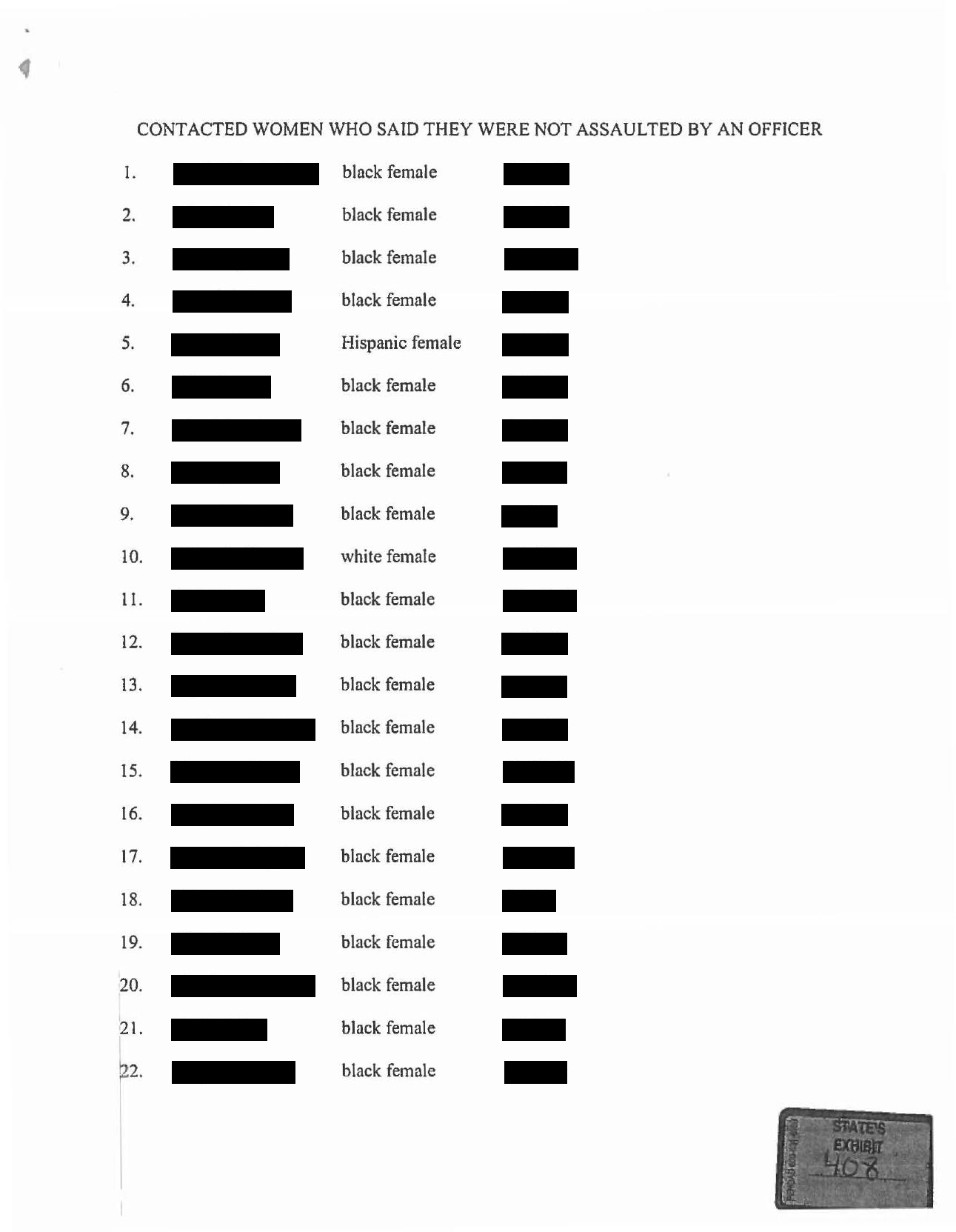
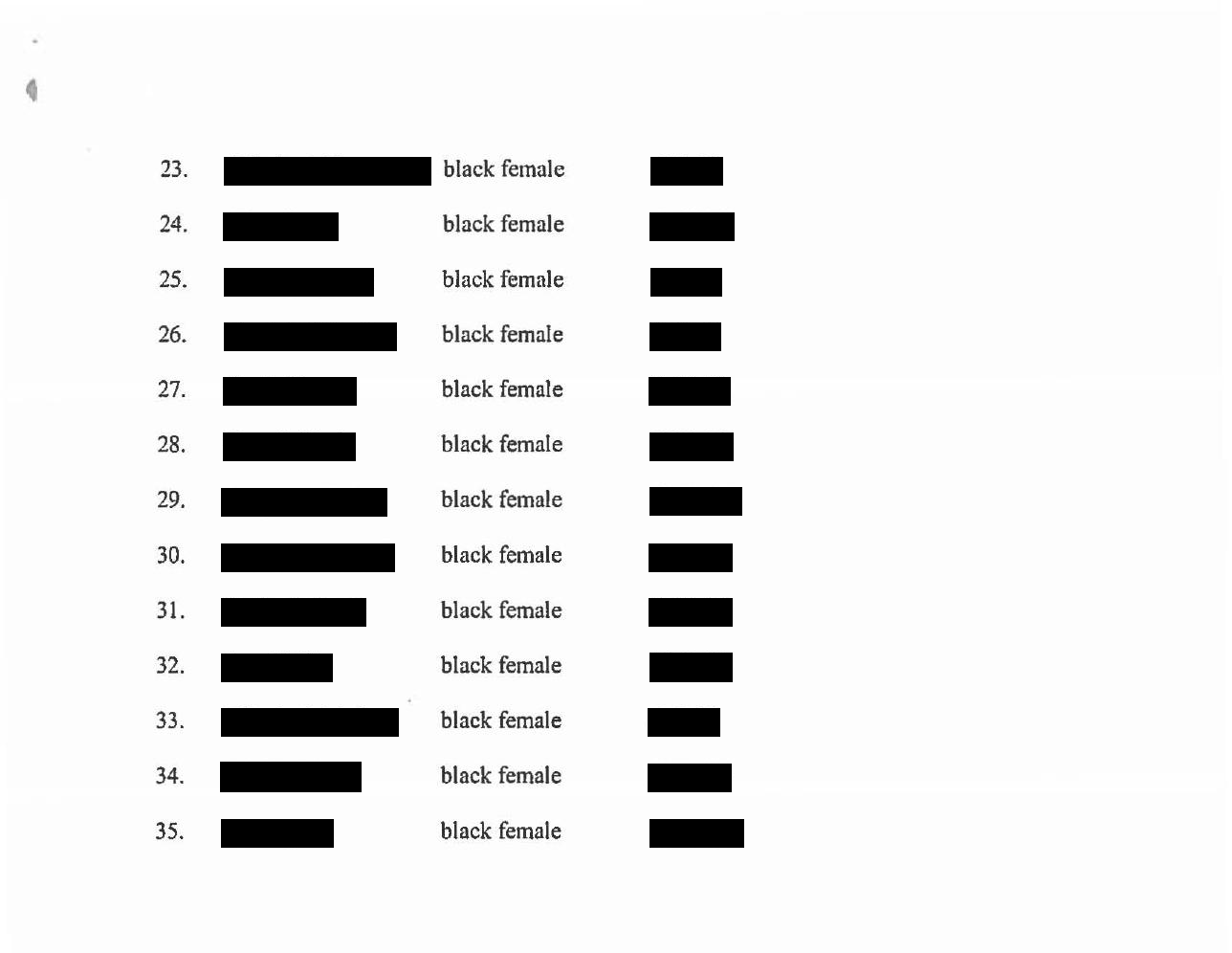
What a real contact log would look like, in any investigation where the denials are meant to count for something: for each woman, the date and time of contact, how it was made (door, phone, jail visit, card left), where, by which detective, how her name got on the list (which query, which packet), what she was told the contact was about, whether she was given the “tip” premise, what she was asked, her answer in her own words, whether she was shown a photo, whether the contact was recorded, whether a report was written and its number, and any follow-up. That is what the surviving reports contain for the women who said yes. Exhibit 408 shows that for the women who said no, none of it was kept, or none of it was created.
In survey terms, Exhibit 408 is a list of completed interviews with one answer category, and nothing in the record supplies the denominator. Investigators say they approached more than forty women. Nobody documented how many names were on the lists in total, how many were attempted, how many were never found, how many were reached and refused to talk, how many were reached by phone rather than in person, or how many said no and then, after a second visit or after Daniel’s face was on the news, said yes. Without that, “34 said no” could be 34 of 50 or 34 of 120. Trial Tr. 2401–02, 2461:16–2462:3; OKC 0394–0395; Turvey & Mares at 8.
Police had him in the room with a signed search waiver. They never took his underwear, never swabbed his penis, never collected his other uniforms.
On June 18, 2014, Daniel sat in a Sex Crimes interview room for the better part of an afternoon. He signed a body-search waiver. Detectives took four buccal swabs and the uniform pants he was wearing. That is the complete list of what they collected from him. Scott Adams 00013, 00025, 00072–00117.
Nine months after the verdict, on camera, the two lead detectives explained the rest. His underwear: “Didn’t take them.” Gregory: “Daniel had said that he had washed the underwear.” Asked whether she believed that, Davis: “I guess believe and hope. Most people change underwear, usually.” His other uniforms: “Why do we need another uniform? We don’t have other victims that had been assaulted yet.” His phone, that night: “Take it for what?” The pockets of the pants they did take: “Why?” Gregory–Davis interview for Michelle Malkin Investigates, Sept. 19, 2016 (transcript). Disclosure: Michelle Malkin is married to UNCUFF president Jesse Malkin.
They didn’t take his compression shorts. He’d told them what he was wearing; nobody asked for them, no warrant was sought, and the pair he had on that day was never collected. Ligons’s oral-sodomy allegation was hours old when he walked in, and a penile swab could have carried her DNA if it happened. None was taken. The pants they did take were never screened with an Alternate Light Source, never tested for what kind of fluid was on them, and the pockets, the built-in control for ordinary transfer, were never swabbed at all. Scott Adams 00104, 01391; Trial Tr. 1146, 4078–79, 4084; Ruddock Dep. 30:8–11, 33:5–17 (Mar. 21, 2019); Gregory–Davis interview for MMI, Sept. 19, 2016.
Nor did they go back for anything. The other alleged encounters ran from December 2013 to June 2014, on other shifts, in other pairs of uniform pants. Those pants were never collected. His home computer was never examined. Scott Adams 00104; OKC 0884–0938.
They did go back for a crack pipe. On August 27, 2014, Det. Homan sent two gang-unit sergeants to NE 14th and Jordan to look for the pipe Grate said Daniel had made her break there in April, four months earlier, and for the purse she said he drove off with on top of his car. Sgt. Cadena reported there was glass all over the intersection and there would be no way to determine a particular crack pipe.
The purse wasn’t found either. Two sergeants went looking for broken glass from April. Nobody ever collected the uniform pants Daniel wore that day. Scott Adams 00552, 05958.
The objective records placed a patrol car. They never placed a crime.
A database hit shows Daniel ran a name. AVL puts a car on a street. A phone record shows a call. None of that says what happened during a stop.
Carla Johnson is the best contact corroboration in the case: AVL shows Daniel’s car stopped on Jordan for about nine minutes and then following the streets she said she walked. It shows a stop. It says nothing about the stop. Scott Adams 05857–59, 12825.
When the records were actually checked, they sometimes cut the other way. Florene Mathis was certain Daniel had stopped her in December or January. The records showed it was a different officer. Trial Tr. 2426–27, 2467–68. Regina Copeland’s “corroboration” came from a detective on the phone walking her through Google Maps until she picked a house. Trial Tr. 2903–04; Scott Adams 03332. The bedroom where Rosetta Grate said she was raped was eventually processed: chair, underwear, panties, all negative for semen, no DNA. Forensic Examination Report SD-14-399, pp. 1–2; Taylor Dep. 105:9–20.
“She told someone” proves only that someone says she did.
The State leaned on the idea that the women had told someone before police arrived. Only Jannie Ligons left a record from the night itself: she flagged down officers and reported it within hours. For everyone else there is no report, text, email, saved voicemail or note from that night. For Sherry Ellis and Syrita Bowen, the evidence is the men they lived with testifying, a year and a half later, that each told him that night. Scott Adams 00055; Trial Tr. 3039:10–12, 3424:4–9. For the rest, what the people they told remember either doesn’t back up a sexual act or can’t be squared with the woman’s own account. Johnson has phone records showing she called her roommate minutes after the stop; he deleted the voicemail and told the jury he couldn’t understand what she was saying. Trial Tr. 3511–18, 3537:19–23; Scott Adams 05857–59. At most, the call shows she was upset after a police stop. By her own account the stop was upsetting on its own terms: after midnight, in the back of a patrol car, asked again and again whether she had drugs in her pants, and told as she walked away that she had a warrant. Carla Johnson; Scott Adams 00264–65. Copeland’s sister-in-law told police that Copeland had described a rape during a summer car ride. Her husband, who was driving, didn’t remember it, and Copeland herself said she told no one about a rape until Davis called. At trial the judge limited the sister-in-law to the topic of the conversation: an officer who had “put his hands on her.” Scott Adams 00526, 00529–30; Copeland Interview Tr. 15–16; Trial Tr. 2883–84, 2887:20–2888:1. The man who owned Grate’s house thought that night that she had “Brought someone into the house.” Barnes’s boyfriend recalled only that the officer made her raise her dress. Trial Tr. 2625:11–24, 2147:16–20. Gardner’s mother told police her daughter came home talking about “this really hot cop” she had exchanged numbers with. Scott Adams 00226. Mathis told no one. Raines said no at least five times. Trial Tr. 2307, 2322–24.
The verdicts didn’t track any of this. Hill’s mother described a detailed sexual disclosure and Lyles’s boyfriend described a crying phone call right after her stop, and the jury acquitted on every count involving both women. Trial Tr. 1502:16–1503:1, 3669:4–3670:25. A friend’s or relative’s account of what a woman told them proves only what that witness says now. It doesn’t prove what she said then, or that what she described happened.
The stories changed under oath.
Carla Johnson said the touching was over her clothes, then under, skin to skin, at the preliminary hearing, then over again at trial, and agreed on cross that she’d testified both ways. Trial Tr. 3527–30, 3542–43. Kala Lyles told Davis the officer pulled his pants halfway down, and in the same interview that he exposed himself through the zipper. At trial she picked the zipper: “He didn’t pull his pants down.” Trial Tr. 3652–53, 3661–63, 3726, 3736–37. Morris added a condom at trial that no earlier statement mentions. And Ligons told Davis on the morning of the stop that she’d smoked two marijuana joints before driving; by the time she was under oath it was a single hit. Scott Adams 00061; Prelim. Tr. I, 249, 255–56; Trial Tr. 627.
Help fund the investigation and litigation.
UNCUFF pays for records work, forensic review, investigation, post-conviction litigation, and telling the stories of wrongfully convicted people to the public.