
The 2014 Bench Notes
Weeks before trial, the State gave Daniel’s lawyers twenty-one pages it described as Elaine Taylor’s bench notes from the 2014 DNA testing. Each page carries a date. Several pages record evidence that had not reached the laboratory by the date at the top. One is dated October 16, 2015, seven days before the State produced the set. And the pages preserve little of the analysis itself: they list the evidence and tabulate results, with almost nothing about what the analyst saw, considered or decided.
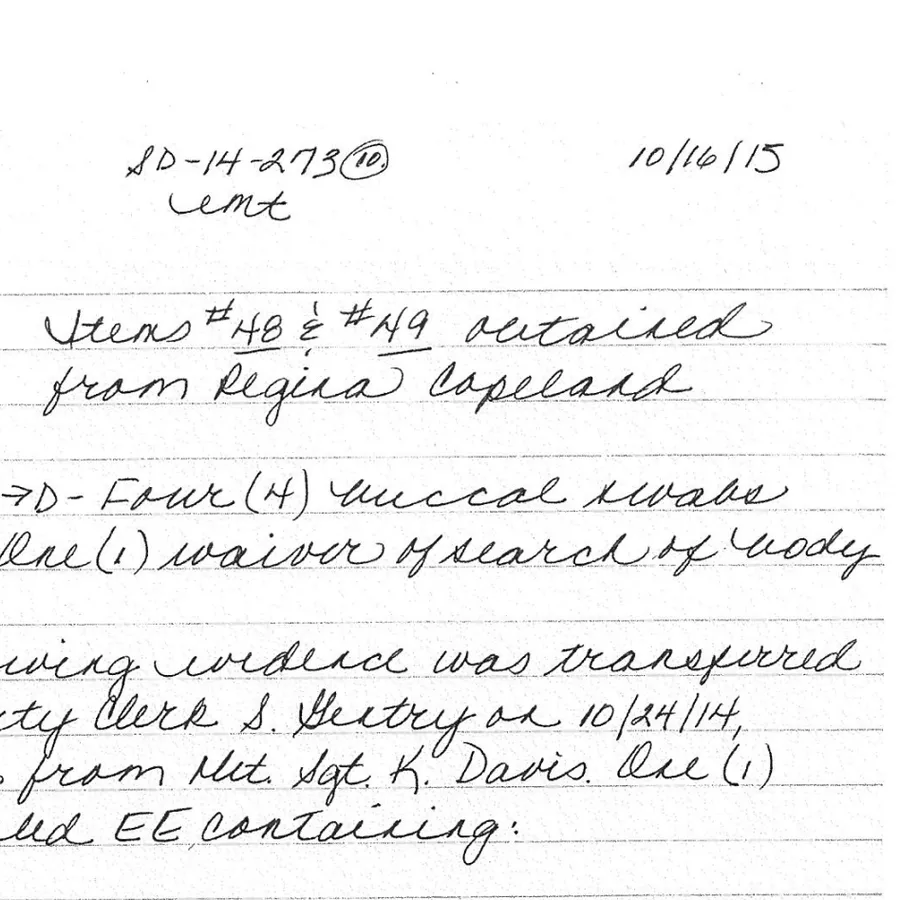
Produced as her 2014 notes.
On August 21, 2015, Daniel’s trial lawyers asked for the forensic analyst’s complete case file, including notes and bench notes.
Def.’s Mot. for Discovery ¶ 40(a) (filed Aug. 21, 2015), O.R. 213. Two months later, on October 23, Assistant District Attorney Gayland Gieger hand-delivered a discovery letter. Item 7 reads: Per your request, a copy of the Bench Notes created by Elaine Taylor in performing the DNA Analysis relevant to this case.
Letter from G. Gieger to S. Adams (Oct. 23, 2015), O.R. 592–93; Scott Adams 03589–90.
The enclosure was twenty-one pages, all bearing the lab number SD-14-273 and Ms. Taylor’s initials, numbered p.1 through p.21. Eleven are handwritten pages logging each item of evidence as it arrived at the laboratory. Five are printed DNA profile summary forms and five are serology worksheets, filled in by hand. OCPD Lab No. SD-14-273, bench notes, pp. 1–21 (DNA profile values masked by UNCUFF); Scott Adams 11825–45.
The defense gave the pages to its experts. After the verdict, Mr. Gieger told the court that bench notes were also produced as well at their request,
and pointed to the October 23 letter. Defense counsel agreed: we did get those and we did give them to our experts.
Mot. for New Trial Tr. 18:15–18, 21:7–13 (Jan. 21, 2016). The pages were never shown to the jury. They were the record the defense was given of how the 2014 testing was done.
They record evidence and results, and little of the analysis itself.
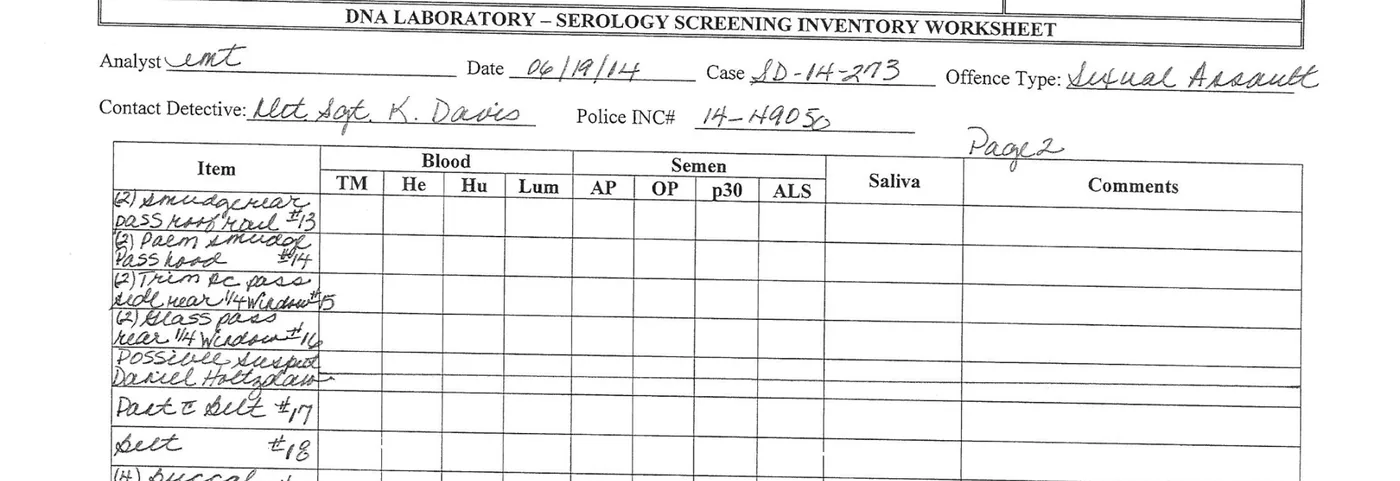
The eleven handwritten pages are an inventory. They record each transfer from the property clerk and describe each item, in language that matches the “Items Submitted” section of Ms. Taylor’s typed report almost word for word, and end with a one-line statement of the requested analysis. Bench notes pp. 1–11; OCPD Forensic Exam. Rpt. SD-14-273, at 1–5. The five DNA profile summary forms tabulate final genotypes. The five serology worksheets are a second inventory, with columns for blood, semen, alternate light source and saliva tests; the only entries in those columns are negative results on Ms. Ligons’s oral wash and oral swab. Bench notes pp. 12–21.
Nothing in the twenty-one pages describes the examination of the pants: their condition when the bag was opened, what was seen under the light and magnifier, whether photographs were taken, or why the two swab sites on the fly were chosen. Nothing records the interpretation of the mixtures found on those swabs. And nothing records a decision to skip the screening the worksheet itself provides for. On the row for the pants, every column is blank, including “ALS,” “Saliva” and “Comments.” The form has a code for an item not examined, “NE.” It is not used.
Ms. Taylor has since given her reasons under oath. She said she began from “a really big assumption” that Ms. Ligons’s skin cells might be on the front of the pants, and did “not do any alternate light source testing of any kind” because she “was not thinking it was going to be saliva or vaginal fluids or semen at that point.” Asked why she did not test the pants for body fluids, she said she “was only looking for touch DNA on the front.” Taylor Dep. 18:16–19:5, 54:17–25 (Jan. 15, 2019). Her deposition may describe what she was thinking in 2014. The notes do not preserve it. They do not record whether alternate light screening or a saliva test was considered, rejected, or never came up. The ISO standard her laboratory worked under calls for records of “original observations” and enough information to establish an audit trail. ISO/IEC 17025:2005 § 4.13.2.1.
Pages dated before the deliveries they record.
Each handwritten page has a date in the top right corner. The entries record transfers of evidence from the property clerk to the laboratory, each with the date of the transfer. On four pages dated in 2014, the transfers written on the page come after the date at the top. Page 10 is dated 2015.
| Page | Dated | Transfers recorded on the page |
|---|---|---|
| p.4 | 06/20/14 | June 27, 2014 (items #21–29, swabs from a Pontiac Grand Am) |
| p.7 | 07/02/14 | July 11 and August 6, 2014 (items #36–39) |
| p.8 | 08/07/14 | August 19, 2014, twice (items #40–43) |
| p.9 | 08/31/14 | September 17 and October 15, 2014 (items #46–49) |
| p.10 | 10/16/15 | October 24 and November 4, 2014 (items #50–53) |
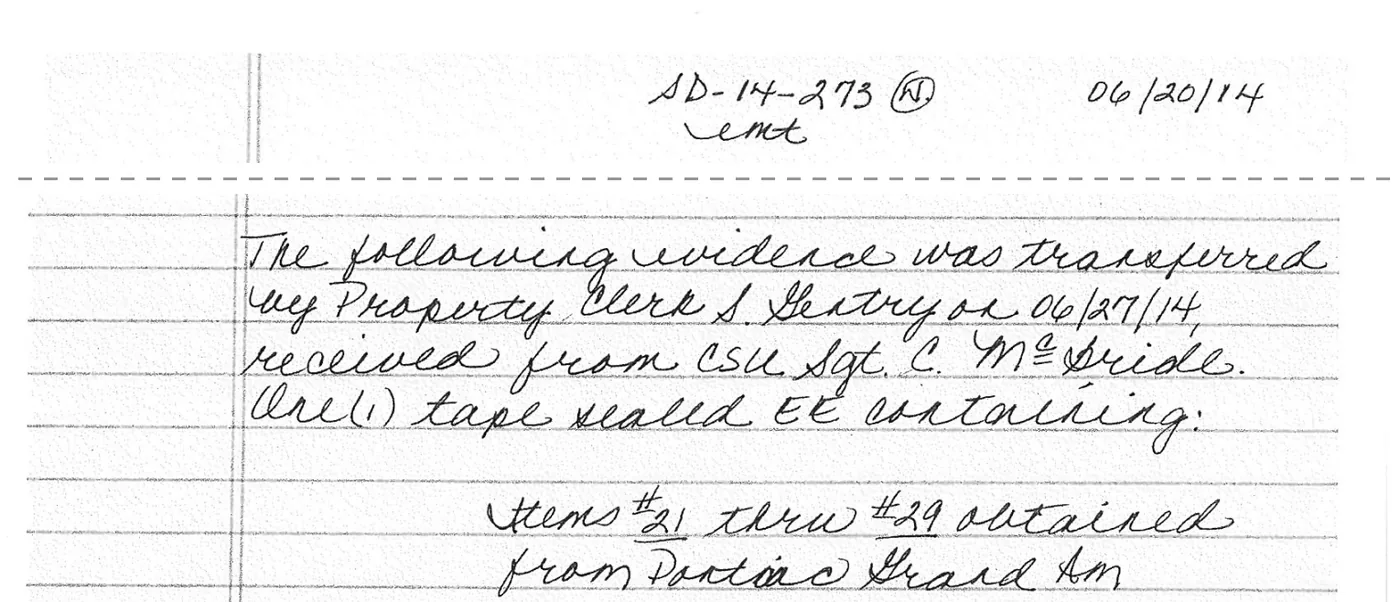
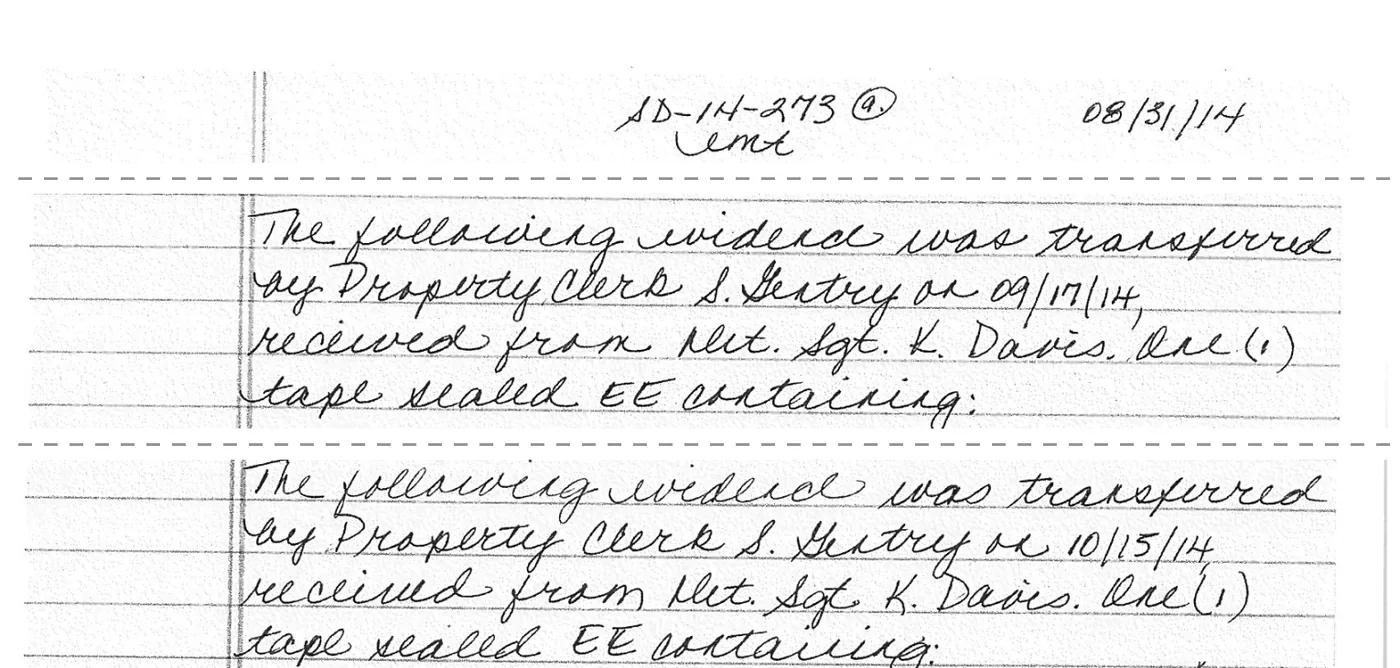
The entries also run across the page breaks. The description of item #22 starts at the bottom of the page dated June 20 and finishes, mid-sentence, at the top of the page dated June 27. The break does not fix when either entry was written. It does mean the date at the top of a page cannot be taken as the date everything on it was recorded. Bench notes pp. 4–5.
A page describing 2014 evidence is dated October 16, 2015.
Page 10 records reference swabs from three women that reached the laboratory in October and November 2014. The date at the top is 10/16/15.
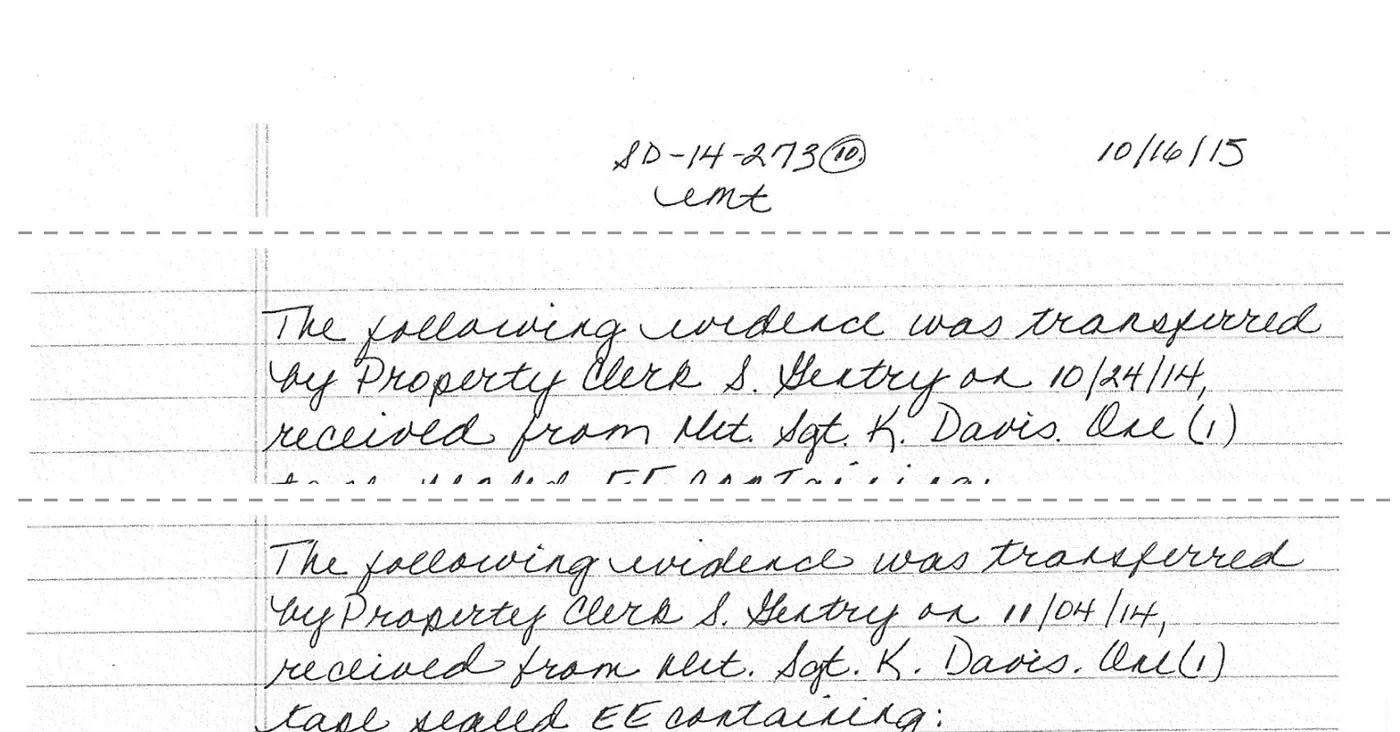
On September 28, 2015, at Mr. Gieger’s request, Ms. Taylor returned to the pants and swabbed the inside of the fly. She reported the results on October 7. Taylor Dep. 65:20–66:14 (Jan. 15, 2019); OCPD Supp. Forensic Exam. Rpt. (Oct. 7, 2015). The date on page 10 comes nine days after that report. Seven days after that, on October 23, the State gave the twenty-one pages to the defense as Ms. Taylor’s bench notes.
A mistaken year would not resolve it. If Ms. Taylor meant to write 10/16/14, the page would still be dated before the October 24 and November 4 deliveries it records.
Forms dated before the samples they list.
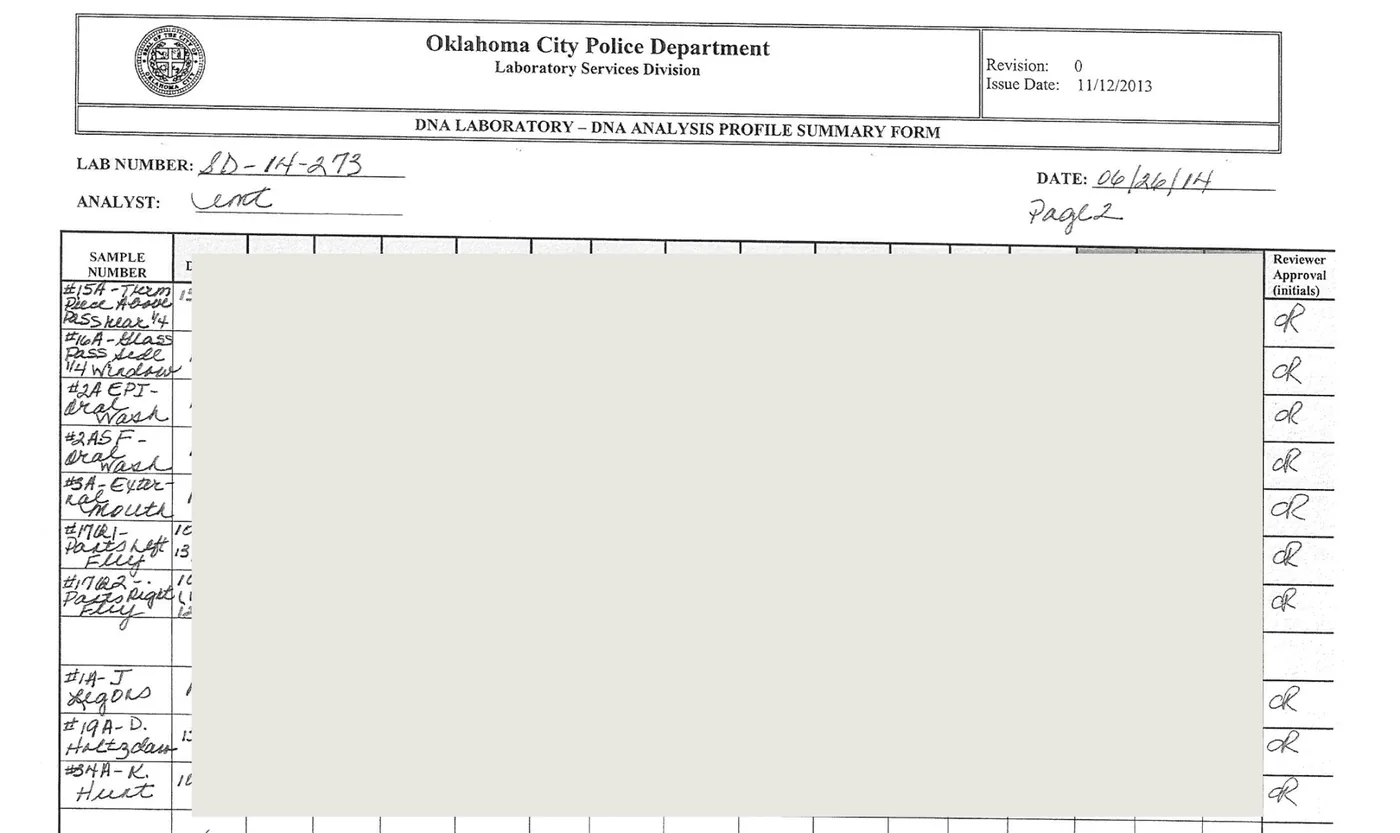
The printed forms raise the same problem with the date at the top of a sheet. The DNA profile summary marked page 2 is dated June 26, 2014. Its last row is the reference profile from item #34A. Those swabs were not transferred to the laboratory until July 2, according to page 7 of the same notes. Bench notes p.13; p.7.
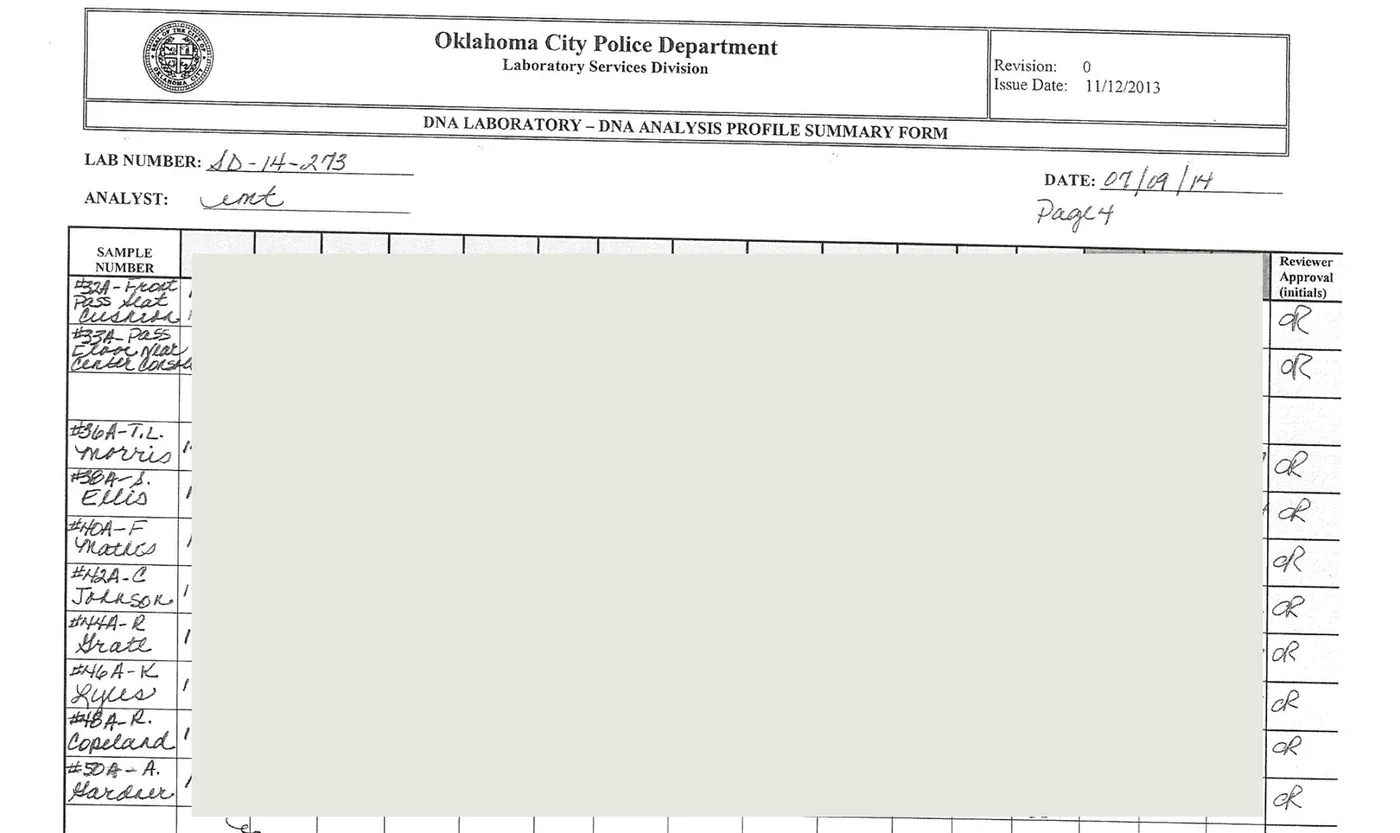
The summary marked page 4 is dated July 9, 2014. It lists the full profiles of eight women, items #36A through #50A. Their swabs reached the laboratory between July 11 and October 24. Bench notes p.15; pp. 7–10.
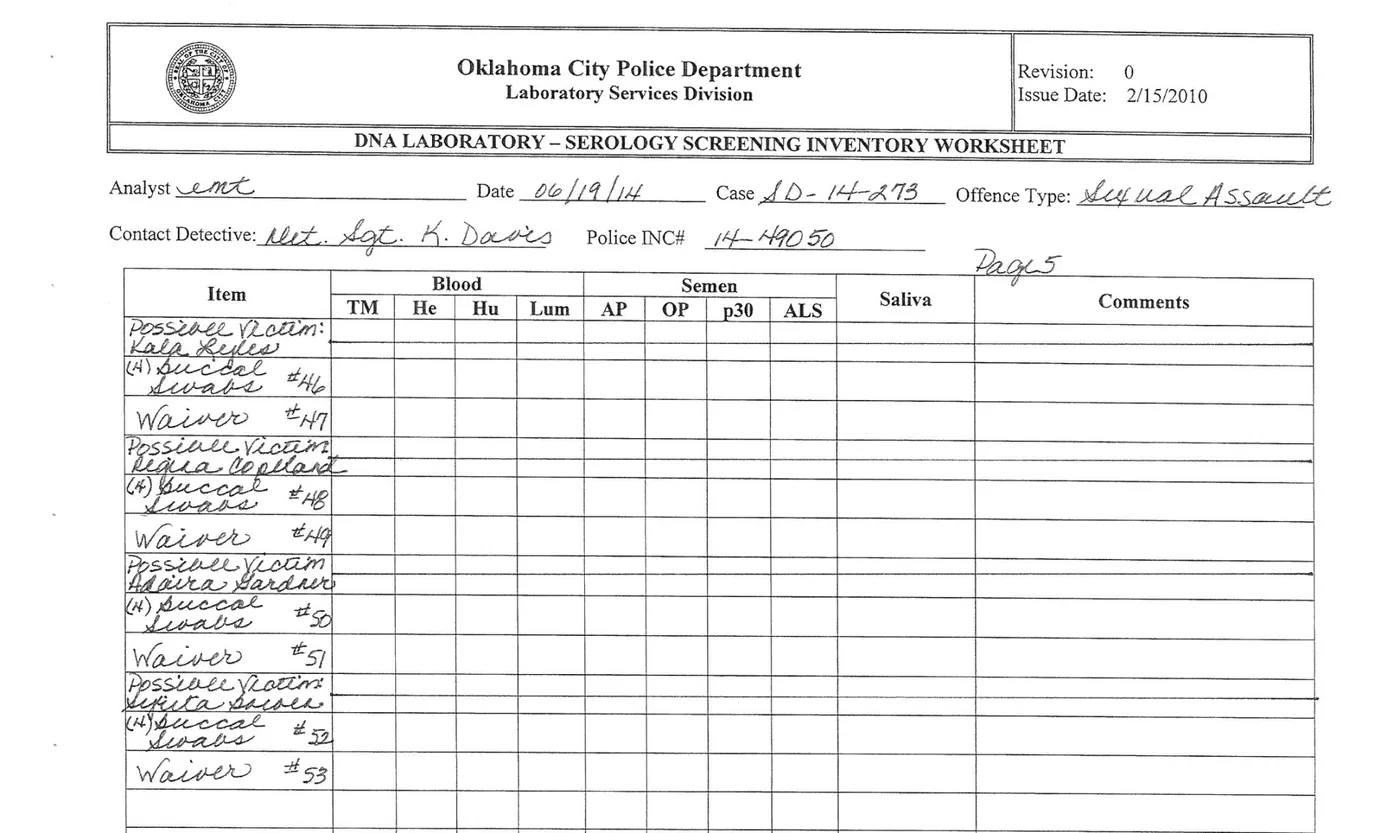
All five serology worksheets carry the date June 19, 2014, the day the first evidence arrived. Between them they list every item in the case, through items #52 and #53, which were delivered on November 4. Bench notes pp. 17–21; p.10.
There may be an innocent explanation for some of this. A form can be opened on one date and added to as evidence arrives. If that happened here, the date at the top records when the form was started. It does not show when a given row was added or when the work behind it was done, and nothing else on these sheets does either. Contemporaneous notes are supposed to answer those questions.
Her laboratory’s accreditation required notes made at the time.
Ms. Taylor told the jury that the OCPD laboratory had held ISO accreditation since 2010, under standards a little bit higher
than the ordinary crime-lab accreditation. Trial Tr. 2694:22–2695:15. The ISO standard for testing laboratories in force in 2014 required that observations, data and calculations be recorded at the time they are made.
ISO/IEC 17025:2005 § 4.13.2.2. The DNA unit’s own quality manual, issued in April 2014, listed handwritten case notes as part of the case record. OCPD DNA Unit QA1, Quality Assurance Manual, Rev. 0 (Apr. 18, 2014), § K; Scott Adams 03809.
Notes made at the time preserve what the analyst wrote while the work was going on, before later events could shape how it was described.
The date on a page is not the date of its contents.
The documents do not say when each entry was written. They do show that the date on a page is not the date everything on it was recorded. Several sheets list evidence that arrived after the date at the top. One handwritten page is dated October 16, 2015, and the set was produced seven days later as “Bench Notes created by Elaine Taylor in performing the DNA Analysis.”
The pages could be sheets begun in 2014 and added to later, copies of earlier notes, or entries written after the work was done. What the State has produced does not distinguish among them, and no earlier version has been produced.
The State handed these pages over as notes “created by Elaine Taylor in performing the DNA Analysis.” By their own dates, at least one was written in 2015. Taken at face value, the pages are an inventory of the evidence and a table of results. They preserve almost none of the analysis: not the examination of the pants, not the reasons the screening was skipped, not the reading of the mixtures.
Explore the rest of the case.
Daniel Holtzclaw: case summary
A summary of the whole case: the investigation, the DNA, the accusers, the trial, and where things stand.
The DNAHow the State Distorted the DNA Evidence
A trace of DNA, less than a car door handle leaves, and no stain. The prosecutor called it “fact” that it came from a rape.
The searchHow the State Manufactured Accusers
Nine of thirteen accusers were found by police, who opened with a “tip” that didn’t exist. Thirty-some other women said nothing happened.
Accuser evidenceThe Questions Nobody Asked
Missing recordings and what the objective records actually showed, once each woman had made her allegation.
The investigationA Rocky Timeline
Detective Gregory’s report of his search for Terri Morris: five stops in twenty-eight minutes, a start time two hours after the first stop, and a date on the report five weeks before the visit it cites.
The investigationThe Officers They Didn’t Look For
Four women described an officer who was not Daniel. The detectives checked who had run their names, found other officers, and stopped. Each description, followed through the file to where the inquiry ended.
The investigationThe Police Reports
Detectives Gregory and Davis wrote summaries, not transcripts. Where a recording of the interview survives, it has things in it the detective left out: denials, a description, a promise, a map on the table.
Case studyTerri Morris
How Morris's allegation changed, how police selected May 8, and what the AVL records do and do not show.
The first accuserJannie Ligons
The June 18 allegation, the unrecorded first interview, and the negative forensic test results.
Case studySherry Ellis
How police found Ellis, the description that did not match Daniel, and her later testimony that she had never seen him before trial.
Case studyKala Lyles
Twenty or thirty minutes through the fly, hours before the pants were seized. Her DNA wasn’t there, and the patrol car’s records leave about eleven minutes.
Case studyVictim #14
Her account fit Daniel’s records better than most. The State closed her case for a reason it never applied to the allegations it took to trial.
Case studyDemetria Campbell
A 2013 use-of-force complaint became a sexual-assault claim in a 2015 lawsuit. When it threatened to cost the City money, the City attacked her changing story with the arguments it never applied to Daniel’s accusers.
The fly“I Don’t Know How He Did It.”
Jannie Ligons said it at trial. Eight of the nine women who alleged rape or oral sodomy placed the act through the fly of pants that stayed on. Under the uniform, Daniel wore compression shorts with no fly. Getting past them would take work. Nobody has ever explained how he was able to extricate himself with so little time and effort.
Guilt by associationOne Accuser’s DNA Carried Twelve Others
The only physical evidence belonged to one accuser. All thirteen were tried together, and jurors later said the DNA got deliberations moving when they doubted some of the others.
The courtroomThe Circus-Like Trial
The protests, audible chanting, courthouse conditions, and the denied request to sequester the jury.
The manWho Daniel Was
A rookie his supervisors called eager and liked by all, whose phone and work computer held nothing incriminating, and who sat for two hours with the detectives accusing him and urged them to test his DNA.
The analystThe Analyst In Her Own Words
The State’s only forensic witness, on video: what she looked for, what she didn’t test, what she told the prosecutor, and what her opinions rested on.