
The Gill Report
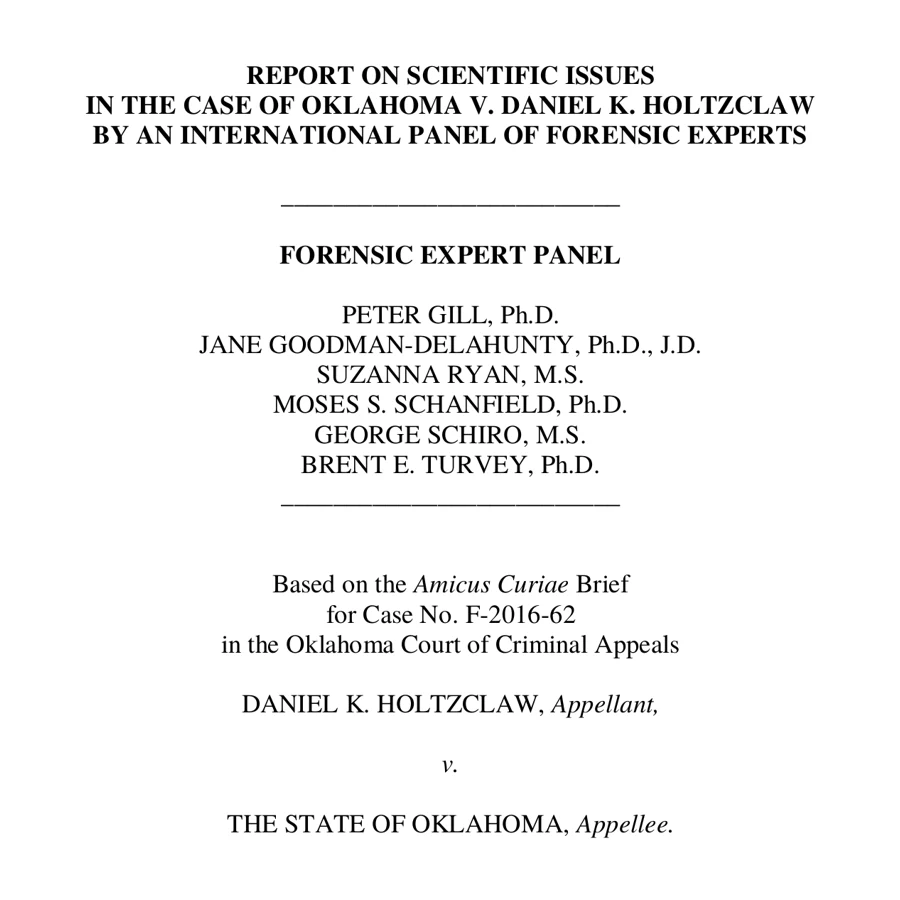
The only physical evidence tying Daniel to any accuser was DNA on the fly of his uniform pants. In July 2017, six forensic scientists led by Peter Gill, who co-authored the first demonstration of forensic DNA profiling, published a 46-page review concluding that the DNA had little probative value. The report found that the State’s analyst and prosecutor misrepresented the DNA evidence. The scientists agreed that Daniel should get a new trial. The Court of Criminal Appeals refused to admit their amicus brief.
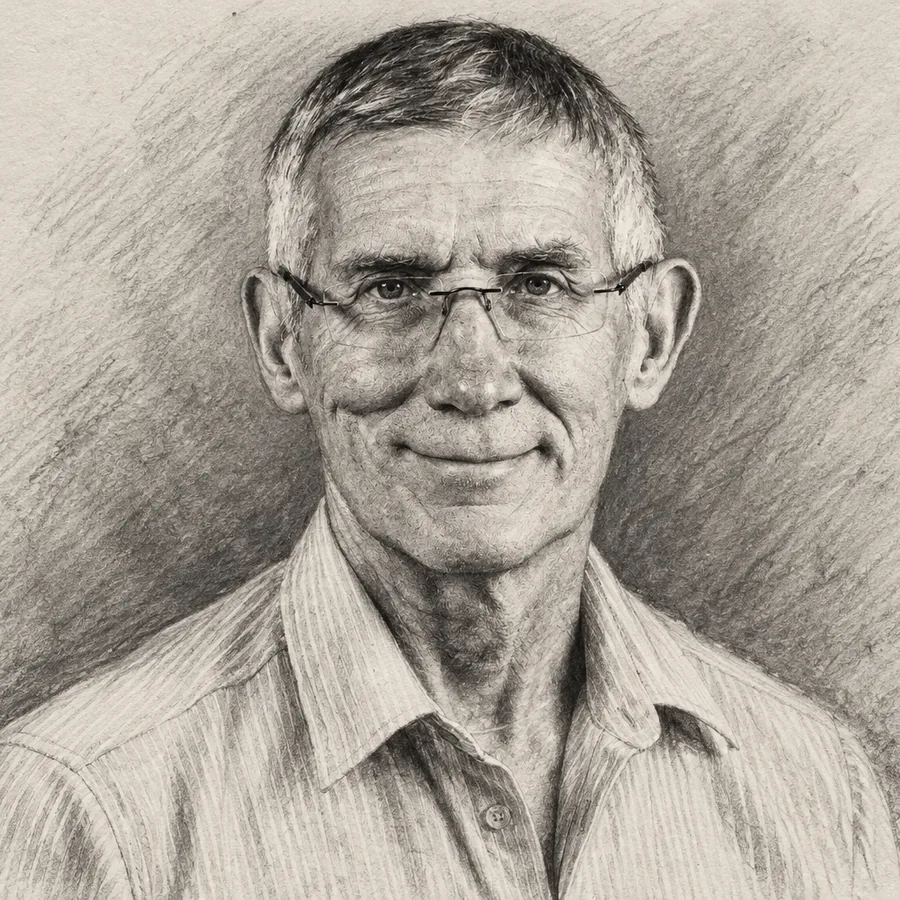
Six scientists, one of them a founder of the field.
Peter Gill began DNA research in 1985, working with Sir Alec Jeffreys at Leicester, and that year co-authored the first demonstration that DNA profiling could be used in forensic casework. He spent twenty-six years at Britain’s Forensic Science Service, helped develop the STR multiplexes behind national DNA databases, analyzed the remains of the Romanov family, and developed the methods for “low-template” DNA and complex mixtures that laboratories now use. At the time of the report he chaired the DNA commission of the International Society for Forensic Genetics, which gave him its scientific prize in 2013, and he has published more than two hundred peer-reviewed papers and a book, Misleading DNA Evidence: Reasons for Miscarriages of Justice. Gill et al. (2017), p. x.
The State’s own DNA manager, asked about him under oath, called him “a highly regarded member of the community” whose papers he had read in training, and agreed he is a renowned DNA scientist: “Absolutely, yes.” Ruddock Dep. 21:10–21 (Mar. 21, 2019).
The other five cover serology, crime-laboratory work and how juries weigh DNA: Jane Goodman-Delahunty, a psychologist and lawyer at Charles Sturt University; Suzanna Ryan, a forensic serologist and DNA consultant; Moses Schanfield, professor of forensic sciences at George Washington University and a former crime-laboratory director; George Schiro, a DNA technical leader who has testified in 195 trials; and Brent Turvey, a forensic scientist and author of textbooks on rape investigation. Gill et al. (2017), pp. x–xv.
The report describes itself as the work of scientists “concerned about the improper use of forensic evidence that causes a miscarriage of justice,” and it was first prepared as a friend-of-the-court brief for Daniel’s direct appeal. Gill et al. (2017), p. ix; Gill et al. (2017), cover.
The DNA had little probative value because it could be explained by ordinary transfer.
The laboratory matched the DNA on the fly to Adaira Gardner, the seventeen-year-old he had stopped twice the day before the pants were collected. The panel’s central finding is that this DNA, in this condition, could not tell the jury how it got there. It was found “without any visible stains or deposits, without any body fluid testing, and with low quantities of DNA in mixtures from unknown people.” Those findings are consistent with non-intimate transfer: skin-cell DNA from Gardner, her clothes or her purse to Daniel’s hands during the stop, and from his hands to his fly at a restroom break. Gardner herself testified that Daniel went through her purse that evening. Tr. 3757:2–15; Gill et al. (2017), p. 8.
The panel did not say that is what happened. It said it is “a reasonable explanation,” that research “proves that non-intimate DNA indirect transfer occurs, even to incriminating locations,” and that a DNA profile alone “does not inform about ‘when, where, how or why’” the transfer occurred. It quoted a 2016 study: given the sensitivity of modern testing, “nobody can be sure about the way DNA was deposited at a crime scene, neither by whom or when.” Gill et al. (2017), pp. 8–9, 21.
The studies were on the shelf before trial. A 2010 study found that after ordinary social contact with a woman, a man who then unzipped his trousers to urinate carried her DNA to his underwear in a third of trials and to his penis in two thirds. A study published online in October 2015 found that DNA from one person’s neck reached a second piece of cloth by way of another person’s hands. A 2002 paper co-authored by Gill reported recovering the full profile of someone who had never touched an item, while the profile of the person who did touch it was absent. None of this was put before the jury. Gill et al. (2017), pp. 10–11.
Two more observations pointed the same way. There was no visible staining. The panel acknowledged that vaginal stains can be faint or invisible, but cited research finding visible stains on men’s underwear after two minutes of intercourse without ejaculation, against the ten minutes of rape through the fly the State alleged for Gardner. The State also alleged that hours later he forced Jannie Ligons into oral sodomy through the same fly, and the jury convicted him of it. Taylor examined the fly under a very bright light with a magnifying glass and found nothing suspicious. And every sample was a mixture of DNA from several people, “typical of the complex DNA mixtures frequently found due to non-intimate DNA indirect transfer.” Gill et al. (2017), pp. 11–12; Tr. 3768–73, 501, 511, 4084:2–22; see The DNA evidence.
The analyst called vaginal fluid “a very good possibility.” The panel found no basis for it.
Elaine Taylor told the jury that it was “a very good possibility” that Gardner’s DNA had reached the fly in vaginal fluid. The panel found three errors in that opinion. It was “not founded objectively upon the evidence,” since nothing was visible, no fluid test was done, and Taylor herself agreed on cross-examination that transfer from the purse Daniel had searched could not be ruled out. It used a DNA profile alone to compare the likelihood of two transfer routes, which a profile cannot do. And her remark that “a young woman of her age would be very likely to have quite a bit of lubrication” was testimony “beyond the forensic science professional expertise.” Tr. 4065, 4073, 4083; Gill et al. (2017), pp. 20–22.
The panel found that Taylor also told the jury there was no male DNA on the two inside-fly swabs, when the laboratory’s own quantification report, a page she had initialed, showed male DNA on both. And it disputed her testimony that Daniel was excluded as a contributor to all four samples: the mixtures had alleles below the stochastic threshold, her own reports called the minor contributors “not suitable for comparison,” and most of Daniel’s alleles were present in two of the four samples. The correct answer was “inconclusive,” which is what the laboratory’s own interpretation manual required. Tr. 4072; Gill et al. (2017), pp. 22–26.
The prosecutor then told the jury in closing that it was a “fact” that Gardner’s DNA “from the walls of her vagina was transferred in vaginal fluids” to the fly. The panel’s answer: “a basic tenet of science is that one cannot claim the presence of a substance for which one has not tested.” He also argued that finding the DNA on the fly and nowhere else was damning, when he himself had asked the laboratory to test only the fly. Tr. 4307, 4059; Gill et al. (2017), p. 29.
The State’s DNA manager, deposed in 2019, did not defend any of this. He said the laboratory had never tested for vaginal fluid, that calling the DNA vaginal fluid was “an assumption,” that the lubrication testimony was outside a DNA analyst’s expertise, and that he “would not present evidence in that fashion.” Ruddock Dep. 29:7–33:4, 40:19–42:14 (Mar. 21, 2019).
No underwear, no penile swab, no light source, no control samples.
The panel found that the investigation skipped the steps that could have helped tell the two explanations apart. Detectives took Daniel’s pants and belt and nothing else: not the underwear he was wearing, not the pair from the night before, and no swab of his body, though the Ligons allegation was hours old. Asked where that pair was, Daniel said, “Uh, in the wash,” and when Gregory asked “They’re in the washer?” he said “Washer.” He never said they had been washed; a washing machine is where many people put dirty laundry. Davis took it to mean they were washed, and testified that a washer “washes it away.” The panel found both steps wrong: nobody checked, and laundered clothing can yield complete profiles anyway. The analyst never screened the pants with an alternate light source, never tested for any body fluid, and testified that an amylase test for saliva “would not have aided anybody.” No one took elimination samples from the detectives who handled the evidence, or from the two friends Gardner was with when Daniel stopped her. Gill et al. (2017), pp. 13–17; Scott Adams 00104 (interview transcript); Tr. 1164:5–18.
The panel also listed five ways DNA on the pants could have been contaminated or moved onto the fly during collection and testing: the pens the detectives handed Daniel during a two-hour interrogation, the detective’s bare hand in the evidence bag, the pants and belt packaged together, DNA moving from one part of the pants to another inside the bag, and the brick surface the pants appear to rest on in the laboratory’s own photograph. “The trial defense attorney mentioned none of them.” Gill et al. (2017), pp. 17–19; see The questions nobody asked.
A juror called the DNA “very crucial.” The investigation was built on it.
A juror told a television station after the trial that “the DNA evidence was very crucial.” Juror Daniel Speaks said jurors who doubted the accusers came around on the DNA, and explained his understanding of it: “They told us it was DNA from the vaginal fluid from a 17-year-old.” That is the claim the panel found no basis for, in a juror’s mouth. The panel also surveyed the research on how heavily juries weigh DNA evidence, in circumstantial cases above all. Gill et al. (2017), pp. 31–32, 37.
Jurors haven’t all said the DNA decided it. In August 2017 two of them told the Associated Press they were confident the jury would have convicted Daniel anyway. Speaks called the DNA “pretty crucial” to deliberations but said “it wasn’t strictly the DNA.” Juror Karen Hancock said she was still convinced he would have been convicted without it, because of the circumstantial evidence. AP, “DNA Issues Raised Amid Secret Hearings in Ex-Cop Rape Case,” Aug. 23, 2017.
The harm ran deeper than one count, the panel wrote, because the State built its investigation on the DNA. Before Gardner was identified, the prosecutor told the trial judge it was an “undeniable fact” that “there is at least one more woman out there, because we have her DNA, that he has had sexual contact with.” The hunt for her produced the victim profile, the list of women Daniel had run, and the “received a tip” interviews that generated most of the thirteen accusers. The panel called it forensic confirmation bias: an assumption of guilt founded on a forensic error, then an investigation “working backwards” from it. Gill et al. (2017), pp. 40–44; see The search for accusers.
Its conclusion: “We believe that Mr. Holtzclaw was deprived of his due process right to a fair trial because the State misused DNA evidence,” and “Mr. Holtzclaw’s conviction should be overturned and he should be given a new trial.” Gill et al. (2017), p. 45.
Gardner’s own testimony puts Daniel’s hands in her purse. The report didn’t press the point.
The transfer route the panel described starts with Gardner’s own testimony that Daniel went through her purse during the stop that evening. The State didn’t dispute it. In closing, Gieger answered it with sarcasm, telling the jury, And what Mr. Adams wants you to believe is he searched her purse. And so from her hand to her purse, from her purse to Officer Holtzclaw’s hand, from Officer Holtzclaw’s hand to Officer Holtzclaw’s -- I guess he does this (indicating) after he searches somebody?
Tr. 3757:2–15, 4307:14–18.
Contact with her skin would make transfer likelier still. Gardner testified that she was wearing a tank top and shorts, and Taylor agreed on cross-examination that transfer from touching a person’s skin is much greater
than from touching clothing. Tr. 3767:15–21, 4085:19–4086:14.
Whether he touched her skin rests on Daniel’s account. In his 2019 deposition, two years after the report, he described how he searches people and demonstrated it on one of the lawyers. He has the subject interlace the fingers behind the back, grips the hands from behind, has the subject spread the feet, and keeps his own foot right by his foot.
Of Gardner, who with two friends outnumbered him three to one that evening: I’m sure I touched her skin, I’m sure I touched her hands.
Asked whether she wore shorts, he said, Summertime, I -- she could have been wearing shorts.
She testified that she was. He also drove her home in the back seat of his patrol car. Holtzclaw Dep. 244:14–247:23 (Oct. 21, 2019); Tr. 3767:15–21, 3806–08.
None of this is a criticism of the panel’s work. The purse search alone, which Gardner described and the State didn’t contest, gives the explanation the panel called reasonable a starting point in her own testimony.
The Court of Criminal Appeals refused the brief. Its opinion never mentions the panel.
The panel first offered its analysis to the Oklahoma Court of Criminal Appeals as an amicus curiae brief in Daniel’s direct appeal, No. F-2016-62. In June 2017 the court denied leave to file it, a procedural ruling that says nothing about the science, as it had denied a brief by law professor Randall Coyne and attorney J. Christian Adams three months earlier. The scientists then published the analysis as a report, dated July 25, 2017. Gill et al. (2017), cover; Associated Press, Aug. 23, 2017 (the court “refused to admit the report to the record”).
The court’s August 2019 opinion affirming the convictions does not mention the panel, Peter Gill or the report. It addressed the DNA through the 2017 affidavit of Dr. Michael Spence, and taking his assertions as true, found that Taylor “may have either misinterpreted or misstated her own findings” about male DNA. The question before it was procedural: whether Daniel had shown enough to get a hearing on his trial lawyer’s performance. It held he had not, because, in the court’s reading, “Taylor never testified the DNA was transmitted in vaginal fluid”; she had called it a “likely possibility” given the allegation. That distinction between a possibility and an identification was lost on the jury, which heard the prosecutor call the vaginal-fluid transfer a “fact,” and on the juror who later explained, “They told us it was DNA from the vaginal fluid from a 17-year-old.” Holtzclaw v. State, 2019 OK CR 17, ¶¶ 61–63; Tr. 4307.
One month before the panel’s report, in June 2017, the same court sent the case back to the district court for a sealed two-day hearing on issues attendant to the testimony of an expert witness. It was held without Daniel or his lawyers. The State’s DNA manager testified at it. The transcripts remain sealed to the public. Daniel’s appellate lawyer was allowed to read them in 2017, under an order barring him from sharing them with anyone, including the experts he needed to make sense of them. Not until 2025 did the court let his DNA expert and co-counsel read them, under supervision and the same bar. Holtzclaw v. State, 2019 OK CR 17, n. 7; see the case timeline; Ruddock Dep. 56–57.
One clause from the AP. Nothing from the Oklahoman.
The Associated Press mentioned the report once, in an August 23, 2017, story about the sealed hearings, as “a report written by six forensic scientists convened by a Holtzclaw supporter,” and summarized the defense’s transfer argument in two sentences. It did not name the scientists, say who Peter Gill is, or describe what the panel found. AP, “DNA Issues Raised Amid Secret Hearings in Ex-Cop Rape Case,” Aug. 23, 2017.
The Oklahoman, the state’s largest newspaper, covered the trial extensively. It published no article on the report. The sustained treatments came from opinion outlets: Conservative Review in August 2017, and a syndicated column by Michelle Malkin in February 2018. Chris Pandolfo, “Bombshell report: Holtzclaw conviction should be overturned,” Conservative Review, Aug. 2017; Michelle Malkin, “Science, Secrecy and Lies in Oklahoma,” Feb. 14, 2018. Disclosure: Michelle Malkin is married to UNCUFF president Jesse Malkin.
So the record stands this way. The scientist who helped invent forensic DNA profiling reviewed the only physical evidence in the case and found it could not show what the jury was told it showed. The court would not take the brief. The State’s own laboratory supervisor, asked under oath what he thought of it, was told not to answer. And the newspaper of record in the city where the trial took place never told its readers the report existed.