
Adaira Gardner
Adaira Gardner was 17 when Daniel stopped her twice on the evening of June 17, 2014. He ran her for warrants and let her go, and two hours later he drove her about two blocks to her mother’s house. Four months later she told a detective he had raped her on the enclosed porch, and in that first interview she put it in March or April. Her mother’s first account of that evening was that her daughter came home talking about this really hot cop.
The State’s laboratory attributed DNA on the fly of his uniform pants to her, the only forensic evidence offered for any of the thirteen women. Counts 30, 31 and 32: fifty years.
The records show two stops he called in, a ride home he logged, and a call he made from his own phone.
That morning Gardner’s mother had called the police. The officer who took the report wrote that he was dispatched IN REFERENCE TO A RUNAWAY JUVENILE
and that her daughter HAD NOT COME HOME SINCE LAST NIGHT.
The report wasn’t entered into the department’s records system until June 20, and Detective Kim Davis, who led the investigation, told the jury nothing in that system could have told Daniel she was a runaway. Scott Adams 00242; Tr. 3907:8–3908:17, 3951:17–20.
At 6:50 p.m. Daniel put himself out on a stop a few blocks from her mother’s house, where Gardner was walking with two adults. No one had called it in. The call record shows he started the stop himself. At about 6:57 he ran all three for warrants. Two came back clear, and Gardner had a city warrant. By her account he went through her purse, told her she could take care of the warrant before she turned 18, and let everyone go. The call closed at 7:09. Tr. 3914:8–23, 3929:11–15, 3898:12–17, 3900:19–25, 3938:10–13, 3757:2–15, 3752:1–4, 3754:2–12.
At 9:20 he put himself out on another stop about a block from the house. This time she was alone, she had no identification, and at 9:26 he ran her again. She told him her mother might be home to confirm who she was, and he drove her there in the back seat of his car. He closed the call from his computer at 9:28. His activity card logs him out on a subject at her mother’s address from 9:30 to 9:45, with the house number off by two, and the car’s GPS puts it there until about 9:43. He didn’t radio that he was transporting her. Tr. 3919:24–3921:8, 3901:1–5, 3758:23–24, 3807:6–18, 3911:7–18, 3922:3–16.
At 11:36 the GPS puts his car back on her mother’s street. At 11:42 Daniel called the house from his personal cell phone. Her mother testified that a man who said he was with the Oklahoma City Police Department asked for Adaira, that she called him a pervert and hung up, and that he never got to say why he was calling. Fourteen minutes later he ran her mother’s name. Her mother’s number was listed with Gardner’s own record in that system. Tr. 3930:22–3932:15, 3903:23–3905:24, 3874:6–3875:1, 3875:15–16, 3888:15–19, 3901:14–21, 3964:10–19.
The State asked the jury to read the call as something sinister. Davis testified that Daniel asked for Adaira, not her mother, and that an officer checking on a girl would ask for the mother. In closing, the prosecutor Gayland Gieger told the jury, If you think he’s calling to check on her welfare I’ve lost this case already,
and argued that an officer worried about her would have knocked on the door. Tr. 4000:12–4001:15, 4182:22–4183:4, 4308:6–19.
The State’s lead detective had already conceded the point. On cross-examination Davis agreed it wasn’t improper for an officer to drive home someone who lived a block away, that it wasn’t unreasonable for him to try to confirm the person lived there, and that, given Gardner’s age, it wasn’t unreasonable for him to check with her mother later to make sure she was home. At 11:42 at night, a phone call is a gentler way to check than a knock on the door, and asking for Adaira is the direct way to find out whether she’s home. Tr. 3962:6–3963:4.
In her first interview it happened in March or April, months before the day her mother called the police.
Gardner gave her first full account in a video-recorded interview on October 24. It was warm enough for shorts, she said, and it was in the beginning of the year.
Pressed for a month, she said around like March or something like that,
just before her boyfriend went to jail, which she thought was in April. Davis wrote in her report, She thought it was in March or April.
Gardner Interview Tr. 20–21 (Oct. 24, 2014); Scott Adams 00232.
Davis then told her that, by her mother’s account, she had come home talking about a hot cop
on the day the two of them got into it on the south side of town and her mother called the police on her. Gardner said that day came later. That was like months later,
she said. The stuff with that cop happened way before that.
Gardner Interview Tr. 23–24 (Oct. 24, 2014); Scott Adams 00232–33.
The police report of that fight is dated June 17, 2014, the morning of the day Daniel stopped her twice. Gardner testified that she met him on only one day in her life. Davis’s crime report dates the assault June 17, the day in Daniel’s records. Scott Adams 00242, 00225; Tr. 3797:23–3799:6.
People misremember months, and a 17-year-old moving between her parents’ homes with no phone or watch could easily have. The month isn’t the point. She tied the assault to a day that can be checked, the day her mother called the police on her, and said that day came months later. The records put both on the same day. Tr. 3746:12–14, 3754:18–20; Scott Adams 00226, 00232–33, 00242.
| Detail | First interview, Oct. 2014 | Trial, Dec. 2015 | Deposition, May 2019 |
|---|---|---|---|
| When it happened | around like March or something like that.March or April. | Told the records put it on June 17, It sounds about right, yes.Not sure if it was 17th or 18th. | I think it was the 17th of June or July. |
| Her mother’s police report that morning | way after, months later. | I didn’t think that was the same day we had gotten into an argument. | Asked whether she’d had any recent fights with her mother, Not that I recall. |
| How he exposed himself | he like started unbuttoning his pants and stuff.In Davis’s report, he unfastened his pants. | I didn’t see him take it out of his fly but I heard him unzip his zipper. | I’m not sure if he unbuttoned his pants. I heard him unzip his fly. |
Gardner Interview Tr. 19, 21, 23–24 (Oct. 24, 2014); Scott Adams 00232; Tr. 3796:17–19, 3836:14–16, 3778:2–3; Gardner Dep. 65:8–10, 88:5–6, 136:16–19 (May 22, 2019).
By 2019 she could say where the date had come from. When the GPS to the police car was corroborated with that date, that could have been the only date that he had contact with me,
she testified. I agreed with that.
Asked whether the police had told her they had GPS and she had agreed with the date they came up with, she said, Yes.
Asked whether she had first told them it happened much earlier in 2014, she said, I may not have done that because I don’t remember.
Gardner Dep. 137:9–14, 137:21–138:10 (May 22, 2019).
The jury never heard about March or April. Davis told the jurors there was nothing significantly inconsistent between Gardner’s first interview and her preliminary-hearing testimony, and that What her testimony was about the incident is exactly what she told me.
In closing, the prosecutor Lori McConnell asked the jurors to consider the women’s ability to remember the sex acts and tell them consistently over and over again over a year period of time.
Tr. 4008:14–23, 4021:14–16, 4185:9–13.
The fly showed no stain, and no more of her DNA than a car door handle.
Detectives took Daniel’s uniform pants the next afternoon, after Jannie Ligons reported him. The State’s laboratory later reported that a reference sample attributed to Gardner matched the major contributor to the DNA on swabs from the fly. It was the only forensic evidence the State offered for any of the thirteen women. Tr. 422:23–423:7; Forensic Examination Report SD-14-273 (Nov. 12, 2014); Supplemental Forensic Examination Report, SD-14-273 (Oct. 7, 2015).
There was very little of it. Dr. Michael Spence, a forensic DNA analyst retained on Daniel’s appeal, reviewed the laboratory’s data in 2017 and found only modest quantities of DNA from Ms. Gardner
on the four fly swabs. He compared them with a swab of a car door handle taken in the same investigation. The handle gave about as much DNA as one fly swab and four to four and a half times as much as each of the other three. Vaginal fluid is rich in cells, he wrote, and even a small amount of it yields a lot of DNA. The fly’s yields looked like what handling leaves behind. The jury never heard any of these numbers. Spence Aff. ¶ 14 (Jan. 30, 2017).
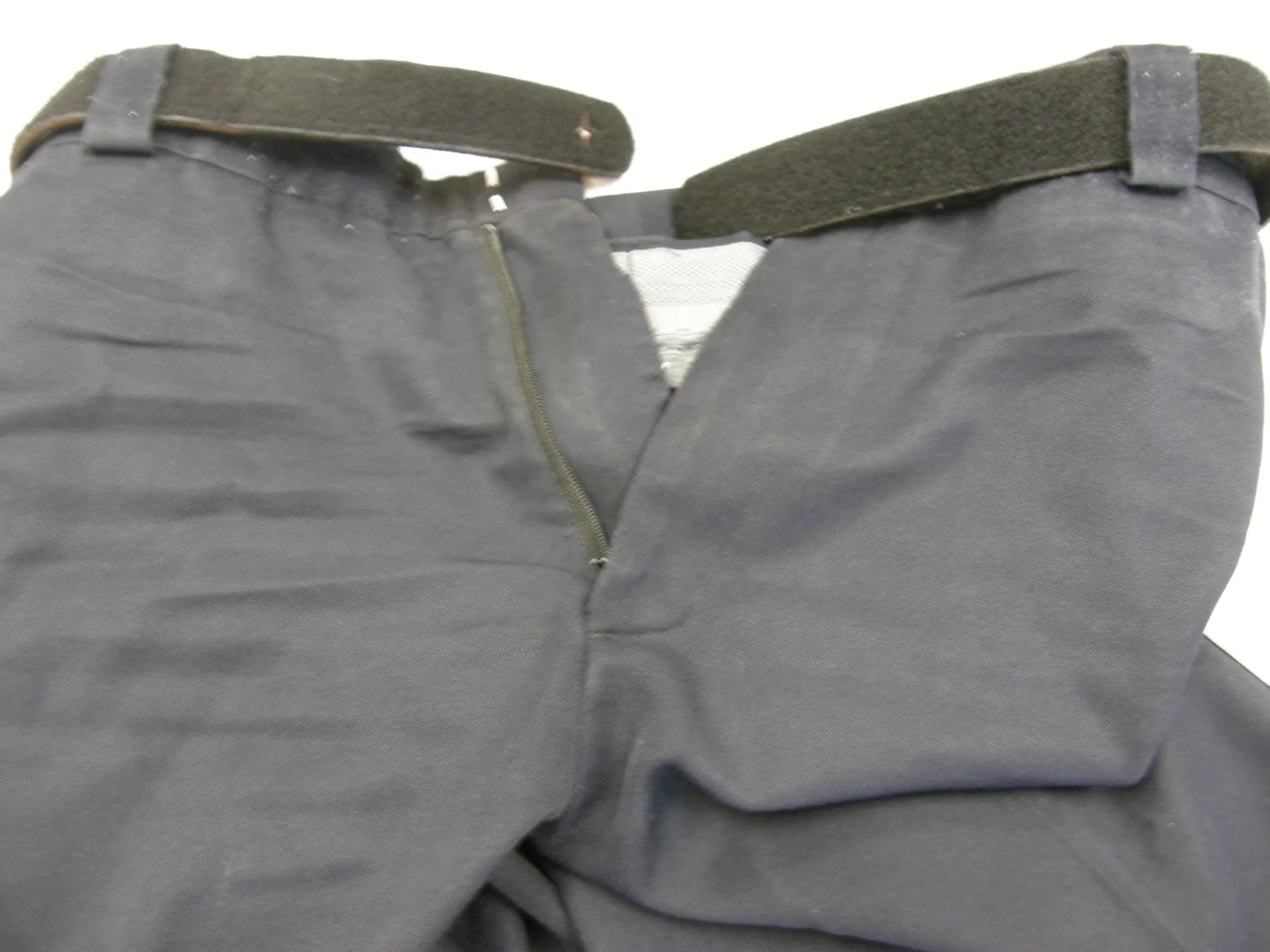
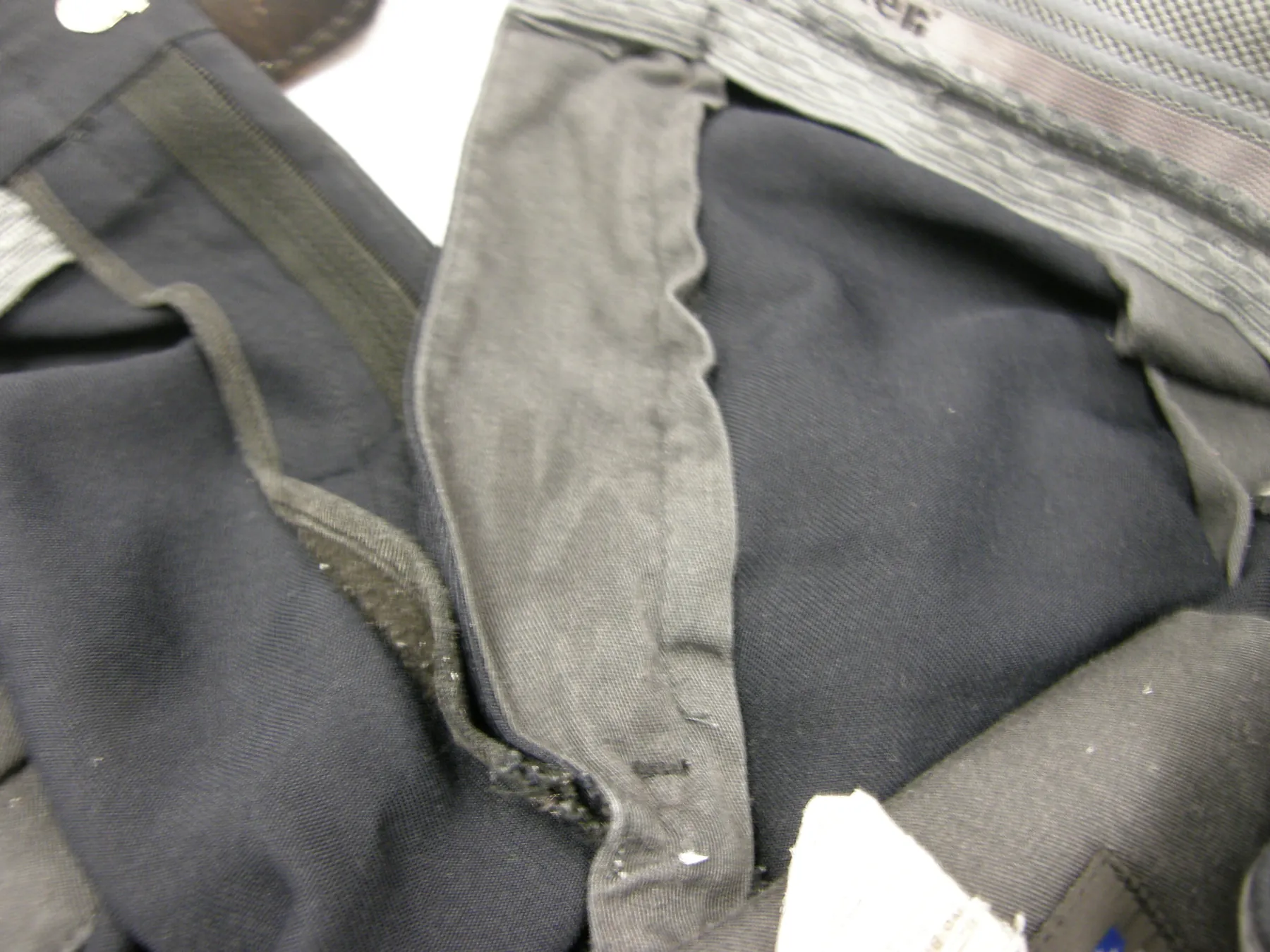
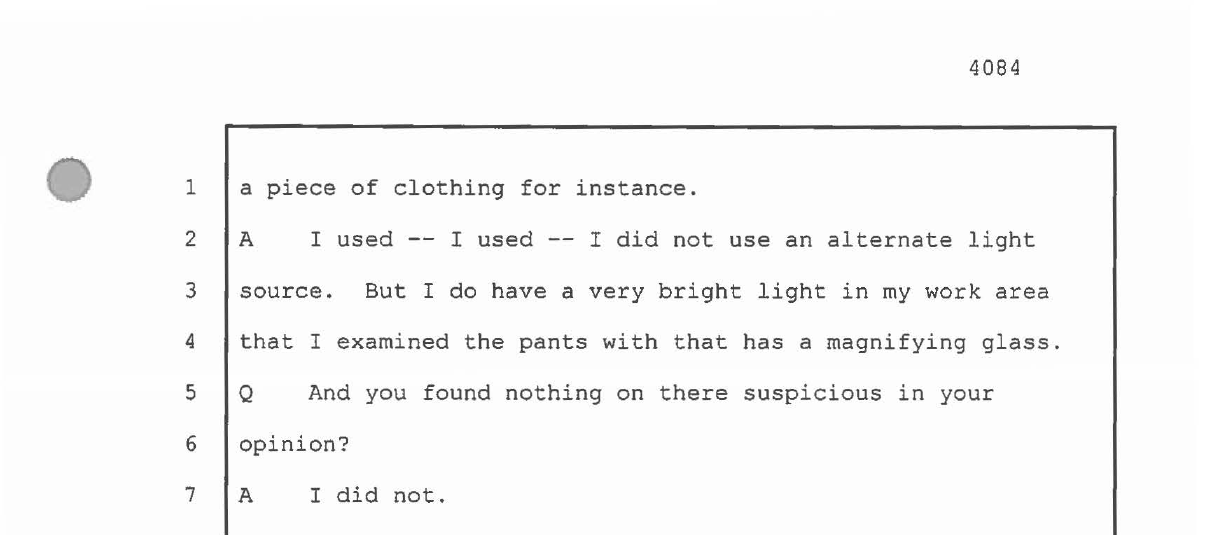
There was nothing to see, either. Taylor testified that she examined the pants under a very bright light
with a magnifying glass, and asked whether she found anything suspicious, she said, I did not.
The photographs of the pants agree. Taken two days after the seizure, and again in September 2015, they show no stain on the outside or the inside of the fly. She didn’t screen them with an alternate light source, the standard tool for finding body-fluid stains on clothing, and no test for any body fluid was ever run on the swabs. Tr. 4084:2–7; Spence Aff. ¶ 9.
A DNA profile shows whose cells are on a piece of cloth. It can’t show whether they came from skin, saliva or vaginal fluid, or when they got there. That evening Daniel went through Gardner’s purse, by her account, and she rode in the back seat of his car in a tank top and shorts. In 2019 he testified that he pat-searches anyone he puts in his car and was sure I touched her skin, I’m sure I touched her hands,
though that was five years later and he couldn’t remember what she had been wearing. Tr. 3757:2–15, 3767:17–21, 3759:9–12; Holtzclaw Dep. 243:14–19, 244:7–20 (Oct. 21, 2019).
The State’s analyst, Elaine Taylor, told the jury that transfer in vaginal fluid was a very good possibility
and that a young woman of Gardner’s age would be very likely to have quite a bit of lubrication.
In closing, Gieger called it a fact that her DNA from the walls of her vagina was transferred in vaginal fluids onto the outside and the inside
of the fly. No test had found any fluid there. Tr. 4073:21–24, 4065:18–19, 4307:8–11.
The same fly carried nothing from Ligons, who said Daniel forced her into oral sodomy through it that night, or from Kala Lyles, who said he raped her through it hours after Gardner. A 2017 panel of six forensic scientists that included Peter Gill found that the DNA had little probative value because it could be explained by non-intimate DNA indirect transfer.
Forensic Examination Report SD-14-273, pp. 7–8; Tr. 3627:13–18; Gill et al. (2017), p. 2.
Her mother’s first account of that evening was a daughter talking about this really hot cop.
Detectives found Gardner the way they found most of the women. After Kala Lyles’s DNA failed to match the profile on the pants, Davis said, they decided to look at every woman Daniel had run, starting with his last shift and working backward. Gardner was on the list, and Davis and Detective Valari Homan left a card in her mother’s mailbox. Tr. 3892:15–24, 3948:1–3; Scott Adams 00226, 00241.
Her mother, Amanda Gates, called back on October 3. Davis told her she was investigating a police officer being inappropriate with women,
the mother said an officer had been inappropriate with her daughter, and Davis connected a recorder. By Davis’s report, the mother said that on the day she made a police report about her daughter running away, she came home that evening to find her standing in the yard. Her daughter told her she had met this really hot cop.
He had told her she had a couple of warrants but not to worry about it, and they had exchanged phone numbers and they were going to go out.
Gardner didn’t have a cell phone. Later that night, the mother said, an officer called asking for her. Scott Adams 00226–27; Tr. 3877:17–19.
A girl who had just been assaulted might well say nothing about it to her mother, and Gardner testified that she didn’t. But her mother didn’t describe silence. She described a daughter talking about a cop she had swapped numbers with and was going to go out with. Tr. 3780:20–3781:4; Scott Adams 00226.
At trial the mother told it differently. Her daughter had been at the front gate just with a blank stare on her face
and said an officer had brought her home. Asked about the hot cop, the mother said she didn’t recall it, and then that we were talking about somebody else. I was confused.
After listening to the October recording she said, It sounded like me,
but she thought she had been thinking of another occasion. On redirect the prosecutor asked whether her daughter had ever told her she’d met a really hot cop. Well, yes,
she said, adding that there are some good-looking cops out there.
Davis testified that the defense had quoted the recording correctly. Tr. 3876:6–8, 3884:10–3886:5, 3887:5–9, 3890:12–19, 3948:7–13.
Gardner denied it when Davis put it to her. Her mother, she said, has this boyfriend that was a cop. I didn’t say anything about that cop.
Gardner Interview Tr. 23 (Oct. 24, 2014).
Gardner first told Davis that Daniel raped her in a phone call from Detroit on October 10, after learning detectives wanted to talk to her. She testified that before agreeing to an interview she searched online and read that seven women had come forward. With seven others, she told the jury, I knew that I at least had some backing behind me.
Scott Adams 00230; Tr. 3784:23–3785:14.
A neighbor who had helped her get into the house before told Davis that sometime that summer she said a police officer had sexually assaulted her, that a cop took advantage of her.
He said he didn’t believe her, couldn’t remember details and didn’t know when it happened. Neither he nor the friend Gardner said she told testified. Scott Adams 00236; Tr. 3781:11–17, 3818:1–3819:23.
She was told the evidence backed her up. By her account, the prosecutor told her it was her vaginal fluid.
At trial Gardner testified that during her first interview, as she described where she had walked, Davis told her, Yeah, that matches up with the GPS.
Davis said that didn’t happen. She hadn’t pulled the GPS records until three days after the interview, and the recording of the interview has no mention of GPS. The transcript of that recording bears Davis out. Tr. 3791:3–8, 3794:10–18, 3895:12–3896:2, 4025:9–11; Gardner Interview Tr. (Oct. 24, 2014).
But Davis allowed that it may have come up later. Asked whether, while encouraging Gardner to stay with the case, she might have mentioned that the CAD calls, the radio traffic and the GPS backed up where Gardner said she had been, Davis said, It’s possible, yes.
Before the preliminary hearing she and Detective Homan drove Gardner two and a half hours from Muskogee to Oklahoma City. There is no report of that drive and no recording. Davis testified that it is possible that I said we have some things to back up what you said.
Asked why she hadn’t documented it, she said, That’s just not done.
Tr. 3982:9–20, 3979:22–3980:14, 4019:7–20, 4020:3–9.
In her 2019 deposition Gardner described what Gieger told her in the witness room before she took the stand. I believe you, out of all the other women I believe you.
When she asked why, she said, he answered, because we were looking for a match of DNA that we found inside his police pants and it was you, we found your vaginal fluid on the inside and outside his police pants.
He encouraged her to testify, she said, because it would help the other women if I testified because I was the only one with physical evidence.
Pressed on whether Gieger had said he believed her more than the others, she backed away from the comparison but not from the reason: out of all the other women he had reason to believe me because of the evidence.
He was giving me confirmation,
she said, that my testimony was going to go through because I had evidence,
which she explained meant It was going to be proven.
On her account, the prosecutor singled her out from the other women by one thing, the evidence, and she was the only one who had any. Gardner Dep. 146:17–147:6, 148:2–24 (May 22, 2019).
No one ever tested the pants for vaginal fluid or any other body fluid. Asked whether she could say from a scientific standpoint how the DNA got there, Taylor told the jury, The only thing I can tell you is it is a biological material that originated from Ms. Gardner.
Tr. 4074:12–15; Gill et al. (2017), p. 8.
He ran her name, drove her home and left.
The records from that evening are the police department’s and the phone company’s. They show a 17-year-old with a city warrant whom Daniel stopped twice, ran twice and let go, a ride home he wrote on his activity card, and a late call to her mother’s house from his own phone. The DNA the State’s laboratory attributed to her was found on the fly of a man who had gone through her purse and driven her home in his back seat that evening.
Everything else comes from Gardner, and it began months before the only day she ever met him. Her first account put the assault in March or April and the day her mother called the police months after it. Her mother’s first account of that evening was a girl talking about a hot cop who had told her not to worry about her warrants. By 2019 Gardner said the date had come from his GPS.
The call is the State’s best point, and it proves less than the State asked of it. He had left a 17-year-old who couldn’t prove who she was at a house where no adult was home. He called the number listed for her mother in the police system and asked for the girl he had dropped off. Her mother cursed him and hung up before he could say more, and he then ran her name, which Davis agreed he could have done to confirm who he had reached. Nothing about the call says what happened on the porch two hours earlier. Tr. 3888:15–19, 3964:10–3965:5.
The jury convicted Daniel on all three of Gardner’s counts, and he is serving fifty years for them. It never heard that she first put the assault in March or April, and it heard the lead detective say her account had never changed. UNCUFF believes Daniel stopped Adaira Gardner, ran her for warrants, drove her home and left, as the records show, and that the rape she described never happened. Tr. 4326:5–13.