
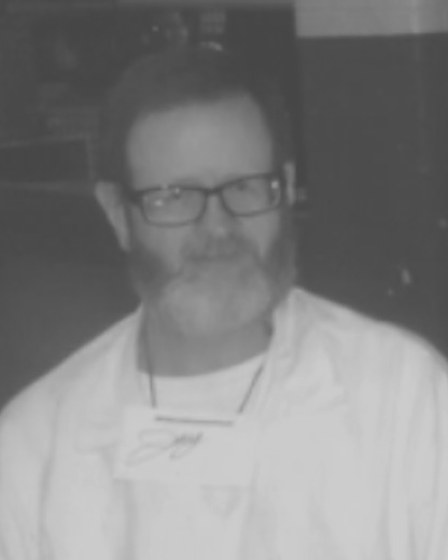
Jay B. Van Story
Jay was in his mid-twenties when a Lubbock County jury sentenced him to life in 1989. He has been imprisoned since then. At the 1989 retrial, the child accuser told the jury Jay had never touched her and identified someone else; she renewed the accusation the next morning. As an adult, she has repeatedly returned to the recantation under oath. UNCUFF supports his effort to obtain a new trial.
“Because I did something wrong. I put an innocent man away.”The accuser, explaining at Jay’s 2009 habeas hearing why her trial testimony still troubled her. Hr’g Tr. 26:25–27:5 (July 17, 2009).
The child recanted at trial and has repeatedly recanted as an adult.
Child Protective Services questioned Jay’s seven-year-old cousin at school in April 1987. A medical examination four days later was inconclusive and could neither confirm nor rule out abuse; the police report listed physical evidence as “NONE.” Jay was convicted in January 1988, but the conviction was reversed because the court had denied his request to represent himself. At the 1989 retrial he represented himself with standby counsel, was convicted of aggravated sexual assault of a child, and again received a life sentence. CPS narrative at 17 (Apr. 7, 1987); Lubbock Police Dep’t Case Report No. 87-011859; Van Story v. State, No. 07-88-0107-CR (Tex. App.—Amarillo Sept. 6, 1988); No. 07-89-0344-CR (Aug. 29, 1990).
The record also contains two facts that weigh against Jay. He had a separate 1985 conviction for promoting sexual performance by a child and was on parole when this case began. After the 1987 indictment, he fled to California and lived under a false name until his arrest. He has admitted the earlier offense. The State used the flight as evidence of guilt. Both facts were properly before the jury. They do not resolve who abused the child in March 1987. Lubbock Avalanche-Journal, July 25, 1987, at 1C; State’s Response to Application for Writ of Habeas Corpus at 1, 3–4, 45–48 (July 2, 2009); Letter to Texas Board of Pardons and Paroles at 2 (June 1, 2010).
At the retrial, the child testified that Jay had not touched her, identified someone else, and said she had accused Jay because she was told that doing so was the only way to return to her mother. The court recessed. The next morning she accused him again. In sworn affidavits in 2001 and 2005 and live testimony in 2009, she returned to the recantation and described pressure during the overnight interval. Retrial Tr. 201, 210–32, 552–55 (Aug. 22–23, 1989); Affidavits (Nov. 9, 2001; Mar. 3, 2005); Hr’g Tr. 25–33 (July 17, 2009).
No physical evidence ever identified Jay.
The State’s case centered on the child’s accusation. No physical evidence identified Jay as the perpetrator. At the retrial, the child withdrew the accusation in front of the jury. The only other witness who claimed to have observed incriminating circumstances later acknowledged that the key observation was made up.
The first CPS interview was not recorded
The accuser says she named her brother at school and that CPS investigator Roger Bowers insisted the offender was Jay. Bowers testified that she volunteered Jay’s name. There is no audio, video, or verbatim note of that school interview. A contemporaneous agency summary survives, but it is not a recording and cannot resolve what questions were asked or how the accusation emerged. Hr’g Tr. 29–33, 135–42 (July 17, 2009); CPS case narrative; Affidavits (2001, 2005).
The child recanted in front of the jury
During the retrial, she said Jay had never touched her and agreed that adults had told her what to say. After the overnight recess, she reversed herself. In 2009 she testified that elected District Attorney Travis Ware spoke with her alone, told her to keep accusing Jay, and warned that she would never see her mother again if she did not. The trial prosecutors denied that Ware took the child aside or told her how to testify. The habeas court credited their testimony and rejected the accuser’s account of Ware’s intervention. Ware did not testify at the hearing. Retrial Tr. 201, 210–32, 552–55; Hr’g Tr. 25–26; Findings of Fact and Conclusions of Law at 9–12 (Aug. 27, 2009).
The only other witness who claimed to see incriminating circumstances withdrew the key detail
The accuser’s oldest brother told police that he had walked in and seen Jay pulling up his pants. At the retrial, according to the State’s own 2009 filing, he admitted that the part about entering the room and seeing Jay pull up his pants was made up. He is also the person the accuser named at the retrial and has named since as the person who abused her. State’s Response at 33–34 (citing 2d Trial R.R. vol. 6 at 637–38); Retrial Tr. 224–27; Affidavits (2001, 2005); Hr’g Tr. (July 17, 2009).
The State explained the recantation with a “Stockholm” theory
After the child recanted, a psychiatrist told jurors that Jay’s self-representation and questioning had created a hostage-like “Stockholm phenomenon.” A 2008 systematic review found no validated diagnostic criteria for Stockholm syndrome, noted that it is not described in international diagnostic classification systems, and found little scientific support for treating it as a psychiatric diagnosis. Retrial Tr. 405–06; Namnyak et al., 117 Acta Psychiatrica Scandinavica 4 (2008).
Two defense experts supported the recantation. The habeas court rejected their conclusions.
In 2009, psychologists Richard Wall and Philip Davis concluded that the recantation appeared valid and that the 1987 interviewing methods were not forensically sound. Wall testified that a short-lived hostage response could not explain a consistent recantation maintained for two decades. Judge Cecil Puryear nevertheless found the accuser not credible and recommended that habeas relief be denied, relying in part on the “hostage situation” or “stockholm-type” explanation. Affidavit of Philip J. Davis, Ph.D. at 2–4 (July 16, 2009); Hr’g Tr. 53–59; Findings at 16, 18–20 (Aug. 27, 2009).
UNCUFF is evaluating a possible claim under Texas’s scientific-evidence statute.
Article 11.073 of the Texas Code of Criminal Procedure, sometimes called the “junk science writ,” permits post-conviction relief where relevant scientific evidence unavailable at trial, or scientific evidence that contradicts what the State relied on at trial, would probably have changed the outcome. UNCUFF is evaluating whether the State’s “Stockholm” explanation and the later expert evidence can meet that standard. Texas post-conviction counsel will have to determine whether the claim qualifies and how any application should be framed. Read Article 11.073 ↗
UNCUFF has paid for investigation, remains in contact with Jay and longtime volunteer counsel David O’Neil, and is seeking the legal and expert resources needed for the next filing. Jay has been in prison since 1989 for an offense the accuser says he did not commit.
Help us pursue a new trial for Jay.
Your support funds investigation, expert review, and Texas post-conviction counsel.